
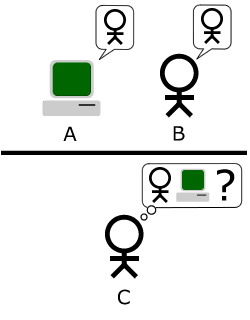
 In 1950, Alan Turing challenged if machines could ever deceive a human judge from being identified non-human by answering questions indistinct to the real human responses. This proposed experiment is now well-known as the Turing Test, an essential concept in the philosophy of artificial intelligence. Now computer scientists generally agree that the Turing Test in a single standalone computer is likely unfeasible. With the rise of World Wide Web, however, people quickly revise the question by asking whether the collectivity of all computers in the world may eventually pass the Turing Test. May a network of computers do the trick? Or, a little bit more dramatically, may one day WWW evolve to be the Skynet?
To pass the Turing Test machines need to prove they may answer questions by free will, a unique character of the living creatures especially humans. In definition, free will is the putative ability of making choices discarding constraints. Constraints generally exist in any situation. The trick of free will is that independent to any other agent's prediction the agent may determine whether or not his decision is bound to any of the constraints. Free will means the ability of breaking rules with no limit and warning. Then a question follows: may we be able to assign this ability to the machines (discarding whether we will if we can)?
Here is my thought to the answer. If we continue building the computers based on the current computer architecture and programming them using the current type of the programming languages, there is no hope of inventing machine free will no matter of the standalone intelligence or the collective intelligence. The reason? The computer architecture and the programming languages themselves have already settled a set of rigid logic constraints. The machines built upon the architecture and programmed by the languages will not work correctly unless obeying these constraints. Please be aware that working incorrectly due to the technology problem is not a free will. Therefore, no true free will can be realized. In theory, we can always develop a set of questions that can cause trouble by the rigid set of logic to distinguish a machine from the real humans.
Now let's retreat half a step. May the machines have will despite it is not free? I believe, however, that the Web evolution is approaching this goal.
 Recently in Wired Magazine, there is an article titled "Algorithms Take Control of Wall Street". In it the authors shared how the robots hired by the Wall Street traders instead of the traders themselves are controlling the stock prices. This scenario is a classic example on how the machines start having will, which is programmed by their human masters. In the article the authors also mentioned how some tragical events had happened due to the machines' will, which, the authors argued, was not really humans' expectation or intention. I think the authors may have underestimated the greedy nature of human beings. Behind the numerous rules there sits a word called "greed". Any single rule must be fair. The overall is, however, the consolidation of the greed. So it was not that the machines suddenly fell into greediness by their free will, the tragedies were nothing but the revealing of the overall greed in Wall Street. "There be no beasts." (quoted from Lois Lowry's Gathering Blue)
With the evolution the Web starts embodying the wills of not only the Wall Street traders but also many of us as the regular Web users. For example, the Google robots silently execute your will every time you press the search button. The Web starts being filled with the embodied wills and the machines claimed the ownership. That machines have will is already a fact.
With will, the machines now can do something fantastic. Also with will, the machines someday may do something horrible than we could imagine. The Wall Street tragedies mentioned by the Wired Magazine article are warnings. There is no any single rule that is particularly evil. It is the overall of all the rules/wills (established by the humans but) executed by the machines that causes the problem. If overall all of us are with good, positive intention, the embodiment of our wills overall will only lead our society and our world to becoming better and better. On the contrary, the tragedies will be inevitable. A little bit "harmless" greed by each of us can be accumulated by the machines that claim the embodied wills to become a great evil overall. Which future and which type of the Web we want it to be? The decision is in the hand of everyone of us. Now!
To the end, let's remember it. Machines may have will, but it is not free will. The future is in the hands of the free-thinking people, who are you and me. Let everyone of us uses the Web with good intention and thus the Web will be good to us. Otherwise, the tragedies will not just happen in the Wall Street.
This is a brilliant (in that it gave me great insight) article! Would you mind if I used your illustrations/words ? If you decide to give me an ok, I will provide this article link as my reference send you my blog's address as well.
ReplyDeleteI am neurotic about identity exposure on the web. Sorry for not saying anything more about myself at this point
Thanks
P