
Thinking Space 2007 in 12 months
This post is the highlight of what was on Thinking Space in 2007 month-by-month. I am grateful to all the readers of Thinking Space and wish you merry Christmas and happy new year!
January 28, 2007, Web 2.0 panel on World Economic Forum
How would Web 2.0 and the emerging social networks affect world business? The annual World Economic Forum at Davos organized a panel with five outstanding Web business leaders addressing this issue at the beginning of 2007. The talks, however, showed that the executives from traditional big companies such as Microsoft and NIKE were less alerted to the new technologies than the executives from new-age companies such as YouTube and Flickr. In short, both Bill and Mark were talking in languages other than Web 2.0. By their viewpoints, the Web-2.0 phenomenon was certainly less important than their own imaginary vision towards the future. What web evolution really impacts world business was severely underestimated.
At the end, the speech by Viviane is worth of re-emphasizing. When the Web evolves to be more and more mature, who are going to govern the virtual world? This question may gradually become a severe issue when web evolution goes further. Will there be conflicts between the virtual world governments and the real world governments? I do not think that in 2008 we will immediately see this type of conflicts. But the traditional means of national boards do have started to diminish while the new means of digital boards are forming; these changes are slowly but inevitably.
February 18, 2007, The Two-Year Birthday of AJAX
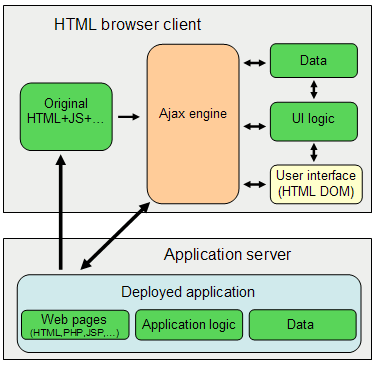
Few technologies have affected the Web so much as AJAX has done. AJAX is more than a technology; it is a philosophy. What AJAX really does is to decompose Web content into smaller portable pieces that are feasible to be uploaded and updated independently. AJAX prompts the dynamic recomposition of pieces of Web content from varied resources. Hence it significantly improves the reuse of information on the Web.
The prevalence of AJAX causes the fragmentation of the Web. The reverse side of this phenomenon is, however, how we may defragment the small pieces of information and reorganize them from end-users' perspectives. This defragmentation issue is the next critical challenge for Web information management. Twine is an example that has started to address this issue. I expect to see more proposals to solve this defragmentation issue in 2008.
March 23, 2007, Will the Semantic Web fail? Or not?
Whether the Semantic Web is going to succeed is always debatable. There are many supporters of Semantic Web, and there are nearly as many as the opponents as well. Will Semantic Web become true? The answer partially depends on whether the Semantic Web researchers can humbly learn from the success of Web 2.0. The normal public might not welcome Semantic Web if its research is still kept inside the ivory tower. Practices such as Microformat are good examples that the Semantic Web research approaches normal web users. But there are still too few of this type of examples. For instance, will the new W3C RDFa proposal be too complicated again? We don't know yet. Hopefully this time W3C would focus more on simple solutions that are feasible to normal users rather than on sound and complete solutions that the academic researchers favor. In comparison, if our real human society is far less than being perfect in reasoning and inference, why must we have theoretically perfect plans to build a virtual world?
April 18, 2007, New web battle is announced
Google is expanding rapidly. Google had replaced Yahoo being the leading Web search engine. Google has already been the largest site that produces Web-2.0 products. Google is competing against Microsoft to be the leading online document editor. Google is fighting against Facebook to be the leading social network through the OpenSocial initiative. More recently, Google starts another battle against Wikipedia to be the leading online knowledge aggregator by the announcement of Google Knol. Can Google succeed simultaneously in all of these fields? Are Google's plans too ambitious to be successful?
The age of Google is about to pass; this is my prediction after watching all these ambitious plans issued by Google. Google has started losing its momentum on originality. By contrast, Google is now repeating a "successful" path of many traditional big companies, i.e., dominating the market by defeating the opponents not by new achievements on technologies but by its superior money resources. This strategy has been proved successfully in many fields. However, it is not a winning strategy on web industry. The reason is that World Wide Web itself is evolving. When the Web evolves, Web technologies evolves. Any company that stops evolving would be thrown away. The history once happened to Yahoo may happen to Google again in the future. The age of Google will be passed with the over of Web 2.0.
May 8, 2007, Web Search, is Google the ultimate monster?
Google is beatable, but Google is not going to be defeated by another Google-style solution. When I predict that the age of Google is about to pass, I mean new revolution on Web technologies. Google is thinking of itself as the God of World Wide Web; and indeed many Web users accept this interpretation (because we have no other better choices at present). But history has already told us that this type of fake gods like Google could not stay forever. In history, we humans abandoned most of the fake gods as soon as the public education system was prevailed. In similar, this history will repeat itself in the virtual world of the Web. The fake God of the virtual world (Google) will step down when the education on Web machine agents prevails. Hakia would not threaten Google if it continues following the Google strategy by addressing itself to be a more powerful fake God on the Web.
In addition to this short summary, I have a preliminary funding request. I will graduate next year and currently I am looking for an assistant professor position. If I'd get an offer, I would start a new research project on next-generation Web search that is beyond the current Google-style search strategy. In fact, I have already done the project proposal. For any reader, if you are responsible on looking for and funding new research projects that are full of potential in the future, I am far more than happy to discuss my project with you. I can be contacted through yihong.ding@gmail.com. The philosophy underneath my new web search strategy can be read at here.
June 29, 2007, Epistemological extension to ontologies: a key of realizing Semantic Web?
The application of epistemology into Semantic Web is less explored than it should have been. We need ontologies to enhance the collaboration and agreements. We also need epistemologies to emphasize the individuality and privacy. I expect more research on this topic in 2008.
July 31, 2007, What does tagging contribute to the web evolution? | An introduction of web thread
There are many ways to describe web evolution. One unique expression is the transformation from the node-driven web to the tread-driven web. Web thread is a new term proposed by myself. In short, a web thread is a connection that links multiple web nodes to a fixed inbound. I observed that the Web was not only syntactically connected by human-specified links, but also semantically connected by latent threads each of which expresses a fixed meaning. A straightforward evidence of the existence of web threads is Web-2.0 tags. On Web 2.0, resources are automatically mutual-connected when they are specified the same tag by individual human users. When weaving these tags together, we obtain an interconnected network of all web pages.
The existence of web threads is an interesting phenomenon that lacks of insightful research at present. From one side, web threads are part of the implicit web because they are generally latent at this moment. On the other side, by proactively revealing web threads and explicitly weaving them, we might produce more comprehensive social graphs for individual web users. This new concept thus may contribute significantly to the vision of Giant Global Graph. I will publish more research on this concept in 2008. By the way, a broader discussion of web links and web threads can be found at here.
August 24, 2007, Mapping between Web Evolution and Human Growth, A View of Web Evolution, series No. 4
World Wide Web is evolving. But why does the Web evolve and how does it evolve? Few answers have been given. The view of web evolution is the first systematic study in the world that directly addresses the answer to these questions based on a theoretic exploration.
This view of web evolution stands upon the analogical comparison between web evolution and human growth. I argue that the two progresses are not only similar to each other by their common evolutionary patterns, but also literally simulate each other from all the major aspects. At present, the simulation mainly happens in the uni-direction from the real world to the virtual world. In the future, however, we are going to see more evidences of simulation on the reversed direction, i.e. from the virtual world to the real world.
The virtual world represented by the Web is nothing but a reflection of our human society. Due to the limit of web technologies, however, we are not able to completely simulate our society from every aspect into this virtual world. In particular, we are not able to well simulate all the activities of individual humans on the Web. By contrast, we can simulate individuals at a certain level within any specific evolutionary stage. This continuous upgrade of simulation of individuals on the Web represents the main stream of web evolution.
This theory of web evolution has published for half a year and I have received many requests on discussing this vision. I hope this study would bring more attention to the fascinating web evolution research.
September 16, 2007, A Simple Picture of Web Evolution
The simple picture of web evolution expresses a straightforward timeline of web evolution. The Web is evolving from a read-or-write web to a read/write web, and eventually it may become a read/write/request web. The implementation of the "Request" operation would be a fundamental next-step towards the next generation Web.
October 7, 2007, What is Web 2.0? | The Path towards Next Generation, Series No.1
What is the next generation Web? This is a grand question to all Web researchers at this moment. We might see critical breakthrough on answering this question in 2008.
At present, the advance of Web 2.0 has already slowed down. The progress of web evolution has reached another stable quantitative expansion period after the exciting qualitative transition from 1.0 to 2.0. The seed of next transition is growing underground now.
In order to figure out the path towards the next generation Web, we need to know the present and where the present was coming from. In the first post of this series "towards the next generation", I summarized the various definitions of Web 2.0. In the following installments at this series, I will continue discussing my vision of the path towards Web 3.0. I feel sorry about the slow progress of this series. I will try to post this series more frequently in the coming year.
November 23, 2007, Multi-layer Abstractions: World Wide Web or Giant Global Graph or Others
Giant Global Graph is a new concept. Although Tim Berners-Lee proposed this concept intuitively for freely deploying personal social networks onto the Web, my view of the intent of this concept is beyond this intuition. In general, I believe that the proposal of this concept is the first sign of a great transition---the organization of web information is transforming from the publisher-oriented point of view to the viewer-oriented point of view.
The impact of this transformation could be greater than we may imagine. Most importantly, this transformation will show that the Web may automatically re-organize its information system without a human-controlled organization such as W3C or Google. World Wide Web is a self-organizing system. This observation is essential to the understanding of web evolution.
December 3, 2007, Collectivism on the Web
The implementation of collectivism has been the landmark of Web 2.0. But do we know how many types of collectivism we may implement onto the Web? This last selected article at December 2007 summarized a few typical implementations of collectivism on the Web. Some of them (such as collective intelligence) have been well known, while others (such as collective responsibility and collective identity) are less known by the public. I expect to watch more creative implementations of collectivism in 2008.




 English to Chinese BETA
 English to French
 English to German
 English to Italian
 English to Japanese BETA
 English to Korean BETA
 English to Russian BETA
  English to Spanish