Showing posts with label Semantic Web. Show all posts

Thursday, August 04, 2011

Computing, a new public utility of the 21st century, Part 1

Computing is qualified to be a public utility of the 21st century; and it is good if it comes true.

This is the part 1 of a three-installment mini-series.

Part 1: a broad view of public utilities

A public utility represents an infrastructure that serves a general demand of the public. The typical general demands include such as the demand of water supply, the demand of power supply, the demand of waste disposal, the demand of transportation, the demand of remote communication, and the demand of safety. Respectively we have the public utilities such as water, electricity (and natural gas), sewage, road (and rail), post (and phone), and police services.

Because of public utility ordinary people as well as the businesses may reach their general demands in low cost. Take the demand of power supply as the example. Before electricity became a public utility, power supply for not only the ordinary persons but also the businesses was expensive. In consequence, both the intensively energy-consuming personal gadgets and the intensively energy-consuming businesses were economically infeasible in society. After the invention of electricity distribution network, electricity became a new public utility of the 20th century. With the significantly lowered cost of power supply, many cutting-edge energy-consuming personal gadgets and factories rose from the horizon. It was the last great industry revolution.

But it is not to say that any general demand is suitable to be a public utility. Let's take a look at two examples.

The general demand of food supply is rarely implemented as a public utility. Comparing to the demands such as water supply or power supply, the food supply is too diverse in its demand. Different people often have varied requests on the food they demand. As the result, unless it is in some toughest time of history (such as during the war time when the general demand of food supply is generally reduced to be bread only) few governments take the demand of food supply to be a public utility.

Another typical example is the general demand of marriage. Although certainly everybody expects a spouse, never have this demand been a public utility. The reason is similar. Everybody has his (or her) unique preference. Such a demand is infeasible for a public utility solution.

With these insights we may start to study the other general demands and see whether they are feasible to be a public utility. Let's begin with a controversial topic---the general demand of healthcare. Shall our society be dominated by the government-run hospitals or the government-operated health insurance? The answer shall be no. The demand of healthcare is similar to the demand of food supply. The demand is general to everybody. But at the same time it is also too diverse in the demand with respect to the individuals. Government must initiate a few special programs for taking care of the health of the low-income people. It is the same as government has already provided special food supply programs for the low-incomes. But it is not a good idea to make the general demand of healthcare be a public utility, which would be equivalent for us to have made the general demand of food supply be a public utility.

Finally we are able to touch the theme---the demand of information computation. Based on what we have studied, we shall answer two questions in order to determine whether computing would be qualified for a new public utility. (1) Is the demand of information computation general to the public? And (2) are the requests from people in this demand too diverse to be handled by a public utility?

Since the invention of personal computer and World Wide Web, our society has already entered the information age. The digitized information is flooding over the daily life of many of us. Nowadays few people claim too little information to look at. By contrast, we often complain there are too much information but too limited ability to digest. The demand of information computation has been general to most of the ordinary people of our society.

Simultaneously digital data representation is gradually becoming uniform. After decades of studies the data storage at the physical layer has already been unified. We can now indistinguishably access the data stored in varied devices that are produced by different manufactures. Even at the presentation layer, due to the efforts of the Semantic Web and the linked data initiatives the data representation is approaching a common standard across the Web. All these achievements lays the foundation for implementing the general demand of information computation to become the new public utility of computing.

Summary

This first installment explains briefly why computing is qualified and good in theory to be a new public utility in the 21st century. The next installment will continue the topic by illustrating the Web evolutionary trend how computing is actually approaching to be a public utility.

Friday, June 03, 2011

Schema.org and some of my take

A recent initiation by the three leading search engines (Google, Bing, and Yahoo) made people excited, especially to the Semantic Web community. The initiation, Schema.org, is a loose standard that declares supporting a common vocabulary for structhttp://www.blogger.com/img/blank.gifured data markup on web pages. I simply type some of my take on this announcement.

First, it reveals the difficulty faced by the traditional search engines to further improve the quality of Web search. With the advance of the Web technology, webmasters inject richer content and more variety in data layout structure. It significantly increases the difficulty of the high-quality web crawling and thus the efficiency of Web search. The apply of the various SEO tricks increases not only the load of the webmasters but also the load of Web sense disambiguation. This new announcement simply shows that such a problem has been so severe that these major Web search players have to sit together and figure out a common platform to solve it for the sake of everybody.

Second, it is unusual for us seeing the three rivals sitting together so peacefully, especially between Google and Microsoft in the field of Web search, in the recent few years. If I use the eye as a historian to look at this unusual case, I would make a brutal claim that it is the sign that the peak of the glory of the traditional Web search engines (certainly including Google) has been passed. From now on, they can only walk downhill. Typically, the reach of a critical standard in a field represents the complete mature of the field. After the complete mature, the only thing left is decaying gradually.

Third, this method is not the ultimate solution. Certainly, however, the adoption of Schema.org may ease the problem at some level. But it will not hold for long time. The real problem beneath is the debate whether machines can truly replace humans in answering genuine questions. Most of the regular questions, such as what will be the weather in Philadelphia next Wednesday, are certainly answerable through the optimization of the automated Web search methods. The others, such as what should I do when visiting Philadelphia, are essentially not answerable by machines because the understanding of "I" is so profound that even humans may not really know each other. To this type of questions, social search is not the solution either. We need some totally new invention to address them. The traditional search engines can only help us to the certain point and such a point has already been very close to us. The initiation of Schema.org may lay that landmark 1000 miles further. But that is all about it.

The last but not the least, it is not such an exciting news to the Semantic Web community. By Schema.org, the big three formally claims the support to microdata instead of RDF/RDFa. To the non-technicians, they may not feel much about the difference. To the Semantic Web technicians, however, it is a major loss because from now on more swing players are going to leave the more complicated RDF behind their back and embrace the simpler (of course less powerful, however) microdata. It is a major loss for competing into the field of real economy. Maybe eventually RDF may still win the battle. But it will take more years. And, everybody knows, timing to a Web technology is very critical!

Friday, March 04, 2011

The Art of Immersion, the magic of storytelling

Life is storytelling. Or let's say it alternatively---writing a story is constructing a life. On the Web we tell stories, our own stories. Some of them are professional, some of them are personal. What in the stories are the lives embodied. These stories altogether constitute the Web. By the constitution the Web becomes us and we are immersed into it since it is indeed our lives. The ways of utilizing the storytelling is therefore the art of immersion.

I just finished reading a new 20ll book authored by Frank Rose, a writer and contributing editor at Wired. The title of the book is The Art of Immersion. The book is well written with solid and rich content. I am afraid, however, that the content is so rich and the theme is so profound that the author has not fully disclosed the potential of the topic in spite of the over 300-page length of the book. Nevertheless, I highly recommend the book to whoever is interested in learning how the Web has fundamentally revised our society. In particular, how may we start thinking of the art side of the Web? Make ourselves be immersed and become part of the Web in contrast to being the gods of the Web.

Story

What is a story? In the Prologue Rose wrote, "Stories are recognizable patterns, and in those patterns we find meaning. We use stories to make sense of our world and to share that understanding with others. They are the signal within the noise."

This description of stories is insightful. To a Web researcher such as myself, the term "recognizable pattern" has a few unique interpretations. For example, a recognizable pattern often means a well-defined semantics that machines can identify. Following this interpretation, a story is a meaningful arrangement of data that machines may logically render. Therefore, may we say that the ultimate goal of the Semantic Web is indeed to have data presented in stories? Data without story is a string of digits; but data within a story becomes a reusable product. Isn't the Semantic Web to assign every piece of data a context of story so that we (and machines) can speak of it with emotion? By the way, have I mentioned emotion? What the hell is that?

Storytelling

Through the art of immersion, we can use WWW to drill down as deeply as we like about anything we care. Many Semantic Web people are enthusiastic about the creative consumption of the linked data. I am wondering, however, whether such a linked-data initiative is an art of storytelling indeed. Linked data by themselves are boring. But to speak of them into various stories is fascinating. To me, this is probably the ultimate meaning of the Semantic Web.

But there is another point. Through the storytelling what do we really look for? There is a difference between to explore the characters and to explore the stories. The characters are us, or more precisely the embodied ourselves. The stories are the embodied thoughts and behaviors of us. The difference is as the following. If the storytelling is about to explore the deeper inside of each of us, the data must be annotated in the sense of subjectiveness. On the contrary, the data shall be annotated in the sense of objectiveness when the storytelling is about to explore the objective extent of each of us. This delicate difference is an often neglected point in the exercises of the Semantic Web.

If life is true and art is construct, is a virtual world such as the Web a truth or an illusion? This is a tough question. To me, a virtual world such as the Web is about experience. In particular, it is about the embodied human experience. When we are immersed in the Web, we do not simply put ourselves into a fiction, but into an embodied fiction. A fiction is not real. But it is surreal to have embodied fictions, such as the Disneyland. The Web is a surreal existence that is the embodiment of the countless storytelling.

The wonder of being immersed (and embodied)

In the book Rose frequently referred to an example that is the success of the produce of Mad Men, an AMC's Emmy and Golden Globe-winning series. There is a question. Who shall control a story such as the story of Mad Men---the story writer or the fans?

Accompanied the rise of Web 2.0, there is the crisis of the authorship of the story writers. The prevalence of the social networks makes the communication between the authors and the audience become in dual ways. The storytelling is no longer a single direction activity from the author to the audience. By contrast, more and more audience have participated into the storytelling that is imitated by any author, especially the popular and well-known authors. (Am I doing an editing of the story told by Frank Rose right now?) Especially to the fictions, the audience are revising the characters the author created. The ownership of the characters is no longer solely belong to the author, but to the public collectively. The author creates the characters and the situation they find themselves in. The audience, however, complete the drawing of the characters within the scenario. This is one consequence Web 2.0 has brought to us. Its impact into our society is deeper than we ever have imagined.

But even just this effect has other deeper meaning. If we are embodied in the Web and the embodiment of ourselves is not totally controlled by each of the individuals, the Web actually reveals a deeper resemble of our society, which is beyond we could have thought of before.

How much value and how much reality to be a fictional character online after we are immersed? This is another grand question. The answer to this question could be the motivation to Web 3.0, the next generation of the Web.

Back to the real life

"Life is a constantly functioning information exchange." Rose wrote in the book.

The statement is profound. It tells that a virtual life must also be a constantly functioning information exchange. That is, the Web composed by the virtual lives shall primarily be the aggregation of services in contrast to the ontological layout of concepts. It matches what I foretold the Semantic Web must not be realized until it would be more than a web of data.

In the book, Rose described a four-piece composition of storytelling in the real life. A successful storytelling shall consist of the narrative (one who tells story), the conceptual (one who creates the theme), the stylist (one who decorates the story), and the systemic (one thinker who constructs and directs the distribution of the story). According to the author, the last component is brand new to us due to the emergence of Web 2.0. Moreover, the nature of online distribution is the "serendipitous discovery on a global scale". Unless we start to learn more about this new pattern of storytelling, it will be difficult to lead to the next true leap forward in the Web evolution.

What a deep-thought book it is!

Thursday, January 27, 2011

Another Reason for Studying Semantic Web

Semantic Web research may lead to the invention of creation in the Web.

Certainly we have already had many reasons for studying Semantic Web. Here I add, however, only one extra but exciting---the invention of creation in the Web.

At the end of yesterday's post, very briefly I mentioned the "measurement=creation" principle formerly being studied for understanding Heisenberg uncertainty principle. In Heisenberg's view, "a measurement does not only serve to give meaning to a quantity, it creates a particular value for this quantity." Does this inspiration mean something for the Semantic Web research?

The key is measurement. Till now most Semantic Web entrepreneurs look forward to the business model of data package and selling. Nevertheless is it a great idea, there is a key value missed. The missed value is laid when the consumers measure data.

In Semantic Web every measurement leads to a re-interpretation of the data. By what we discussed in the last post, the result of the re-interpretation is theoretically unpredictable. Therefore, if we include the process of measurement into the business cycle, the value of the data may always increase through time. Moreover, if we may invent automated "data observers" that sit in the Web restlessly measure the Semantic Web data, the Web invents new knowledge every second.

We need a new way of thinking to explore the wealth of the Web in the microscale.

Wednesday, January 26, 2011

The Horatio Principle and Logic on the Web

“There are more things in heaven and earth, Horatio, than are dreamt of in your philosophy”, said Hamlet. By it Ken Binmore concluded:

The Horatio Principle:
Some events in a large world are necessarily nonmeasurable.

The Web is a large world. Hence we may suspect the applicability of Horatio Principle onto the Web. If this suspicion could be valid, there are a few interesting consequences. For example, it is unsafe for us to adopt an arbitrary definition on the Web without information loss. The Web expands everyday!

One essential assumption of the Semantic Web is that we can safely share terms each other defines online as long as we have coded them properly according to a well-designed logic description format. By Horatio Principle, however, such an assumption is questionable if the Web expands indefinitely, which we generally agree. Horatio Principle does not claim the Semantic Web approach being unrealistic. By contrast, it says that we might still have overlooked its complexity though we have already been very serious about the problem.

The Web versus the Semantic Web is similar to the world versus the world in microscale. In theory the world (observed in marcoscale) is the same world as it is in microscale because to the end there is only one world where we live. But indeed the two views of the world have many subtle but crucial different facets. At the macroscale, nearly all things in the world can be well determined and measured by the mechanical laws. At the microscale, however, many things become uncertain. A famous example is Heisenberg uncertainty principle. We can contrast the Web and the Semantic Web similarly. At the macroscale nearly all objects on the Web can be soundly defined based on the computable logic. At the microscale, by contrast, those logic rules perfectly sound in the macroscale start to be questionable when the target objects become more and more fine-grained. An effect similar to Heisenberg uncertainty principle emerges. Some events/definitions become nonmeasurable; the Horatio Principle takes action. Is this a small shadow over the great Semantic Web project?

The more I think of the Web 2.0 hype and the Semantic Web initiation, the more I feel that the Semantic Web research starts a journey to explore the micro-structure of the Web while Web 2.0 is a continuation of the ordinary macroscale journey of the Web. From now on, we must take this distinction into our mind and use different types of thinking to observe the two approaches. With hesitation, I used to avoid directly speaking Semantic Web being a direct successor of Web 2.0. Now the feeling becomes even stronger since they are studying different aspects of the Web. It is the same as avoiding claiming the quantum mechanics being a direct successor of the class mechanics. The relation between the two are not a relation of succeeding, but a relation between two sibling views onto the same target.

Without any kind of proofs at the moment, however, I want to make a bold claim as the following and make an intuitive explanation afterward.

The claim: In a web of fine-grained, linked data, one cannot simultaneously accomplish the following two requests: (1) precisely measure the definition of a data, and (2) precisely compare the data to another definition.

Before explaining the claim, let's take a brief review of a classic explanation of Heisenberg uncertainty principle. According to Heisenberg, in order to measure the position/momentum of a particle one must shoot a photon at the target. In our classic world, this is certainly not a problem at all since the mass of the target is generally million times, if not billion times, greater than the mass of a photon. The introduction of a new photon into the system thus affects no measurement result in the system. Therefore, we can precisely measure the position and the momentum of the target simultaneously. But such an argument becomes invalid in the microscale when the mass of the target is close to the mass of a photon. The introduction of a photon significantly affects the original state of the system. As the result, it becomes impossible for any observer to identify the original position and the original momentum of the target simultaneously.

I analogize the former situation onto the Web. Anytime we measure the definition of an object we actually assign a few fine-grained new properties to the target such as measured-by and several central attributes about the observer. This property-assignment impact actually does nearly nothing to the target in the macroscale Web because every object is defined coarse-grained. By coarsely defined, the newly introduced object properties caused by measurement generally do not affect us retrieve the definition of the target and compare it to another definition simultaneously. When we study an object in a web of linked, fine-grained data, however, the situation changes. One cannot omit the impact of a new measurement to the interpretation of an object. In fact, every new measurement enriches the intent of an object non-neglectably. Therefore, the simultaneously measurement to the precise definition of the data and its precise comparison to another given definition is impossible.

It is not a proof. But I incline to the so-called "measurement=creation" principle, which has been studied for explaining Heisenberg uncertainty principle, in the Semantic Web thinking. When we go to measure a definition in the microscale, we actually are creating in contrast to querying or retrieving a meaning. This is how the microscale world is different from the macroscale world. And this is going to be how the microscale Web would be different from the macroscale Web.

Tuesday, January 11, 2011

Data, Mind, A Web of ?

The advance of technology should always make us smarter.

Data and a web of data

When it is related to computing, data is information in a form suitable for use with a computer.

Data owns many merits. Data is honest, objective, and long-lasting. Data is convenient to be connected, shared, copied, manipulated, consumed, transported, bought, and sold. And in general data is inexpensive to be created and stored.

But data is also with some weaknesses. Data does not think. Data cannot interpret itself. Data could be confusing. Data is easy to be abused. And after all data does not produce. Data is consumable goods like grains or coal in contrast to tools such as lathe or electric generator. Data is for the Wall Street traders and retail salesmen to trade in contrast to for the manufacturers to produce.

What is going to be if the Web truly becomes a web of data, or more precisely a web of linked data? It will be a paradise for salesmen and Wall Street traders. The Web becomes a super supermarket. Wonderful! Bravo! Done. A new age of mankind arrives ...

But wait! Is there anything wrong? Imagine a society where the salesmen and traders dominate everything but the producers and manufacturers are second-class, may the society be sustainable? Oh, maybe it is the United States now.

Mind and a web of mind

Mind is the aspect of intellect and consciousness experienced as combinations of thought, perception, memory, emotion, will, and imagination, including all unconscious cognitive processes. This definition is too long. In a short version, a mind is how a human interprets the world, and his result interpretation. In the sense of computing, mind is the methods/procedures for manufacturing data, and the manufactured output.

Mind also has a few merits. Mind is creative, genuine, active, and exciting. Mind flows by itself. Mind produces. A mind never stops interact with the other minds. Mind grows. Mind is alive.

Despite of all the merits, mind has terrible weaknesses too. Mind is subjective. Mind could be selfish or with unspeakable bad intention. Mind could be deceived. It is more difficult to share or connect minds because they could own their own identity that claim to be uncompromisable.

A web of mind is like a world of factories. Everybody debates, competes, and even fights each other. Such a world is like a mess such as a troubled third-world country you can imagine.

Contrast

But there is a very interesting discovery if we compare the two very different Webs more carefully. In the world of the data web, humans are outsiders, observers, or at most the communicators to the world. Or let's speak the fact in another way, humans are not part of the world though they do business with the world. On the contrary, in the world of the mind web, humans are part of the world because it is THEIR mind and it is THEM who fight each other on such web in contrast to through such web. We are becoming part of the Web.

Such a distinction is crucial since the goal of our Web development must not be teaching computers to think and make them smarter and smarter. By contrast, the right and indeed ever-lasting goal for any of the human creation must be to make us, human beings, be smarter and smarter over time. We should be using computers to help humans think and create value instead of the opposite. When we are part of the Web, we become smarter when the Web gets smarter. When we are outside of the Web, we tend to be more stupid when the Web gets smarter. Only if we can correct our intention of Web development to the right track, the eventual enthusiasm of the general public will be invoked into this, possibly great ever, achievement of all mankind.

We need data and we need mind. The future of World Wide Web demands the both, simultaneously and being balanced.

In the last year, I witnessed the final death (corrected by the founder, it was in hibernation instead of being given up) of an early-born baby that donated itself to the mind Web. It is sad but the hopes remains. Myself have learned many lessons for this attempt, and I am certain the founders must have learned more. However, I am fully confident that it is still the correct path forward. The next footstep after Netscape, Yahoo, Google, Apple, and Facebook will be on this path. Human and human mind being the driving force in (instead of "to") the Web is the next great invention about the Web.

Friday, February 12, 2010

My brief comment on iPad, Siri, GBuzz, and Aardvark Acquisition

Due to my schedule, I do not have time to make intensive posts that explore the news in depth as I used to do. To celebrate the Chinese New Year and Valentine's Day (this year they happen to be in the same day, Feb. 14) together with the Thinking Space readers, however, I would like to share my brief comment on some of them with my friends. Happy holidays!

iPad

iPad represents a remarkable breakthrough in concept. Its current product design is, however, immature. It is a terrible misleading to think of iPad an enlarged iPhone. To see the real intrinsic distinction, let's take a minute thinking of the following comparison.

The innovation of notebook computer brings the Web to people anywhere in the world; the innovation of iPhone brings people anywhere in the world to the Web; the innovation of iPad, on the other hand, makes an instant bridge between a person anywhere in the world and a specialized subset of the Web---his Web of interest. This is the real gap Steve Jobs claimed to fill in the product launching show.

Certainly, the current iPad design has not reached the goal yet. This is why I call it immature.

Siri

Siri on iPhone is a milestone though there is still a long long way ahead to reach a meaningful success.

Believe it or not, Siri and iPad actually belong to the same philosophy---developing a personal assistant. iPad plans to construct a hardware platform of personal assistants. Siri attempts to build a software platform of personal assistants. Compared to iPad, the road ahead for Siri is even tougher.

On the positive side, Siri provides a fascinating environment to experiment many key concepts of the Semantic Web and linked data in the real world. Idehen Kingsley must be interested in exploring his journey with this service. We as normal users, however, still need more time to watch the future progress of this service.

Google Buzz

Twitter but in Google? Maybe. But GBuzz means more.

Google Buzz reveals the GMail users the social communities they implicitly belong. These social communities existed disregarding GBuzz. GBuzz, however, makes them explicit. This is a critical step Google made towards exploring the treasure of the social web. Google has been hesitated on how to step into the social web for long time. Finally it seems the company finds their unique asymmetric strength to enter this market by cashing the popularity of its dominating GMail service. This is remarkable because in comparison Microsoft still does not get how they might exploit their asymmetric strength in this field.

Google's Aardvark Acquisition

The innovation of Aardvark is ended. This acquisition is probably a good news to the Aardvark investors and the Mechanical Zoo employees. It is, on the other hand, not so good a news to the evolution of the Web.

In short, Google's ultimate interest contradicts to the eventual potential of Aardvark. Google's ultimate interest is to make itself a super-smart brain while everybody using it may follow it stupidly. The social search services such as Aardvark aims to locate smart people and make people rather than machines be smarter through the social communication. This contradiction in the level of philosophy actually is the intrinsic reason that made the Aardvark designers leave Google several years ago. Although at present the power of money brings them back, it does not solve the fundamental conflict.

I had a phone conversation with Max Ventilla two years ago and we shared quite a few thoughts about what the social search was and how to approach it. I am glad of and sincerely congratulate his achievement in business by sealing this acquisition deal. I am afraid, however, that he will start another journey sooner or later when his original passion catches him again.

Monday, May 11, 2009

We intelligent because we connected, and unless we connected

We have thought of developing artificial intelligence for long time. Many Sci-Fi novels and movies have predicted the intelligent robots that may bring us both convenience in life and trouble in society. Nearly all of them, however, are trapped by a tiny little misconception of intelligence. Nobody could be really intelligent until he is connected in intelligence. Therefore, the so-called intelligent robots are impossible to be made until we have already pre-constructed an intelligent society (such as an intelligent web) for them to communicate. Standalone will NEVER lead to true intelligence, even the artificial ones.

Truly this is a point that is easy to be overlooked. Many of us are not aware of the fact that we are intelligent because we are born in an interconnected web of intelligence. This situation is by default to nearly every one of us. If we take a look at the very few who are born outside the normal human society and are not able to connect to the pool of human intelligence (such as the kids adopted by animals), they are instead very well adapted to the respective animal intelligence. And for those who are forced to be isolated to any web of intelligence, they show no intelligence at all in any aspect. People may explain the reason to be the lack of "education". Such an explanation is not totally sound because there are many uneducated ones in our normal human society who are very intelligence. Hence the main point is indeed whether the one is able to connect to a pre-existing web of intelligence. Once connected, the true intelligence follows.

We may derive a few very interesting conclusions by applying the insight back to the study of artificial intelligence and Semantic Web. For example, the construction of the Semantic Web may be the prerequisite of developing the true intelligent robots (i.e., the real artificial intelligence). Deep Blue was smart. But any simpler robot (i.e. with simpler algorithms coded) built upon Semantic Web will be 100 times smarter than the Deep Blue. Moreover, this insight could be a momentum for linking the Semantic Web research to the real world practices because it opens a door of the wild wild west that is full of potential of commercial opportunities. The insight allows us to view the picture of Semantic Web in a fresh new way.

In progress, I will post more articles in this track of new intelligence. By the way, the point is also a derivation of the model of Web evolution I suggested.

Sunday, March 22, 2009

Consciousness has no single "seat" in brain

NewScientist has an interesting summary of some newest progress on consciousness research. One statement, however, catches my attention and thinking. It is said that "Consciousness is more a question of dynamics, than of a local activity."

What does it mean when we embody consciousness onto the Web? This was the question I was thinking when reading the line. When originally we mention collective consciousness on the Web, we think of a group of embodied and "seated" mind and make them collaborate each other. Now I am curious to think whether collaborative consciousness is indeed the consciousness itself. That is, there is actually no consciousness when there is no collaborative. If we apply this thought to the research of linked data, however, it means that actually every individual piece of data itself should not be the center of issue. By contrast, a mechanism of collaboration among the whatever data is much more valuable and essential. I am wondering whether this is indeed the problem behind the present, slowly progressing achievement of linked data.

Saturday, February 14, 2009

From Semantics to Things, where the killer is

If the Semantic Web is a network of knowledge, the Internet of Things is a network of artifacts. May this movement reveal us how the long-time-expected Semantic-Web killer application might/should/would be looked like? Every Semantic-Web entrepreneur must take a second look at this recent Read/WriteWeb article and think it over.

Tuesday, February 03, 2009

Variation of meanings

Stephen Downes has a nice summary of the variation of meanings. It is valuable to have precise understandign of all these variations, especially for the Semantic Web researchers (or even developers).

Knowing exactly which type of semantics is modeling is a crucial demand to the Semantic Web ontology constructors. Many times the confusion is due to that we do not really understand these subtle distinctions among the meaning variations. For example, when modeling the domain of book,
    we need to specify the literal semantics if the goal is for linguistic parsing;
    we need to specify the semantic meaning if the goal is for library collection;
    we need to specify the pragmatic meaning if the goal is for book sale;
    we need to specify the intentional meaning is the goal is for capturing book review;
    we need to specify the social meaning is the goal is for book club;
    and so on...

The ontologists truly need to read this revelatory article, think of it hard, and read it again.

Sunday, February 01, 2009

Do not exaggerate the importance of machines

There is a trend, which began several centuries ago since the First Industrial Revolution and it is still a fashion until today. We often tend to exaggerate the importance of machines, and think of this exaggeration to be scientific prediction, though history has repeatedly disapproved the imaginations.

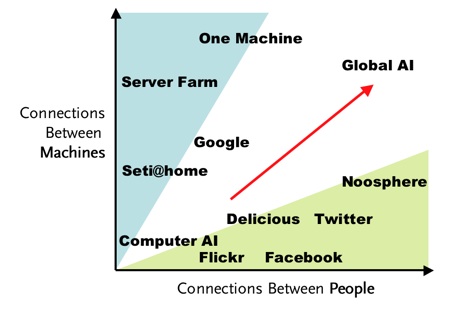
Kevin Kelly, one of my most respected living thinkers, has a recent post titled Two Strands of Connectionism. In the post, Kevin claimed the co-existence of human connections and machine connections on the Web. Kevin thus suggested the future Web to be a balanced network in the middle of the two strands of connectionism. Nevertheless the vision is illuminating, Kevin exaggerated the importance of machines and, inevitably, overlooked the true value of human mind.

Kevin is right on observing the two strands of connectionism. What I do not agree to Kevin is, however, to equalize the importance of the two strands. The danger of this equalization is that it easily misleads people to believe that the Web intelligence is a fair mixture between the collective human intelligence and the collective machine intelligence. In fact, there is only human intelligence on the Web. The so-called machine intelligence is nothing but a steady, lack of self-creative, and embodied portion of the human intelligence. Any exaggeration of the machine intelligence would only lead us to some unrealizable plots that waste our resources and time.

We should be clear that the strand of machine connection is a way of distributing the strand of human connection instead of being another independent set of connections. By this vision, we may grasp the true spirit of World Wide Web evolution, which is essentially an evolutionary reorganization of human intelligence in contrast to constructing certain independent machine intelligence that is beyond humans. The greatness of the Semantic Web is not about building up machine intelligence. By contrast, it is to be able to connect various pieces of human intelligence in the mind of different individual human beings that we can never realize in any other environment except of the Semantic Web. Whether or not understand this distinction could be fundamental and crucial to the success of any Semantic Web business institute.

Sunday, January 25, 2009

Learnable and Unteachable

In this world, many things are what we may learn and a few others are not. To what are not learnable, we know them by our genes. For instance, the concepts "I" and "you". Newborns generally know them very well just after born. When the babies hold a thing towards themselves, they mean "I"; while they start crying when seeing/missing you, they call "you" (which is different from "he" or "she"). The babies do not learn the concepts; the knowledge is born with them. On the other hand, to the babies who do not know the distinction between "you" and "I" when they are born (that are born with mental disability), it is impossible to teach them the concepts afterward. The concepts (not the words representing the concepts) such as "you" and "I" are unteachable. It seems that they are part of the hardware (i.e. our body) instead of the software (i.e., the knowledge we learn after born).

This distinction brings interesting thoughts on machine learning and the construction of the Semantic Web. An essential question is: which semantics must be pre-coded inside machines (i.e. realized through design) and which semantics can be specified/modified gradually by machines (i.e. realized through evolution)? If the eventual Semantic Web is a place that we may issue orders to machines, we may have to seriously think of this basic issue.

In the following I try to have a formal specification of the learnable semantics and the unteachable semantics. Any comment of the issue is highly welcomed.

Semantics that can only be expressed in the default setting of a machine-processing system but it may never be taken as an input to the system is unteachable to the system. Any other semantics that is not unteachable is learnable to the system. There exists certain semantics that is "unteachable" to all the machine-processing systems.

By the way, Happy Chinese New Year!

Thursday, November 27, 2008

GoodRelations allow Semantic Web to improve E-Commerce

Martin Hepp, a professor at Universität der Bundeswehr and also affiliated at the STI Innsbruck (original DERI Innsbruck), recently released a 15-min Webcast that introduces a recent work of the GoodRelations project and explains his vision on bridging e-commerce and the Semantic Web.

I have known Martin since 2006 when I was an intern under his supervision at Innsbruck, Austria working on the multi-million-euro MUSING project. Since then we have kept close relationship with each other and co-authored several papers. Martin is a sharp and kind scientist. With his dual background on business and computer science, Martin is passionate on improving the efficiency of e-commerce by the Semantic Web technologies. I feel glad to watch his accomplishment of the GoodRelations project.

In brief, GoodRelations "is a lightweight ontology for annotating offerings on the Web." A little bit more detailed, the GoodRelations ontology is a lightweight vocabulary that can be used for describing the details of offers made on the Web in a machine-readable way. In particular, it may allow users to specify the relationships between "(1) Web resources, (2) offers made by means of those Web resources, (3) legal entities, (4) prices, (5) terms and conditions, and (6) the aforementioned ontologies for products and services." The targeted users of this ontology include Web shops, product manufactures, and software developers. After briefly examining the content of the ontology, I must say that it is an impressive product and I look forward to more real-world use of this product in the future.

Back to the talk itself. Martin has emphasized the audience of the talk to be the general public. After having listened to it, I agree that anybody with some basic knowledge of World Wide Web can easily understand the talk without the need of any particular technology background.

One of the key points Martin mentioned in the talk is his view of the primary limitation of the current Web. He believes that "the loss of the data structure [of the data stored in its original source] over the Web" is the main problem. Because of this loss, it is fairly difficult for people to reverse engineer the displayed Web data into its initial structure. The Semantic Web addresses a solution to the problem by allowing Web data carrying its initial data structure when traveling over the Web. This is a very clear and convincing explanation of why we need the Semantic Web.

Why do the data producers need to care of this "overhead" of producing extra description of the data structure? This is a common argument against the Semantic Web. To the end, it seems that it is a user's problem in contrast to a producer's problem. Hence why should the producers spend their extra cost to produce the portable structure of the data when the effort seems not directly benefit themselves? Martin also provided a fairly good answer to this question in the talk.

Martin agrees that just by adding the semantic description to data it might not necessarily improve the ranking of the pages in search engines. However, the effort does provide extra support to the data producers because by doing so the pages may become more accessible to a wider range of queries, especially a wider range of "related" queries. It thus means connecting more related customers to the producers. This is why the data producers should spend their extra time and money to perform this technology.

At present, GoodRelations has been officially supported by the Yahoo! Search Monkey. I am impressed by learning this news from Martin too.

Anyway, the talk is worth of listening and the ontology is promising of use. Just check it out by yourself and try it if you are a commercial data producer. Please let me know how you feel of it.

Tuesday, October 21, 2008

Twine went public

Finally, Twine went out of beta.

To introduce this service, in Thinking Space I had written two pieces (first impression and second impression) of post that were synchronized with Twine's steps of going public. I am interested in this service because it is a representative Semantic Web application until now. After talking and debating Semantic Web for so many years, Twine is among the very few successful (or at least workable) real-world Semantic Web applications. Just by this mean, it deserves our special attention.

For readers who are still not familiar to Twine, Paul Miller had a fairly comprehensive discussion of the service at ZDNet that is worth of reading. Also, you may directly go for Twine.com to try the service by yourself. In this post, however, I continue my style of service analysis following the first impression and second impression.

The up side of the public version

1) from producing knowledge networks to producing interest networks

I vote this update of mind to be positive. Knowledge network is a great concept. Producing knowledge networks is probably the ultimate goal of Semantic Web. However, this intent is too broad to manage. How to project this broad concept of knowledge network onto a narrower and easier-to-manage alternative is a challenge. I am glad that Nova seems figuring out one---interest network.

Personal interest is a subset of personal knowledge. Moreover, personal interest is probably the most heavily cared portion of personal knowledge. By reducing knowledge network to interest network, it decreases the amount of potential information processing and narrows the size of the application domain. Hence it could significant improve the performance of the service if the service designers truly understand the meaning of this change.

2) emphasized personalization and privacy

Nova has emphasized that "What Twine will be doing will be to make excellent PERSONALIZED AND TOTALLY PERSONAL AND PRIVATE recommendations to users." Moreover, Nova mentioned that Twine would monetize its service through the coupling of recommendation and privacy protection. I agree to Nova. This is the right direction.

3) enthusiasm of the users

Nova reported that at present Twine users spend 12 minutes per session on average. This is a very encouraging number. It means that the service is sticky in some sense, or at least among the ones who really use the service it is sticky.

4) good quality of content

I use Twine regularly. Based on my experience, the quality of bookmarking service Twine currently performs is fairly good. When I search information inside a twine, the quality of searched results is satisfactory in general.

The down side of the public version

1) move towards 2.0 rather than to 3.0

I was said that Twine was likely a Web 2.5 application in its beta. Then I expected that Twine would gradually move towards 3.0 when it went public. However, my prediction is wrong. By inspecting this public version Twine, it is more similar to the other Web 2.0 applications than becoming a revolutionary new service. In the other words, Twine is moving towards 2.0 rather than to 3.0.

At the beginning we might instantly tell the difference between Twine and another standard Web 2.0 service. But now it has been very hard to tell why Twine is not another Web 2.0 application. By just adding a few semantic computation is not enough for Twine to claim Web 3.0.

Twine needs to hire some visionary service manager in contrast to (or in addition to) the experienced service manager it has now. By experienced Twine could only go for what is popular now. Only by visionary Twine might lead the trend into the future. Twine is losing innovation.

2) too low traffic flow in monthly visits

Based on the information provided by the CrunchBase, the number of Twine.com's monthly unique visitors at the past September is only about 50K. Be note that Thinking Space has monthly unique visitors in the same September more than 5K. In this month, the unique visitors at Thinking Space is close to 10K. But Thinking Space has no invested money at all, with respect to Twine.com has $13 million only in its series B round of fund raising. Isn't it a serious problem of Twine?


Referenced resources:

Sunday, August 10, 2008

A quick thought of Semantic Web

As I continue reading Seth Lloyd's fabulous book Programming The Universe, a thought strongly takes me over and I cannot get rid of it. Is the W3C interpretation of Semantic Web a realizable plan according to the second law of thermodynamics?

In general, the central point of the W3C interpretation of Semantic Web is to upgrade the present Web of linked documents to the future Web of linked data. From the view of useful information (i.e., entropy with respect to the second law of thermodynamics), entropy of the system (i.e. the entire Web) must be inevitably decreased.

Certainly, however, World Wide Web is an open system in contrast to a closed system. Thus the mentioned systematic decrease of entropy does not directly violate the second law of thermodynamics. However, in order to truly decrease the entropy of an open system and maintain a low level of entropy systematically, the system must continuously be added useful work from outside of the system. To World Wide Web, human mind is the only available resource for the external useful work, and we must add an assumption that humans are not part of World Wide Web (will this assumption be hold all the way to the future?).

Even with all the previous assumptions, the W3C interpretation of Semantic Web still has a few intrinsic difficulties. In his book, Seth pointed out that the cost to decrease the entropy of a system is significantly high, let it alone that the W3C interpretation of Semantic Web asks not only to maintain the low entropy environment for long time (and potentially forever) but also to continuously push the systematic total value of entropy being lower and lower. It thus must demand unbelievable large amount of human mind to be the external useful work so that the goal can be fulfilled. In the other words, this requirement fundamentally contradicts to the optimistic declaration popularly among Semantic Web researchers that we may figure out a few low-cost, fabulous Semantic-Web killer applications and suddenly the dream of Semantic Web comes true.

The second law of thermodynamics tells that such a type of low-cost, fabulous Semantic-Web killer application simply may not exist. Or otherwise, they are typical perpetual motion machines of the second kind. Based on the second law of thermodynamics, it is theoretically impossible to build these perpetual motion machines. (If someone believes it to be possible, he will eventually discover the need of the amount of external input being quickly beyond the original expectation, just like Powerset has experienced.)

Does this observation sentence the death of Semantic Web? I still don't think so. To make Web content be more machine-executable is not impossible. However, we may need to have new thoughts of how semantics might be cost-efficiently added to the Web. In the other words, whatever tools we build should not violate the second law of thermodynamics, or otherwise the business would not be sustained (such as Powerset).

More and more, I tend to the vision of human-directed Semantic Web in contrast to the traditional vision of machine-enhanced Semantic Web. By this new vision of Semantic Web, we abandon the assumption that humans are excluded from the Web. By contrast, we allow humans and the Web together be a comparatively closed system in contrast to the Web alone be a open system. In this comparatively closed system (it is not a truly closed system since it still excludes the supporting equipments such as power plants), we may experience controlled systematic increase of entropy in exchange of a few local, conditional decrease of entropy. It would be a much less perfect Semantic Web than the W3C interpretation. But it would be much more executable, realizable, and it will bring concrete benefits for human users. I look forward Imindi to be the first real-world example of this vision.

Referenced resources:

Tuesday, July 08, 2008

Invariants on the Web

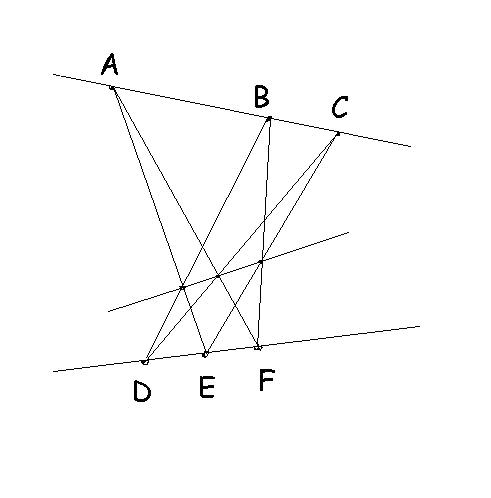
Invariant is something that does not change under a set of transformations. The picture on the right shows Pappus’s Invariant in geometry. The invariant tells that by following certain rules the three intersection points shown in the figure are always collinear no matter how people may draw the two lines and locate ABC and DEF in the lines respectively.

Invariant study is fundamental to any scientific research, especially when the research domain is as complex as World Wide Web. Invariants are supposed to be constant within the specified research scope. By well understanding the invariants we may effectively improve the knowledge over many complicated issues. Therefore, it is unsurprisingly for us to see the discussion of invariant study in the new Web Science Research Initiative.

In "A Framework for Web Science", the flag article of Web Science, Tim Berners-Lee and his colleagues have carefully studied several invariants on the Web. In particular, one invariant is outstanding among all the others. The one is URI (Uniform Resource Identifier). In the paper Berners-Lee et. al. had focused on discussing which invariant represents the binding of semantics with declared objects. There was no final best solution concluded in the paper, however, the one closest to the best was URI.

In varied programming languages we have widely used an invariant, which is declared name. In programming languages such as Java or C++, "each unique object (i.e. with distinct semantics) is declared with a distinct name in one program. By referencing a name, a program accesses the semantics behind the name." Hence declared name is taken to be invariant.

On the Web we are currently using another invariant. "Web researchers decide to use location binding to solve the problem, i.e. URIs and URLs. By default, identical URIs reference the same semantics. Identical URIs on web is the same as identical declared names in programs. However, the name of this URI is varied, i.e. name is no longer an invariant. In constrast, URI becomes a new invariant."

The authors, however, pointed out that indeed neither of the two was proper invariant on Semantic Web (or on the future Web). "The difference is, however, that the requirement of machine understanding," said by the authors. We actually have no ways to promise the consistency of the meaning to which a URI points. It is the same as we cannot enforce users to consistently bind the same name to any unique object on the Web.

Although with the problem, the authors did not provide a satisfactory answer to the problem in their paper. By contrast, they simply emphasized that "W3C suggests that do not transfer URI to another object. That is, whenever you create an object, giving it a unique URI. This requirement is thus the same as that whenever we create a new object in program, make sure we give it a unique name." In other words, please do not change the referred destination of any URI though anybody has the right to perform such a change. This passive resolution is not a satisfactory answer. Deprecated URI has gradually become a severe problem when more and more Web applications start to assume URI to be invariant on the Web. May we have an alternate, active answer to the question?


The figure above shows three basic components when we bind semantics with certain object. They are the declared name, the object itself, and a link connecting the two sides. So which one of them is truly invariant when they are presented on the Web?

As the paper has discussed, neither the declared name nor the link (i.e., uri) is true invariant. "Apple" may be fruit or a software company. We have no way to restrict a handpointing to a fixed destination.

The only exceptional one is the object itself. Although by nature an object can only be itself and it is automatically an invariant to itself, how can we present this invariant besides name and link? This is thus the problem.

We humans have so customized of binding semantics with declared names that we have almost forgotten some more intrinsic binding beneath the surface.

When we are binding the declared name "apple" with the object apple, we are actually making a semantic computation in our brain such as to determine whether it is a fruit with red or yellow or green skin and sweet to tart crisp whitish flesh. For people, a name is not just a name, but also a computational procedure in human brains. It is actually not the name that identifies an object, it is the procedure that identifies the object. The declared name is only a named shortcut referred to the particular procedure in brain. When we convert the procedure to machines, it is an epistemological process.


The picture above shows the new paradigm of semantic binding on the Web. The left side is changed to a particular epistemological procedure (which could be implemented in various ways such as the one we have suggested). Unlike names, these procedures are unique since they can unambiguously answer either yes or no for any identification request. Based on these epistemological procedures, Web links (such as URIs) are upgraded to be Web threads. The Web threads connect the same Web into a varied layer. Moreover, from the philosophical and economical aspects the construction of epistemological procedures and Web threads would be the basis for the production of mind asset.

In summary, epistemological procedure and Web thread are invariants on the Web. Through Imindi, we are going to demonstrate the world something extraordinary happening on the Web.

UPDATE: related reading about URI, "What do people have against URLs or URIs?" by Kingsley Idehen.

Wednesday, July 02, 2008

The Secret behind Powerset Acquisition

So it has been. Finally, Microsoft and PowerSet reached an agreement of acquisition. It is a deal about $100 Million in total. A question is, however, why does Microsoft acquire Powerset?

I have been at Redmond face-to-face talking with a few Microsoft Live Search top engineers two months before. None of them, however, seemed sympathetic to the coming of Semantic Web. At the same time, however, Microsoft people did emphasize that they expected to walk in a different way from Google because Google is too powerful in its research capability to compete. Does this newest acquisition mean Microsoft suddenly changed its mind and decided to compete Google by adopting Semantic Web? I don't think so. In order to discover the secret behind this acquisition, we may need to look at and think of the following coincidental events related to the acquisition.

1) PowerSet went live to the public only at May 12.

Paul Miller thought "$100million seems like a poor return for those Powerset investors" since the investors have "injected their $12.5million way back in 2006." I agree to Paul's argument based on the assumption that Powerset is a novel semantic search engine full of potential. A question is, however, whether the Powerset approach is indeed full of potential despite of its novelty.

The ones who know the best of the answer to the previous question should be the Powerset investors mentioned by Paul. Especially after Powerset has already been public, its long-term potential must have already been thoughtfully studied by the investors. We can be confident that all of these investors are bright and knowledgeable; and moreover, they are not philanthropists. If all of these analysis are sound, there is only one conclusion we can draw---the potential of Powerset is limited.

Until now, the application domain of Powerset is limited to Wikipedia. As other technology analysts also pointed out, the Wikipedia pages are consistent in their format and there are people dedicating to polishing the English writing of many pages. Powerset's self-limitation of its service only to such a special external site indicates the existence of severe technology difficulty in its approach and it is hard to conquer. I, myself, is a Semantic Web researcher (and particularly on semantic annotation). Thus I very much understand the problem encountered.

With all the concerns, unless Microsoft really thinks of taking Semantic Web as its long-term strategy (which, however, might not be a bad idea), this acquisition is questionable to Microsoft's short-term goal. Hence it becomes confusing---is Microsoft really thinking of going long or going short? Or, maybe, Microsoft plans to take both since it just has too much money.

The investors of Powerset are not foolish, and nor should we assume Mr. Ballmer of Microsoft be so. Then what did Mr. Ballmer think when he made the decision of acquisition?

2) This deal came after the break of Microsoft-Yahoo deal.

By looking for acquiring Yahoo, Microsoft was planning to hit Google in the front. After the attempt failed, Microsoft finally decided to attack Google from the back by acquiring Powerset. This is the real story behind the scene.

Microsoft is looking for the market of online advertisement, everybody knows it. The dominator of the market at present is Google. In order to compete Google, the fastest and also the most effective way for Microsoft is to buy the company in the second place of that market, which is Yahoo. But Yahoo defended insistently to Microsoft's acquisition. Should Mr. Ballmer then abandon the plan? No, or otherwise he must not be the Ballmer. Here thus comes the acquisition of Powerset.

3) Yahoo's SearchMonkey opened up for developers at May 15.

I have said that SearchMonkey is Yahoo's strategy to come back. Although I also predicted negative to the full success of this ambitious project (partial success is however believable), Microsoft has no patience to wait for the natural death of it.

The best way to accelerate the death of SearchMonkey is to defeat the plan directly. By acquiring Powerset, Microsoft may launch a competitive Semantic Web service for SearchMonkey. SearchMonkey itself is already too ambitious. By short of volunteered developers all over the world, the date of its failure thus could be counted. At that moment, Microsoft may go back to the table and buy Yahoo in a much cheaper value. The difference would certainly be greater than $100 million.

4) Google declines to bid for acquiring PowerSet.

In the whole story, Google's situation is quite subtle. From one hand, Google certainly does not expect Microsoft to acquire Yahoo. Hence Google would not be willing to see Microsoft acquiring Powerset.

On the other hand, however, Google does not believe in Semantic Web either. Competing price of Powerset with Microsoft is meaningless for Google. The reason is simple. Neither Microsoft nor Google is really interested in Semantic Web. Microsoft buys a Semantic Web company only to attack Google from the back. If Google attends the competition, Microsoft may just raise the bid and let Google win it. Then Microsoft can simply go for another Semantic Web company. Powerset is surely not the only one who does Semantic Web technology! Google has no chance to win this battle unless it buys all of the Semantic Web companies, which is totally nonsense for its lack of interest in Semantic Web.

I have to say that Microsoft's strategy is very brilliant. The strategy directly hits Google and Google has no effective way to fight back. Now the only pity sacrifice is Yahoo again. But probably it may beg Google to save it once more.

In summary, by acquiring Powerset Microsoft has done an excellent move towards the next acquisition of Yahoo and eventually be closer to beat Google. How would Google and Yahoo take this challenge? The story is to be continued ...

Sunday, May 18, 2008

Building Semantics is different from Building the Web

In my newest post at Semantic Focus, I described the difference between building semantics and building the Web. A real Semantic-Web company needs to demonstrate its ability on both aspects instead of only one of them. By simply adopting RDF, a company cannot automatically become a Semantic-Web company.

Monday, May 12, 2008

How to achieve the Semantic Web

The realization of Semantic Web becomes a chick-and-egg dilemma. Without Semantic Web applications, we can hardly build Semantic Web data. But without Semantic Web data, who are going to implement the useless Semantic Web applications? If Semantic Web really represents the future of the Web, we must have overlooked something crucial.

In a recent post at Internet Evolution, I emphasized again that the missing link is the role of humans in the Web. Semantic Web has been thought by many researchers to be equivalent to a web of data. This is thus the problem. Semantic Web is a web of data. But a sole web of data is not sufficient to be Semantic Web. They are not equivalent. The problem is that in the expression of "a web of data" humans disappear. It is this miss that causes the dilemma of Semantic Web.

This connection between WWW and humans seems has been puzzled by many people, including even top researchers. Last Friday, I had tried to ask this relation to a principal researcher at Microsoft and he did not give me a satisfactory answer either. I bet, however, that this connection is quite straightforward to many Web-2.0 people. Again, we are sorry to see the big gap between the industrial Web 2.0 and academic Semantic Web.

More details of my arguments can be watched in the original article. As usual, many thanks to James Johnson who helped edit my post.