Showing posts with label ontology. Show all posts

Tuesday, February 03, 2009

Variation of meanings

Stephen Downes has a nice summary of the variation of meanings. It is valuable to have precise understandign of all these variations, especially for the Semantic Web researchers (or even developers).

Knowing exactly which type of semantics is modeling is a crucial demand to the Semantic Web ontology constructors. Many times the confusion is due to that we do not really understand these subtle distinctions among the meaning variations. For example, when modeling the domain of book,
    we need to specify the literal semantics if the goal is for linguistic parsing;
    we need to specify the semantic meaning if the goal is for library collection;
    we need to specify the pragmatic meaning if the goal is for book sale;
    we need to specify the intentional meaning is the goal is for capturing book review;
    we need to specify the social meaning is the goal is for book club;
    and so on...

The ontologists truly need to read this revelatory article, think of it hard, and read it again.

Sunday, January 25, 2009

Learnable and Unteachable

In this world, many things are what we may learn and a few others are not. To what are not learnable, we know them by our genes. For instance, the concepts "I" and "you". Newborns generally know them very well just after born. When the babies hold a thing towards themselves, they mean "I"; while they start crying when seeing/missing you, they call "you" (which is different from "he" or "she"). The babies do not learn the concepts; the knowledge is born with them. On the other hand, to the babies who do not know the distinction between "you" and "I" when they are born (that are born with mental disability), it is impossible to teach them the concepts afterward. The concepts (not the words representing the concepts) such as "you" and "I" are unteachable. It seems that they are part of the hardware (i.e. our body) instead of the software (i.e., the knowledge we learn after born).

This distinction brings interesting thoughts on machine learning and the construction of the Semantic Web. An essential question is: which semantics must be pre-coded inside machines (i.e. realized through design) and which semantics can be specified/modified gradually by machines (i.e. realized through evolution)? If the eventual Semantic Web is a place that we may issue orders to machines, we may have to seriously think of this basic issue.

In the following I try to have a formal specification of the learnable semantics and the unteachable semantics. Any comment of the issue is highly welcomed.

Semantics that can only be expressed in the default setting of a machine-processing system but it may never be taken as an input to the system is unteachable to the system. Any other semantics that is not unteachable is learnable to the system. There exists certain semantics that is "unteachable" to all the machine-processing systems.

By the way, Happy Chinese New Year!

Monday, December 08, 2008

How to construct a high quality ontology?

More and more people start to understand and use the term "ontology" when discussing machine intelligence. Informally, an ontology is a set of specified human intelligence that machines can run automatically. How to build ontologies with high quality, however, remains being a hard problem.

In general, an ontology construction procedure has four steps:

• Identify purpose
• Encode content
• Evaluate construction
• Document product

Among the four steps, identify purpose is the first, the most crucial, and the hardest stage. We often have dozens (if not hundreds) varied ways of describing a domain. Many times, however, there is only one best resolution with respect to a designated purpose. Unless we have precisely identified the purpose at the beginning, we often result in low-quality ontologies that can cause much trouble in a long term.

In principle, there are five ways to identify the purpose for an ontology construction assignment.

(1) Decide goal. We obtain a precise description of the target domain, from which we capture the key entities and relationship sets. This is a typical middle-out ontology construction methodology.

(2) Describe scenario. We obtain a set of competency questions about the application scenario. From the scenario descriptions we define the entities and relationship sets. By applying these entities and relationship sets we should be able to precisely express the questions as well as the potential answers to the questions. This is also a middle-out ontology construction methodology.

(3) Narrow down domain description. Start with a general and broad description of the target domain, we gradually winnow the unrelated portions out of the scope until the remainder becomes satisfactory. This is a typical top-domain methodology.

(4) Determine typical activity. This methodology is particularly useful for creating the service-oriented ontologies. In this case, ontologies are created not for domain description but for application presentation. Thus, we need detailed service activity descriptions to build the right ontologies. This methodology is middle-out.

(5) Grow seeds. To produce an ontology for a broad domain, sometime it is easier to start with building a few small ontologies as the seeds. Then we can gradually grow these seed ontologies by adding them more concepts and relationships and connecting them when appropriate until we reach the final goal. This is a typical bottom-up sequence of ontology construction. To properly execute the method, it demands well understanding of many subtle ontology technologies such as modular ontology and ontology reuse.

In real practices, ontology developers need to carefully choose the proper methodology of purpose identification according to their particular assignment. A bad choice often leads to longer time of development and poorer quality of the results. This first step is indeed tough but truly crucial for creating high quality ontologies.

Thursday, November 27, 2008

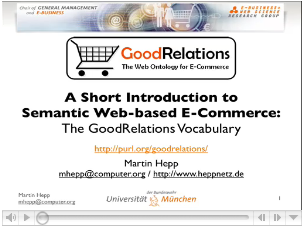
GoodRelations allow Semantic Web to improve E-Commerce

Martin Hepp, a professor at Universität der Bundeswehr and also affiliated at the STI Innsbruck (original DERI Innsbruck), recently released a 15-min Webcast that introduces a recent work of the GoodRelations project and explains his vision on bridging e-commerce and the Semantic Web.

I have known Martin since 2006 when I was an intern under his supervision at Innsbruck, Austria working on the multi-million-euro MUSING project. Since then we have kept close relationship with each other and co-authored several papers. Martin is a sharp and kind scientist. With his dual background on business and computer science, Martin is passionate on improving the efficiency of e-commerce by the Semantic Web technologies. I feel glad to watch his accomplishment of the GoodRelations project.

In brief, GoodRelations "is a lightweight ontology for annotating offerings on the Web." A little bit more detailed, the GoodRelations ontology is a lightweight vocabulary that can be used for describing the details of offers made on the Web in a machine-readable way. In particular, it may allow users to specify the relationships between "(1) Web resources, (2) offers made by means of those Web resources, (3) legal entities, (4) prices, (5) terms and conditions, and (6) the aforementioned ontologies for products and services." The targeted users of this ontology include Web shops, product manufactures, and software developers. After briefly examining the content of the ontology, I must say that it is an impressive product and I look forward to more real-world use of this product in the future.

Back to the talk itself. Martin has emphasized the audience of the talk to be the general public. After having listened to it, I agree that anybody with some basic knowledge of World Wide Web can easily understand the talk without the need of any particular technology background.

One of the key points Martin mentioned in the talk is his view of the primary limitation of the current Web. He believes that "the loss of the data structure [of the data stored in its original source] over the Web" is the main problem. Because of this loss, it is fairly difficult for people to reverse engineer the displayed Web data into its initial structure. The Semantic Web addresses a solution to the problem by allowing Web data carrying its initial data structure when traveling over the Web. This is a very clear and convincing explanation of why we need the Semantic Web.

Why do the data producers need to care of this "overhead" of producing extra description of the data structure? This is a common argument against the Semantic Web. To the end, it seems that it is a user's problem in contrast to a producer's problem. Hence why should the producers spend their extra cost to produce the portable structure of the data when the effort seems not directly benefit themselves? Martin also provided a fairly good answer to this question in the talk.

Martin agrees that just by adding the semantic description to data it might not necessarily improve the ranking of the pages in search engines. However, the effort does provide extra support to the data producers because by doing so the pages may become more accessible to a wider range of queries, especially a wider range of "related" queries. It thus means connecting more related customers to the producers. This is why the data producers should spend their extra time and money to perform this technology.

At present, GoodRelations has been officially supported by the Yahoo! Search Monkey. I am impressed by learning this news from Martin too.

Anyway, the talk is worth of listening and the ontology is promising of use. Just check it out by yourself and try it if you are a commercial data producer. Please let me know how you feel of it.

Thursday, November 15, 2007

The Curse of Knowledge and Semantic Web

In my newest Semantic Focus article, I casually introduced ontology mapping and its solutions by discussing an interesting issue---The Curse of Knowledge. The following is a quote from the article:

"Since the Curse of Knowledge is a major reason for ontology mapping on the Semantic Web, we may try to solve this problem by breaking the Curse of Knowledge. By breaking this curse, we may solve the problem of ontology mapping in reality more easily than trying to exploit the complex algorithms of computer science."

Check out the complete article at Semantic Focus if you would be interested in.

Friday, June 29, 2007

Epistemological extension to ontologies: a key of realizing Semantic Web?

(updated Dec. 21, 2007)

epistemology When discussing Semantic Web, we often think of ontologies. Ontology contains formal specifications of conceptualizations. By linking world facts to ontological declarations, machines can "understand" the meanings of these facts. Moreover, machines can reason on ontology declarations to derive latent conclusions based on explicit ontological expressions. These logical computations form the foundation of the Semantic Web.

But there is a problem. The process of linking world facts to ontology declarations is often ambiguous and subjective. This process, also normally addressed as the process of semantic annotation, is related to another branch of philosophy---epistemology. It short, epistemology studies how we know what we know. A narrower definition of epistemology could be expressed as the study of how we recognize what we know. Human recognition is often subjective.

Besides the distinction of subjectiveness and objectiveness, epistemology is more about the knowledge of recognition. This knowledge of recognition is generally bound to the superficial side of meanings, such as the form and the display, in contrast to that ontology is more about the intrinsic side of concepts themselves. The knowledge in ontologies should not be affected by its external representations, such as the form and the display. The understanding of this distinction is critical to the understanding of semantic annotation.

We should equip machines with not only ontologies but also epistemologies to realize the Semantic Web. Without epistemologies, machines with standard ontologies by themselves can neither recognize new facts, nor verify the correctness of their assigned facts. Hence they must rely on external procedures (such as data extraction routines) to accomplish these missing functions. This type of external procedures are hard to be modified and updated. As a result, we may ask why we must adopt the epistemological declarations produced by others for our own ontology declarations. To solve this problem, we need declarative (but not hard-coded programming subroutines) epistemological extensions to ontologies.

Epistemological extensions of ontologies allow individuals to specify different things of recognition with respect to the same ontology. This requirement is common in our real society. For example, different people may have varied external interpretations of an agreed, shared definition of the concept "beauty." By separating epistemological declarations and ontological declarations, we can have a better and more flexible handling of semantics. This is a key of realizing Semantic Web.

For readers who are interested in exploring more on this topic. Here is a recently accepted paper by the First International workshop on Ontologies and Information Systems for the Semantic Web (ONISW 2007) collocated with ER 2007.