Showing posts with label mind asset. Show all posts

Monday, June 27, 2011

About the Rise of the Knowledge Market

Due to the personal schedule I seldom blogged technologically in the recent months. Today, however, an article from Forbes caught my attention and pushed me to blog again. The title of the article is The Rise of the Knowledge Market. The topic represents a very important phenomenon in our modern society. In fact, I believe it is indeed the soul of the ongoing information revolution, which is the greatest event in human society since the industry revolution. The information revolution is fundamentally reconstructing our life in nearly all the levels and all of the aspects.

More than two years ago, for Internet Evolution I wrote an article titled User Generated Content, Revisited. In the article I pointed out a fundamental problem inside the model of Web 2.0---to the content creators UGC (User Generated Content) is about fame generation in contrast to the exchangeable value creation. The success of implementing the social network explained why Web 2.0 rises. The failure of bringing up a system of the individual valuation would be, however, the cause to the sunset of Web 2.0. The next day in Thinking Space, I thus coined the term UGA (User Generated Asset) and emphasized that the Web evolution urged us upgrading UGC production to be UGA production. With such a transition, the Web will evolve from a social playground to be a social marketplace in which people sell and purchase knowledge (more precisely, it shall be some type of the embodied knowledge) from each other. When we come to the Web, we no longer just browse or socialize through the Web. We use the Web building up our mind asset and trading it on the Web.

Apple's App Store is a great example of UGA production. When the developers create a third-party App and sell it through the App Store, Apple actually provides these developers a way of embodying their knowledge and selling the embodiment through the platform it designs. The success of Apple and its App Store has demonstrated us the power of the UGA business.

But the model of App Store is not even close to the ultimate vision of the UGA production. Right now one must first of all be a professional software developer so that he can take the advantage of this UGA business. Otherwise, the UGA business is simply an illusion no matter how creative a thinker he is or how compelling his mind truly may be. The model must be improved and simplified! By doing so successfully, a tremendous power of production will be released from people and a new golden time of the global business comes. Without a question the world will then be out of the recession.

Another related recent news is J.K. Rowling's decision that she will sell her electronic books directly to the readers but bypassing all the publishers. Although J.K. Rowling is likely too famous to be a typical example for the discussion of the UGA business, this decision is a sign showing the broken of the traditional knowledge trading business models, gradually but indefinitely. In tradition one have to be VERY much knowledgeable in order to earn the eligibility of entering the knowledge market. With the evolution of the Web, however, such a barrier is loosening and eventually it is going to be torn down.

As Jennifer said in her Forbes article, one may start to trade his limited knowledge as long as their is a buyer. The reason? The advancement of the Web has significantly lowered the cost of embodying human's knowledge and making it exchangeable.

This is the trend for the new-generation Web business! And this is where the Web is evolving toward at present.

Friday, June 12, 2009

Five Web Trends Into 3.0 (5)

5) Mind asset, formulating

The evolution into Web 3.0 is in the mean of not only computation, but also economy. That we appreciate Web 2.0 is not only because of the new technologies and the new services. More importantly, it is because What Web 2.0 produces has greatly stimulated the growth of the global economy. If there is an era of Web 3.0, it must show us its comparable impact on the global economy as Web 2.0 did. Hence there must be a trend describing the economic potential of Web 3.0. Such a trend, as I interpret, is the beginning of formulating the formally exchangeable asset of the embodied human mind, or the mind asset.

Web 3.0 is to Web 2.0 will be a marketplace to a social playground.

"Free" and "open" are the keywords of Web 2.0. Free user generated content and open platform/open API compose the foundation of the Web 2.0 business models.

In contrast, "paid" and "protected" will become the main melody of Web 3.0. The Web resource producers will no longer freely contribute their knowledge unconditionally. They will start to think what they contribute as private asset---the mind asset. In consequence, the Web service providers will no longer be able to distribute the user-generated Web resources unconditionally free either. They thus have to protect certain portion of their services, particularly the portion that uses the non-free user-produced resources, by charging the users when they consume it.

A preliminary example of this Web 3.0 style model is Apple's iPhone application store. The third-party iPhone application developers are the resource producers. Although some of them produce for free, many of them do not. As the result, Apple cannot freely distribute all of the user-generated resources since the company has to pay these non-free resource producers. Apple thus must "protect" this portion of the services from free distribution unless their usage is paid properly. By studying this iPhone business model from the view of Web evolution, we can tell that the Web is no longer a free social playground as Web 2.0 advocates. In contrast, the Web is becoming a super marketplace.

I would say that the iPhone model is just the beginning. With the evolution into 3.0, we will see more sophisticated and more profitable models utilizing the mind asset. But this type of business model migration is truly the most fundamental change happening underground. By witnessing more innovation of formulating new types of mind asset, we will eventually admit Web 3.0 being a completely distinct era of the Web in history!

Wrap Up

Very important, it is all of the five instead of any one of the trends that are driving the Web into 3.0. The following short list can thus be used to check whether a service is ready for entering the new era of Web 3.0.

(1) Is the service feasible to support the trend of home space converging?
(2) Is the service producing new type of Web resources and consuming the newest available types of resources at the same time?
(3) Does the data produced by the service machine-understandable?
(4) Has the service been ready to embrace the new data input matrix?
(5) Is the asset produced by the service exchangeable in market?.

If a service may properly answers all of the five questions, unquestionably it must be in Web 3.0.

Previous installment: Five Web Trends Into 3.0 (4)

Sunday, June 07, 2009

It is the free choice that produces the value of mind

A computer can execute a program and output a result. What does the asset of mind generated by a computer different from the mind asset produced by a human being? The difference is the free choice. A human can make free choices upon a request that are beyond any sophisticated program can make. It is thus this freedom bringing the value. This distinction could be essential when we think of producing the mind asset for the coming next-generation World Wide Web.

Sunday, March 22, 2009

"only three things on the Internet that have made money"

A recent New York Times Technology article reports an interesting interview with Steve Ballmer, the chief executive of Microsoft. Yet the article does not really address much news that is truly new to us, I am particularly interested in a sentence spoken by Mr. Ballmer.

"There are only three things on the Internet that have made money: Amazon, eBay and Google."

Mr. Ballmer intuitively recognized what I mentioned about Web evolution. There are three basic types of Web resources that are accumulated in the evolution of the Web---data, services, and links. A successful Internet business is the one that can embody one type of human mind to a form of valuable asset on the Web. Coincidentally, I have also used Amazon, eBay, and Google as the examples that have successfully embodied static mind asset (data), dynamic mind asset (service), and connective mind asset (link) respectively. So, I have a few last words to tell Mr. Ballmer: please, the successfulness is not because search leads to money, but due to implementing a successful way of constructing profitable mind asset.

Tuesday, March 10, 2009

Your online identity is a treasure inheritable

Everyday, we may witness some brilliant new business idea emerging. Legacy Locker shines today.

The intuition behind Legacy Locker is to prevent the loss of the private information after the death (especially in the case of sudden, unpredicted death) of individuals. This is a simple idea but very practical and valuable. When the Web has been involved deeper and deeper into our daily life, many of us do have much valuable information online that we do not want to lose even after our death. Typically, much of the information is what we have learned and saved as treasure. Hence we may wish the significant others to inherit the treasure when we pass away. Therefore it comes Legacy Locker.

This is an imperfect example of mind asset. But it is.

Monday, February 16, 2009

Questioning Facebook's New Terms of Service

Facebook has updated its Terms of Services (TOC), which claims its rights over anything posted onto the site, forever (yes, even after the death of either you or your account, or both). A more detailed disclosure of the new term can be found here. My question is, however, why? What on earth is Facebook doing?

Facebook's reputation of user privacy protection is bad. The infamous Beacon had caught many arguments against this popular service. This time, however, the issue is beyond just privacy. It is also about the protection of intellectual property.

Erick Schonfeld at TechCrunch posted later a statement from Mark Zuckerberg, in which Zuckerberg basically called people to "trust" Facebook of using the data properly into the future. But Mr. Zuckerberg, even if we might trust you and your company (though itself is very much questionable), you and your company have VIOLATED my right of protecting my own intellectual property! Please, this is not only just about privacy, it is also about the value of knowledge.

Whenever I share anything in any network, I should retain the right of ownership of the information. Whenever I keep using the service, as part of the deal for exchanging the service support, it is fair for the service (such as Facebook) to obtain the right of using my shared knowledge. Once I have deleted the account that means I no longer use the service, however, I should and must have the right to decide whether or not I will still give the permission to the previous service to use my knowledge. Facebook's action of eliminating this right from its users simply shows how arrogance and greed this service has become.

I will no longer use this service any more until it literally removes this policy from the term.

Thursday, February 12, 2009

Wikipedia is NOT going to fall, at least in the foreseeable future

No, today's top news in Techmeme is not about Darwin, but an argument "Doomed: why Wikipedia will fail". Is it real? Sorry, I don't think so.

In the article, Eric Goldman (a Law Professor) predicted the inevitable failure of Wikipedia by arguing that by choosing either being "high quality" or keeping on being "open" the destination of Wikipedia is toward "a death spiral".

There is, however, a flaw in Goldman's statement. Why can't Wikipedia be both of "high quality" and "open" at the same time? The hypothesis that "the encyclopedia must choose between being high-quality or freely editable; it can't have both" itself is incorrect. To reach "high quality" we need human maintenance. To reach "open" we demand human participation. Nevertheless are the two goals not conflict to each other, they are supplement to each other.

The key of solving the dilemma is to make maintaining "high quality" be a profitable action! This improvement in the business model requires innovation and creative mind. But it is definitely a goal approachable. And it is another example of why the Web must move from UGC to UGA. When Wikipedia turns the "high quality" maintenance to be a user's profitable action, Wikipedia literally will have been converted its user-generated content (the Wikipedia entries) to user-generated asset (the profitable Wikipedia entries). But be careful, the "profitable" first means that the users who help Wikipedia maintain the respective entries may make profit by offering the help. Then the second it means Wikipedia may produce more revenue by upgrading its business model from UGC to UGA.

Is this hint enough to solve the dilemma? ;-) Yes.

Friday, February 06, 2009

From UGC to UGA, and the limitation of Web 2.0


Yesterday, at ThinkerNet I posted "User Generated Content (UGC), Revisited", which led to interesting and constructive discussion. More or less, all of the discussion pointed to a broader issue implicitly mentioned by the original post, i.e., the limitation of Web 2.0.

To really understand it, however, we may need to review a few of the basics of economy. How is capital generated? When we say that our hard work produces capital, what does it mean? Is capital freely convertible to certain amount of labor and vice versa, or there is something more in the formula?

Capital generation demands labor. No new capital could be generated without labor. But labor only is not sufficient to produce capital. For example, throwing bottles to strangers is a labor, but hardly can it produce capital. To make the labor result be capital, the labor work must produce things that are exchangeable. The internal value of a product is measured by the amount of labor to produce the product; its true commercial value (i.e. the product as a piece of capital or asset) is, however, eventually determined by the degree of exchangeability of the product in the market. The commercial value of a nonexchangeable product is close to zero no matter how much the internal value of the product is.

By this mean, we have capital flow. Things that cannot exchange cannot flow; things that are hard to exchange are hard to flow; and so on. Exchange causes capital flow, and capital flow generates the wealth in our society. When a type of economy can consistently produce wealth to the society, it is a sustainable business model; otherwise it is not.

The essential UGC-based Web 2.0 business model is not sustainable because it does not produce enough exchangeable product. This is the limitation of Web 2.0.

In the post, I revisited a few fundamentals of UGC. From the study, I found that UGC primarily produces attention. Nevertheless does attention contain value, it is not a highly exchangeable product. The connection/attention generated by Web 2.0 help capital exchange rather than itself being capital. Therefore, the businesses built upon this model can hardly walk in a long journey into the future. We need to invent new models to build the real user-generated asset (UGA), or probably we may call it the exchangeable mind asset. By doing so, we will enter a new age of the Web---Web 3.0.

There is one more argument that is interesting. People used to say that nobody would like to pay to read a blog or a message. This is true. But there is actually one more sentence which should follow the previous one. That nobody is willing to pay is because Web 2.0 itself has not really produced anything that is worth of being purchased! Again, it tells the main limitation of Web 2.0.

There are many things we are willing to buy using money. For example, gold, a TV set, or even a pencil. Why do you want to buy them? They have internal value, AND they have exchangeable value, which makes them be asset more or less. Web 2.0, on the other hand, is poor on converting human's knowledge to be exchangeable capital/asset, despite it does help exchange capital in the other forms. This distinction tells the strength as well as the weakness of Web 2.0.

Anyway, from UGC to UGA is not trivial. It demands a great deal of ability of innovation to accomplish the request. But, at least, now we know where we should approach, don't we?

Sunday, September 28, 2008

New generation business demands new DNA

Due to the spread of financial crisis at Wall Street, more people start to rethink the intrinsic problem in the present business infrastructure. In a recent Harvard Business Publishing post, Umair Haque, Director of the Havas Media Lab, appealed to "building a better kind of business" that would challenge the rot he saw at the heart of the institutions of business.

Among the five steps of resolution Haque recommended, I am particularly interested in his third suggestion (which mentioned by himself to be the "simplest, and most fundamental step"): understanding that next-generation businesses are built on new DNA, or new ways to organize and manage economic activities.

Haque believed the reason behind the institutional flux to be that "the centuries-old institutions of orthodox capitalism cannot support the transition to a hyperconnected global economy." Therefore, a tactical adjustment of the present financial policy might not be enough to really solve the problem. By contrast, Haque asked for a strategical revision of business fundamentals.

Unquestionably bold the claim is, I do agree to his words about "bringing new DNA to a table." This is what we need to do now.

What is the new DNA?

In his article, Haque, however, has not clearly explained what the new DNA of new business is. He mentioned the demand as well as the functions the new DNA must hold in order to "addresses the rot which pervades the economy at every level." But there is no explicit interpretation of the new DNA itself.

Certainly to define such a new DNA is not easy. I would also not pretend to knowing the answer. However, from a Web researcher's point of view (since many business people including Haque believe that Internet is the future of economy), I would like to share a few of my viewpoints.

I believe the new DNA would be mind asset. The crisis happening at Wall Street right now is rooted by the fundamental of capitalist economy. By nature, capital is near-sighted and selfish. As long as the economy is still built upon capital transaction, there is no way to really overcome the problem occurred today at Wall Street. The only possible solution is to revise the fundamental. By saying that I do not mean communism. By contrast, I expect the rise of mind asset and a new form of human society (harmonious society?).

Mind asset, as the name suggests, is property of human thoughts. The term is contrast to capital asset, which is property of all kinds of products and services.

About four months ago, before this financial crisis I have discussed a vision on the rise of mind asset when sharing with Adam Lindemann, CEO of Imindi. This vision is a reasonable derivation by my theory of Web evolution.

Web evolution is essentially a gradual increment of quality of Web resources. Meanwhile, Web resource is the basic presentation form of modern mind asset. Therefore, the eventual formation of modern mind asset is an inevitable consequence of Web evolution. Since mind product (in contrast to capital product) is the essential asset type of input and output of the postmodern industry, saying the Web industry (or Internet industry), mind asset would replace capital asset being the basis of the coming new economy.

To understand why mind asset being the new DNA can overcome the fundamental problem in the capitalist economy, we need to learn another subtle difference between capital and mind. In essence, capital is mass/energy while mind is information. As we discussed earlier, mass/energy cannot compute itself unless it consumes while information may compute by itself without consuming extra energy.

Now back to the current financial crisis at Wall Street. The crisis happens because the greedy Wall Street bankers tried to let capital compute itself to produce more wealth without literally consuming any real-world mass/energy. Fundamentally this thought contradicts to the computational nature of mass/energy. Therefore, this financial behavior itself is a bubble to burst from its beginning. It only matters when (but not whether) the financial crisis would come.

On the contrary, in theory information may indeed compute by itself without consuming any real-world mass/energy. Therefore, by replacing capital asset with mind asset we may eventually solve (or at least greatly eliminate) the future financial crisis when it is in reality impossible to get ride of the financial business at all (and nor might we remove greed from human's heart).

Referenced resources:

Friday, August 01, 2008

Why do we bookmark?

The newly updated delicious.com (former del.icio.us) has brought people another round of interest about social bookmarking. Nova Spivack, the founder and CEO of RN/Twine, just posted his thought of the topic in his public Twine. After reading it, I still want to ask a question: why do we bookmark?

According to Mathew Ingram, bookmarking should already have been out of fashion. Once people have bookmarked a few links using social bookmarking services such as delicious.com, how many times do they really go back and watch their bookmarked items again? Based on Mathew's observation, the answer is very few and nearly to zero. Then the immediate conclusion must be that bookmarking is generally nothing but wasting of time. What value may we gain from bookmarking when we actually never watch the items bookmarked?

To response to Mathew's argument, Nova suggested Twine---his own baby---by saying that Twine will actually bring the experience of bookmarking to another level. Hence bookmarking is not about to die. By contrast, bookmarking is about to evolve.

I agree to Nova about evolution of bookmarking. Bookmarking is still a useful and valuable generic function that many Web users look for. There is just too much useful information on the Web and by nature our brains simply cannot remember everything. Bookmarking is always valuable but it also does need to evolve since the current bookmarking technology simply does not meet users' expectation. Is Twine really the solution as Nova advocates?

I don't want to make any judgment. Instead, I just want to share some experiences on how I handle my bookmarked items.

As many others, I often bookmark. I have used several bookmarking tools, from the most traditional IE and Firefox bookmarks to Furl to MyBookmarks to Digg to Twine to Google Reader. Weird that I have never really used delicious (I have a login on the site, however) even though it is the most popular service in this category for quite a long time. Google Reader + Twine + Firefox 3.0 bookmarks + Blogger is the best combination I have experienced until now though it is still far less than being satisfied.

In general, this is what I do.

1) Using Google Reader to grasp potential information of interest, staring the items that I do feel interesting.

2) Using Twine to categorize the items that are interesting, the majority of which is from the stared ones in Google Reader and a few others from random reading on the Web.

3) Using Firefox 3.0 bookmarks to record only the few links that I do frequently browse, access, or reference.

4) Writing blog posts (primarily it is at here Thinking Space though there are a few others places) that digest the bookmarked items into my own thoughts. After blogging, I will delete the bookmarked items from my list since they have already been part of my own thinking.

The reason I explains this process in this detail is to derive an answer for the question I raised at the beginning: why do we bookmark?

My answer is: I bookmark to absorb others' thoughts and turn them to be my own knowledge. Hence a real revolutionary bookmarking service should contain all the four steps I just mentioned but not just any one of them.

An ideal bookmarking service should have (1) an information collecting pipe such as Google Reader, (2) an information categorization and crude digest unit such as Twine, (3) an information winnowing repository such as Firefox 3.0 bookmarks, and (4) an eventual information refining factory such as Blogger. This is how bookmarking can really be useful and Mathew would never complain again.

Again, does anybody sense the term "mind asset" emerged again in this paradigm? Maybe it is a joking. I do feel, however, that someone would better having me help produce such a service. In fact, it could be revolutionary if one does have the vision of mind asset or it might be just another mixture of existing services---novel but not illuminating enough (and hence hardly be a great business success).

Referenced resources:

Thursday, July 31, 2008

Is Web 2.0 cycle coming to its end? yes and no

Chris Shipley and Richard MacManus have recently posted their thoughts on whether the Web 2.0 cycle is coming to the end. Both posts are written thoughtfully and they are definitely worth of reading. Here are a few of my comments on their thoughts.

"Web 2.0 Cycle", an ambiguous term

In her post, intentionally or not, Chris used a vague term---Web 2.0 cycle. She argued that "The Web 2.0 Cycle Has Come to a Close."

Actually there are at least two different Web 2.0 cycles. One cycle is in terms of the evolution of World Wide Web. The other cycle is in terms of the evolution of Web business, which is indeed Chris wanted to talk in her post. Though the two cycles are closely related, they are different from each other in terms of the timing of the beginning and the end. The end of Web 2.0 does not mean the end of Web 2.0 startups. This is a mistake in Chris' post.

In his response, Richard sensed the difference but unfortunately he had not explicitly spoken them out. Richard agreed to Chris that Web 2.0 as "a solid Web platform for applications and services" was coming to the end, but he disagreed to the claim that the Web 2.0 cycle was coming to the close. I support Richard in his point. If someone asks me whether Read/WriteWeb.com (a typical Web 2.0 company) is coming to its close, my answer is no.

We must not be confused. I have also predicted the initiative of Web 3.0 just a few days before. But it does not mean Web 2.0 companies are going to be out of business soon. Web evolutionary cycle and Web business cycle are too different things. Web 2.0 as an evolutionary stage is about to pass. But Web 2.0 business as a typical model continuously serves an irreplaceable role on the Web. This role is not going to decay soon and thus Web 2.0 companies will stay much longer than Web 2.0.

Role of Web 2.0 Business

Web 2.0 companies construct the societies of basic individual functions on the Web.

For example, at Web 1.0 a webmaster can upload a video to its own site. What Web 2.0 business does is to build a site that allow everybody shares their uploaded videos. A typical successful company in this category is YouTube.

Why do I name it is a basic individual function? If we think of that there exist individuals on the Web, video represents the eye of individual. At Web 1.0, every individual may have its own eye. On Web 2.0, these eyes starts to communicate to each other. YouTube is a society of these "eyes" in contrast to a society of the individuals of the "eyes".

But we need to have a society of "eyes", don't we? By sharing what each individual sees, all of us see better than before. This is the power of social networking and this is why Web 2.0 business is valuable.

By this understanding, we can now easily explain why Web 2.0 business will last longer than Web 2.0 itself.

Web 2.0 is about to pass because the intrinsic contradiction in its fundamental---the ever-increasing number of identities vs. the lack of mechanism to manage these identities. By solving this contradiction, the Web will enter a new stage that is very different from Web 2.0 and new business that is very different from Web 2.0 business will emerge too.

But the changes predicted before does not mean Web 2.0 business is going to be close. By solving the identity problem at Web 3.0, we still need communities for each individual functions, or we still need communities for varied roles of each individual. Web 3.0 will bring everything up to a new level. But the lower level communication is still the foundation. This is why Web 2.0 business will not only survive, but also keep on growing in the future. The relation between Web 3.0 business and Web 2.0 business would mainly be complementary instead of contradictory. RWW is going to last long time. ;-)

"Free" will no longer be fundamental

In her post, Chris predicted that the age when "Web content and applications are free" was to be closed. Richard disagree to the point. But this time, I stand with Chris.

Free might be "a business model". But even it is, the glorious time of this business model is passing.

Someone would argue that nobody likes to pay for using Web services. That's true! And it is why "free" has been successful so far. But things are changing.

Let me ask a question: you certainly do not want to pay for consuming the content created by the others, but do you want to get paid by the others who consume the content created by you? Answer it honest and think of the success of Google's AdSense.

Here is a shift. With Web 2.0, more and more users become not only the Web content consumers but also the Web content producers. As consumers, they want "free". As producers, however, they want to receive something in exchange of their hard work on producing the "free" content. That is, they actually do not want their knowledge to be "free". This shift is the reason why free as a business model is not going to be fundamental in the future.

The rise of mind asset is inevitable. When individuals have spent so much on developing their unique mind, it is time for them to be rewarded. Before Web 2.0, there is no chance. After Web 2.0, chances have become tremendous. Knol, Mahalo, chacha, and a few others have already been the pioneers, though none of them have intentionally understood the real magic of mind asset. When some company truly gets the magic, its product is going to shaking the world.

"Free" is great. But pure "free" is passing. "Paid" is not evil. Actually, only through "paid" the quality of the Web can be improved tremendously and eventually everybody will be happy.

For people still do not believe it, let me quote a history of mankind to end this post.

As we all know, in the very early time of human society, humans lived in a crude communist society. Everything was free to the tribe members. With the evolution of the human world, however, this situation changed. Private property emerged and many things became not free. People started to know that in order to obtain something valuable from the others (even if they were tribe members), they had to pay. Such a change is not a retreat but a significant improvement of human society. It was the first time in human history that individual's knowledge became valuable, and hence learning and education became valuable, and hence humans evolved.

On the Web we are going to experience a similar progress. Don't need to cry for the lost of "free". We will only obtain a better Web and a better human society after it.

"The thing that hath been, it is that which shall be; and that which is done is that which shall be done: and there is no new thing under the sun. Is there any thing whereof it may be said, See, this is new? it hath been already of old time, which was before us." (Ecclesiastes, 1:9-10, Bible, KJV)

Friday, July 25, 2008

The Revolution Behind Google Knol

Google has announced Knol to the public. When many discussion of Knol focuses on the potential head-to-head competition between Google and Wikipedia, I want to explain the action from a different angle. Hence the title of my analysis become---the revolution behind Google Knol.

First of all, Knol is about authorship. Any Web user can author a knol about what he/she is passionate on. The philosophy behind is that everyone is an expert of something and thus everybody is qualified to author something. Moreover, Google declared that Knol is (or will be) equipped with powerful community tools so that it would not be solely the original author(s) but also anybody who has the same passion to contribute to the knowledge composition. So far it seems that Knol is just another Wikipedia. But the following improvement not only distinguishes Knol from being the Wikipedia II, but also put Knol into a category of revolutionary products ever.

Google decides to provide the Knol authors with a revenue share through the AdSense program.

Readers may be confused on why this is a revolution. Isn't AdSense already a program for years and with millions, if not billions, subscribers? Certainly, it is. But this time, combining AdSense with Knol means different.

By its original design, AdSense is just an advertisement service to prompt Google's leading position in the online advertisement market. By joining the AdSense program, Webmasters may receive a few unexpected, extra money from hosting their original sites. Though this service is a great exploration about Web business models, it is a little bit flattery to call the service revolutionary in its initial thoughts.

By combining AdSense with Knol, some magic chemistry happens. The first time in history, explicitly abstract knowledge (despite of its shallowness) is immediately converted to be monetary asset. The rise of mind asset---this is what the revolution really is about.

In this modern age, children start to learn knowledge even before they go to school. Then they continuously develop their mind in various aspects during growing up. Eventually, however, only a small portion of their mind may bring them monetary payback, i.e., the so-called professional knowledge---the portion of mind related to their professional work or paid jobs. Most of the other mind is simply wasted. People may have spent much time and money to build up the unprofessional portion of mind (and these mind may be very much valuable to the other people). But until now very few people can really receive physical benefit (especially monetary benefit) from the unprofessional portion of mind. The announcement of Knol starts to change this situation.

Before Knol, people have already been able to freely embody their mind, either the professional portion or the unprofessional portion, online. From Wikipedia to squidoo, many sites have been profitable by asking for the free contribution of user generated content. On the other hand, the human volunteers at these sites receive nothing but a few questionable "fame" by embodying their mind online. Certainly, the value between the generation of mind and the embodiment of mind is imbalanced. Human mind has never been seriously treated as worthy personal asset that has its monetary value.

After coupling Knol with AdSense, Google admits (no matter it is intentionally or unconsciously) that any human mind is worth of certain amount of money. Moreover, Google evaluates the amount of equivalence between embodied mind and currency money through AdSense. In the other words, AdSense plays as a standard to measure how much money certain embodied mind is worth. Popular embodied mind (such as Britney Spears) may be evaluated by Google be more valuable than the others since they are searched and viewed more frequently. Despite people may argue whether such a measurement of the value of embodied mind is fair or it might be improved, this progress itself is revolutionary because it realizes a concept---mind is a type of circulating asset the same as capital!

Google has made a small step, but human world has made a great step. In a previous post, I have predicted the rise of mind asset in the progress of Web evolution. Knol is a concrete signal that this prediction is coming true. Through Knol and AdSense, we are still far away from measure the fair value of human mind, let it alone to produce high-quality mind asset so that it may worth more. But this is still an exciting beginning, when any mind (discarding its shallowness) is generally seen as an asset.

A few more thoughts I wonder

Competing to get the authorship of popular topics in Knol is a way to make extra income, especially for somebody who is knowledgeable. Unlike setting up a random personal site, embodying mind in Knol is guaranteed to be popular if the content is popular (watch the story of reaching Page 1 on Google in 24 hours). Make money by your own knowledge, this is a divine intuition.

Comparing to Knol, Microsoft's Live Search cashback is so clumsy a program. Though both companies try to get more user engagement by paying users, Google pay users to grant for their knowledge---a honorable and bright side of humanity, while Microsoft tries to amplify the greediness of users for paying less to obtain more---a dark side of humanity. "Don't be evil", I am glad to see that Google proves its informal corporate motto again.

Many current analysis focuses just on Knol and Wikipedia. In fact, however, the first sacrifice of Knol might be squidoo, a company whose motto is "Everyone’s an expert on something!". Wikipedia is still too popular and powerful to be shaken by this new initiative. But for little niche players such as squidoo, its time may come to the end. This action is another sign that niche-domain companies must try to either grow up faster or sell themselves quicker to the big brothers. Or otherwise they may not survive long even if once they are seemly to be successful.

At last, Adam Lindemann, Galen Kaufman, and I are thinking of producing a variety of mind asset for end users. Imindi, a company full of genuine products, is going to amaze the world. One of the key mission of Imindi is to help ordinary people build their mind asset. Google Knol has shown us a positive example of mind asset construction. We believe that during the Web evolution, any mind of ordinary people will eventually be some sort of general-purpose asset that can be shared, delivered, and transacted among people.

Saturday, July 12, 2008

Mind, Unconsciousness, Emotion, some coincidence in our life

This is a great short talk. It makes me think of many things, especially how we might explore the power of mind. If we may construct a mind network, it will bring us unbelievable power that steam engines cannot compare.

The talk takes just a little bit more than 8 minutes. Moreover, Linda Stone has a brief recommendation of this talk too.

Tuesday, July 08, 2008

Invariants on the Web

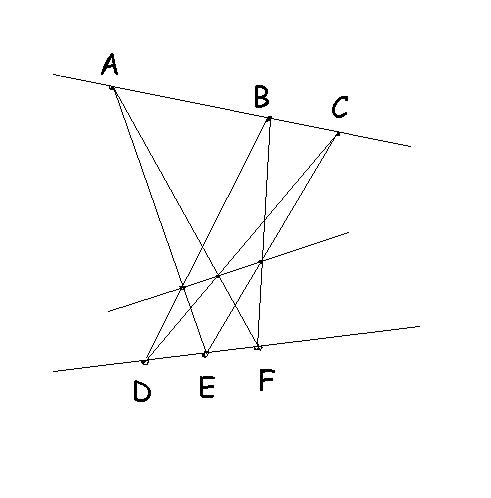
Invariant is something that does not change under a set of transformations. The picture on the right shows Pappus’s Invariant in geometry. The invariant tells that by following certain rules the three intersection points shown in the figure are always collinear no matter how people may draw the two lines and locate ABC and DEF in the lines respectively.

Invariant study is fundamental to any scientific research, especially when the research domain is as complex as World Wide Web. Invariants are supposed to be constant within the specified research scope. By well understanding the invariants we may effectively improve the knowledge over many complicated issues. Therefore, it is unsurprisingly for us to see the discussion of invariant study in the new Web Science Research Initiative.

In "A Framework for Web Science", the flag article of Web Science, Tim Berners-Lee and his colleagues have carefully studied several invariants on the Web. In particular, one invariant is outstanding among all the others. The one is URI (Uniform Resource Identifier). In the paper Berners-Lee et. al. had focused on discussing which invariant represents the binding of semantics with declared objects. There was no final best solution concluded in the paper, however, the one closest to the best was URI.

In varied programming languages we have widely used an invariant, which is declared name. In programming languages such as Java or C++, "each unique object (i.e. with distinct semantics) is declared with a distinct name in one program. By referencing a name, a program accesses the semantics behind the name." Hence declared name is taken to be invariant.

On the Web we are currently using another invariant. "Web researchers decide to use location binding to solve the problem, i.e. URIs and URLs. By default, identical URIs reference the same semantics. Identical URIs on web is the same as identical declared names in programs. However, the name of this URI is varied, i.e. name is no longer an invariant. In constrast, URI becomes a new invariant."

The authors, however, pointed out that indeed neither of the two was proper invariant on Semantic Web (or on the future Web). "The difference is, however, that the requirement of machine understanding," said by the authors. We actually have no ways to promise the consistency of the meaning to which a URI points. It is the same as we cannot enforce users to consistently bind the same name to any unique object on the Web.

Although with the problem, the authors did not provide a satisfactory answer to the problem in their paper. By contrast, they simply emphasized that "W3C suggests that do not transfer URI to another object. That is, whenever you create an object, giving it a unique URI. This requirement is thus the same as that whenever we create a new object in program, make sure we give it a unique name." In other words, please do not change the referred destination of any URI though anybody has the right to perform such a change. This passive resolution is not a satisfactory answer. Deprecated URI has gradually become a severe problem when more and more Web applications start to assume URI to be invariant on the Web. May we have an alternate, active answer to the question?


The figure above shows three basic components when we bind semantics with certain object. They are the declared name, the object itself, and a link connecting the two sides. So which one of them is truly invariant when they are presented on the Web?

As the paper has discussed, neither the declared name nor the link (i.e., uri) is true invariant. "Apple" may be fruit or a software company. We have no way to restrict a handpointing to a fixed destination.

The only exceptional one is the object itself. Although by nature an object can only be itself and it is automatically an invariant to itself, how can we present this invariant besides name and link? This is thus the problem.

We humans have so customized of binding semantics with declared names that we have almost forgotten some more intrinsic binding beneath the surface.

When we are binding the declared name "apple" with the object apple, we are actually making a semantic computation in our brain such as to determine whether it is a fruit with red or yellow or green skin and sweet to tart crisp whitish flesh. For people, a name is not just a name, but also a computational procedure in human brains. It is actually not the name that identifies an object, it is the procedure that identifies the object. The declared name is only a named shortcut referred to the particular procedure in brain. When we convert the procedure to machines, it is an epistemological process.


The picture above shows the new paradigm of semantic binding on the Web. The left side is changed to a particular epistemological procedure (which could be implemented in various ways such as the one we have suggested). Unlike names, these procedures are unique since they can unambiguously answer either yes or no for any identification request. Based on these epistemological procedures, Web links (such as URIs) are upgraded to be Web threads. The Web threads connect the same Web into a varied layer. Moreover, from the philosophical and economical aspects the construction of epistemological procedures and Web threads would be the basis for the production of mind asset.

In summary, epistemological procedure and Web thread are invariants on the Web. Through Imindi, we are going to demonstrate the world something extraordinary happening on the Web.

UPDATE: related reading about URI, "What do people have against URLs or URIs?" by Kingsley Idehen.

Saturday, June 28, 2008

Ahead The Road Ahead

It is now the time to say goodbye to a legendary person who has made our world be different. Bill Gates, founder of Microsoft, left his Redmond office (possibly forever) at Friday, June 27, 2008. I could not help myself picking up an old book written by him---The Road Ahead. What would be the road ahead of what Bill had already accomplished? I would like to ask this question.

Bill is a great visionary. Along with Paul Allen, he imagined a time when computers would be affordable to most of the people and software would do amazing things. From 1970s to early 1980s, such a dream "seemed very crazy." But Bill realized it through Microsoft. When we are now talking about how World Wide Web is bringing human society a great new transition, we must not forget that it is Bill Gates who has made computers be personal. Without the prevalence of PC, there would be no World Wide Web.

What was the road ahead? In his book, Bill told us that he had dreamed of the question "What if computing were nearly free?" Microsoft Windows was his answer. By providing users affordable and easy-to-manipulate operating system, the use of personal computers entered normal people's life. Also in the book, Bill asked the second question, which was his road ahead at the meantime, "What if communicating were almost free?" From the time to now, Microsoft was trying to make itself the leader of the so-called information highway. Unfortunately, however, after more than 10 years we have to say that Microsoft has not been so successful on this goal as it had succeeded in the previous one. An important reason of this failure is the imprecise vision of Internet. Primarily, Internet is an information net in contrast to an information highway system. Due to this confusion of Internet modeling, Microsoft missed the timing of Web 2.0. Google, instead, stole the oppotunity. Now, Gates and Ballmer have to confess that Web search would be the future of the company. This statement finally exclaims that Microsoft no longer seeks for the role of highway patrol but to look for the new role of librarian.

In Bill's two questions, he has particularly emphasized a word---"free". Unquestionably, free is a great feature especially when we would try to engage as many users as possible for a new product. After the product being popular, however, things start to change, especially when the product itself becomes the base of new production lines. The role of Web users is in a transition from mainly as consumer and viewer to be also as producer and publisher. The ones who consume a publisher-oriented Web are information consumers. The ones who consume a viewer-oriented Web are information producers. This important switch of roles appeals a new trend on the Web---"paid" instead of "free".

This switch of roles is actually easy to explain. When you are a consumer, you expect products be free. Once you become a producer, however, you expect your product not to be free. In fact, you expect to make profit out of your knowledge and your hard work. Hence when normal Web users start to realize that they are producers in addition to consumers of information on the Web, they will gradually accept the concept of "paid mind" (not free) on the Web. Web resources thus become mind asset.

Farewell, Bill. You have done excellent work and you will always be remembered as one of the greatest visionaries ever in human history. But there is still much road ahead of the road you have already walked. We will continue the journey and make our world be better and better.

Tuesday, June 24, 2008

Measurement of Mind Asset

Mind asset measurement is a novel and non-trivial issue. I have a few conversation of the topic with Michel Bauwens at P2P Foundation recently. It seems, however, that we only get more confused after the talk than at the beginning. Hence I feel the necessity of writing another essay dedicating to the topic. I believe that well understanding of this topic might be critical especially to new Web startup companies.

Asset Measurement in a Nutshell

In feudal society, value of land asset is measured by how much more land asset could be produced by possessing the land asset. In capitalist society, value of capital asset is measured by how much more capital asset could be produced by possessing the capital asset. Similarly, in harmonious society value of mind asset is measured by how much more mind asset could be produced by possessing the mind asset.

Value of Liability and Value of Asset

Before discussing measurement, we need to distinguish two types of personal belongings---liability and asset.

Liability is anything which only produces expense. Typical examples of liability are such as car, TV, computer, food, etc. Liability has its purchasing value when it is purchased. The real value of liability, however, only decreases with time after it is purchased.

Asset is any item which produces income. Typical examples of asset are such as rental real estates, stocks, bonds, etc. Asset also has its purchasing value when it is purchased. The real value of asset, however, may increase or decrease with time after it is purchased. The real value of asset is based on the real-time mutual consent of sellers and buyers.

The value of asset is primarily measured by its marketing value in contrast to that the value of liability is primarily measured by its purchasing value. For a liability such as a TV set or a car, more expensive means more valuable. For an asset such as a stock or a bond, more expensive per share does not necessarily mean more valuable at all.

For instance, at January 2004 the stock of Apple Inc. (AAPL) was about $11.28 per share in average while the stock of Yahoo Inc. (YHOO) was about $23.49 per share in average. After four and a half years, at June 2008 Apple stock is worth of $175.27 per share in average and Yahoo stock is worth of $21.99 per share in average. Were we able to be back to measure the value of stocks of the two companies in January 2004, which one would be more valuable? Certainly the answer must be Apple though its purchasing value at the meantime was less than the value of Yahoo stocks. This example shows that the real value of capital asset is about its ability of producing higher value capital asset in the future rather than its purchasing value at the meantime. This is a typical asset measurement in the form of capital.

Measurement of Land Asset

We have been familiar to capital asset value measurement since we are currently in the stage of capitalism. In consequence, however, we have forgotten how to measure the value of asset in the other types besides capital. For example, when we think of land, we immediately think of land as real estates---a particular form of capital. We have simply neglected that the value of land asset in feudal society was not measured by its capital value. On the contrary, capital in feudal society was measured by its land value since it was land but not capital that was the key asset of the feudal society. By going over the measurement of land asset in the past age of feudalism, we are going to understand the measurement of mind asset in the coming harmonious age.

The following is a few facts about key asset in society. Land was the key asset in feudal society. Capital is the key asset in capitalist society. Land was the primary input resources of traditional agriculture---the fundamental form of economy in feudal society. Capital is the primary input resources of modern industry---the fundamental form of economy in capitalist society. The class of people in a society is determined by the amount of key asset they own. Respectively, in feudal society the class of people was determined by the amount of land they owned, and in capitalist society the class of people is determined by the amount of capital they own. Due to this distinction, the measurement of land asset in feudal society is essentially different from the measurement of capital asset in capitalist society.

Let's take another example to show the difference of value measurement between land asset and capital asset. In the capitalist society a small penthouse at Manhattan is generally more valuable an asset than a several-acre-large plain land at rural Iowa. The reason is that we compare the two assets by their capital value. In other words, the two assets are only compared as two pieces of real estates---a typical form of capital asset. Now let's turn our clock back for two thousand years. In the ancient Rome Empire, would a small penthouse at Rome generally more valuable an asset than a several-acre-large plain land at Galilee, a far away rural province from Rome? The answer is no, while the reason is not that the land at rural Galilee would be more capital-productive than the penthouse at Rome. Instead, the reason is that a small penthouse at Rome is less land-productive than a several-acre-large plain land at Galilee discarding their capital value. The difference between land-productive and capital-productive is the key of the answer.

Land productivity is a central issue in feudal society. Large size of land and greater land productivity means that the landlords can raise more people under their leadership. By owning more people, the landlords may assemble a force to occupy more land. Hence it shows a fundamental economical cycle in feudal society---land to produce more land.

By contrast, capital ownership was not as essential as land ownership in feudal society. It was not straightforward to convert capital to land. Most of the time, money meant little simply because no land was on sale voluntarily even if someone had offered a large amount of money. On the contrary, it was always easy and straightforward to convert land to capital since nobody would worry of the lack of land buyers. Land, instead of capital, was the fundamental circulating asset in feudal society.

These discussions explain that value of land asset is measured by how much more land asset could be produced by possessing the land asset.

Measurement of Capital Asset

Measurement of capital asset is what we are familiar. Basically, we convert everything into its capital value and compare the amount of converted capital to each other.

What I want to emphasize is some fundamental revolution in human society that causes the change from land as key asset to capital as key asset. In a previous essay, I have discussed the impact of the invention of Watt steam engine. Due to this invention, the rate of capital production the first time in history was above the rate of land production. Industry replaced the agriculture becoming the foundation of modern economy. As the result, capital replaced land becoming the basic scale of asset measurement.

Because of this transformation, the wealth in society is measured by the capital ownership instead of the land ownership. By owning capital, people can buy anything that includes land. On the contrary, owning land does not necessarily mean owning capital because it is possible that nobody would be willing to buy it since land is not the essential input resources of industry. Therefore, land in capitalist society gets a new name---real estate. Land is only considered to be a special type of capital.

In summary, value of capital asset is measured by how much more capital asset could be produced by possessing the capital asset.

Measurement of Mind Asset

What we are facing now is the rise of information industry. Information industry is different from the traditional industry. Information industry takes mind as its primary input in comparing to that the traditional industry takes capital as its primary input. This change has been overlooked by many people until now because we have been used to think of mind also as a special type of capital---similar to simply take land as real estates. It is such a narrowed thought of mind that causes the difficulty of understanding the measurement of mind asset.

Mind essentially is different from capital, which is the same as that land essentially is different from capital. We may evaluate both land and mind in their capitalized value only if they are freely acquired with money or financial capital. When they are essentially more crucial in society than financial capital such as land in feudal society, however, they are not capital any more. By contrast, themselves become the scale of measurement about wealth in society.

Capital is not the natural scale of asset measurement and it will not be the scale of asset measurement forever. If the wealth of feudal society was measured by land but not capital, why can't the wealth of the new coming age be measured by mind instead of capital? We may apply financial capital (money) to measure wealth in any time period. But it does not necessary mean that financial capital is the ultimate scale of asset measurement. There is something money cannot buy, especially within certain particular time period.

Certainly, however, there are many technical issues we need to solve before mind indeed replaces capital to be the measurement scale of wealth. It also took many years for capital completely replacing land being the key asset of society, let it alone that such a replacement be eventually understood and adopted by the general public. (My grand-father-in-law still did not understand it until the middle of last century in China and thus he and his family paid a great deal on this misunderstanding in the rest of their life.)

In the history of capital, the invention of stocks was a landmark. Stock reveals that capital is liquid in contrast to that land is solid. We may look for a similar invention on mind presentation to prompt the adoption of mind asset. Obviously, however, the invention is not ready yet. We still need more patience for the coming new age of human society. (By the way, I will join Adam Lindemann at Imindi. We expect to not only produce novel mind product but also be end up with a few creative improvement on mind asset presentation as the Dutch East India Company did in 1606.)

Michel in his response also has addressed two specific questions of the value of mind asset: (1) the monetary value of mind asset, and (2) the mind asset protection from illegal copies. The following is my answer to the two specific ones.

I agree to the following argument made by Michel.

"There is no one to one relationship between the 100 million downloaded YouTube videos, and the income it can generate. The ratios are very low. This is what the crisis of value is about. Google may make a lot of money, but only a marginal number of websites makes money!! Most use value that is generated, even by high quality mind assets, does not generate a lot of monetary income."

But I have different thought on these facts.

The difference between my thought and Michel's thought is that Michel takes YouTube videos to be mind asset while to me they are more about mind liability than mind asset because (as Michel discovered) people can hardly use them to produce more mind asset. In other words, that until now it is still so difficult for mind product to be asset is because the general lack of production line of mind.

We have YouTube videos, and they are at the end of the current production line of mind. If they are not input resources of some other Web industrial companies, these videos can only be liability but not asset. Moreover, their purchasing value is also low because their producing cost is low (don't count the producing cost of shooting the films).

Such a problem is a generic problem in the current Web industry. The reason that Google makes money is that Google has a well developed production line of mind asset. Google can continuously produce higher quality mind asset by converting the low-quality mind product to be the input resources. Hence Google knows the secret of mind as asset (no matter it is by real understanding or by unconsciousness). By contrast, that many other Web companies can hardly make money is because they don't understand mind asset and they are also not lucky enough to unconsciously catch mind as asset. To the end, they only produce mind product as liability and they do not have the knowledge to design a production line of mind so that their produced liability might be a new form of asset. If Web industrial companies may learn the spirit of mind asset and learn how to make themselves produce asset but not liability, many of them will start to make money.

Why is it hard for us to make money from mind liability, at least at present? The answer is related to the second question we mentioned---the mind asset protection from illegal copies.

Until now, many mind products on the Web are easy to be copied since they are in digital forms and they only describe static content. But things are changing with the progress of Web evolution. The emergence of Web widgets is a typical example.

Web widget is a special type of Web services that service providers implement portable client-side plug-in for users to enjoy the services in their own sites. The difference between Web widget as mind asset and normal Web content as mind liability is that the service providers have the full control of their mind product. Although it is free for users to plug in the client-side widgets, the service providers can subjectively decide whether to continue the service or update the content of the service from time to time. It is generally hard for users to "copy" the server-side program since it is intangible for the client-side users. Hence Web widget is a typical example of mind asset that can produce more mind product and it is not easy for people to steal illegally.

In summary, the production and formulation of the Web-age mind asset is still at its beginning. We still have a long way to go to eventually make the public realize the value of mind asset and understand the measurement of mind asset. However, whoever may catch the spirit of mind asset first would be able to make profit from the knowledge. It is similar to the old day when pioneers got to understand the magic of capital. We are entering a new realm of economy in which we are employing a new form of asset. The entire world is changing gradually in this process.

Friday, June 06, 2008

We are in a new transition, part 2

By two parts, I response to the Harmonious Age suggested by Adam Lindemann. In the first part, I describe its philosophy by civilization evolution. In the second part, I explain the impact of this theory to Web industry. This is the second part of my response.

World Wide Web, the new-age Watt steam engine

At the end of the 20th century, an Englishman Tim Berners-Lee invented how information could be transferred easily over the Internet by using hypertext. The invention is named World Wide Web. This invention is bringing human society to a new age.

Two centuries ago, another Englishman James Watt invented a machine called Watt steam engine. The machine made use of steam at a pressure just above atmospheric to drive the piston helped by a partial vacuum. This invention is more than another technological innovation. By contrast, the invention is a formal mark in history that capitalism had replaced feudalism. Because of Watt steam engine, industrial production was upgraded from the traditional, low-quantitative handicraft work to the modern mass production. Modern industry started emerging above the surface. Also due to this upgrade, capital (the base of modern industry) replaced land (the base of traditional agriculture) becoming the key asset in human society. Human civilization thus evolved from feudalism to capitalism.

World Wide Web is the modern-time Watt steam engine. Due to WWW, information industry is upgraded from handcraft, low quantitative production, elite-conducted work (by professional journalists, photographers, software programmers, etc.) to machine-powered, mass production, plebeian-conducted work (by every regular Web user). Information industry is evolving to its postmodern stage---Web industry. With this upgrade, mind, the base of information industry, is replacing capital, the base of traditional industry, to be the key asset of human society. Human civilization is evolving from capitalism to a new age.

Mind asset, the essential issue

Mind is always an asset. The potential productive power of human mind is known to be overwhelming. Nearly none production could be done without the participation of human mind. Furthermore, people has realized the power of mind for long time. Modern education is a typical effort that people are trying to make a product line of high-quality mind asset.

On the other hand, however, we often experience difficulties when trying to effectively use mind as asset. Unlike land or capital, individual mind is essentially intangible except for the owner of the mind. Presenting mind explicitly in formal ways is a long-time hard problem. Without explicit, formal presentation of mind asset, we cannot efficiently connect and compose varied mind asset and we cannot well measure the value of mind asset. The issue of mind aggregation is particularly critical because individual mind is often too shallow to be high quality.

Among all the others, the issue of mind-asset presentation is the central one. A formal, tangible presentation of mind asset is the key to let mind asset be circulating. Circulating mind asset is then the basis of the new civilizational transition.

Web resource, new presentation of mind asset

In tradition, we have developed varied forms of mind presentation. For example, books, tapes, drawing artifacts, buildings, etc. Through these forms, humans embody mind and preserve the embodied mind to be asset.

There are, however, at least four common problems in these traditional forms of mind asset.

(1) [cost] It is costly to produce mind asset in these presentations, and it is generally more expensive to share mind asset in these forms. In consequence, only the mind asset produced in superior quality (such as best books or artifacts) can be widely spread and shared.

(2) [strength] None of these presentations last long time. They can hardly survive from various natural or man-made disasters such as earthquake or war.

(3) [quality] By adopting these traditional presentations, we may embody mind in its static and passive aspects. But the forms are not good enough to embody the dynamic and active (which is the more valuable) aspect of human mind, let it alone some deeper implicit aspects of human mind such as self.

(4) [measurement] We do not have generic, objective methods to measure the value of mind asset in these traditional presentations.

If an asset is costly to present even in its low-quality form, with weak strength to survive longer, and unable to be measured objectively of its actual value, surely it is not a reliable asset for public to own and share. This problem is fundamental to information industry since mind asset is actually its base. The invention of World Wide Web solves the problem.

mindW3C defines World Wide Web to be "the universe of network-accessible information, the embodiment of human knowledge." This specification expresses three facets of the Web. First, the Web is a place for people to embody their mind. Second, the Web is a network of embodied mind. Third, through the Web people may access each other's embodied mind.

In particular, the mind asset on the Web is presented by Web resources, which are independent pieces of embodied human mind that can be used for producing. Note that this definition of Web resource is not a common one. In common (such as the one in Wikipedia), a Web resource is any object on the Web that is referenced by an URI. Such a definition has not precisely described the essence of Web resources if we compare it to the W3C definition of World Wide Web. By contrast, my new specification is directly based on the W3C Web definition. A Web resource may be a collection of Web data, a Web service, a Web link, or a mixture of them. A Web resource could and should be referenced by an URI, but a Web object referenced by an URI might not immediately be a Web resource unless it may produce. (more descriptions of my interpretation of Web resource are at here.)

the issue of cost

Comparing to producing the traditional forms of mind asset, Web resource production is cheap. The Web is a free and open place for everyone to embody mind. Web resources are presented in digital form, and digital form consumes very few natural resources. Hence in total Web resources are inexpensive to produce. Moreover, sharing Web resources also costs little. In consequence, we can now afford spreading and sharing the embodied mind even if it is in inferior quality.

the issue of strength

Web resources can last long time. Due to the low cost of digital copy and the flexibility of resource transmission on the Web, we may ideally preserve any piece of embodied mind nearly forever. In addition, World Wide Web is a virtual world. Hence it has great strength to survive from most of the real-world disasters, either natural or man-made.

the issue of quality

The most important improvement Web resources have made beyond the traditional forms of mind asset is their presentational quality.

In the traditional forms such as books or video tapes, we can introduce a mind as well as how it works. For example, a stock-market expert may write a book about what stock is and the timing of buying and selling stocks. But the book would not (if ever possible) tell the mind-asset consumers (the ones who read the book about stocks) the exact judgment of stocking selling the author would do in real time cases. The book readers have learned from a book the general principles. But it does not mean that the readers can consume the mind asset as well as the author does in real life. There is a natural gap between the presented value of the mind asset in the book and the real value of the mind asset in real world. This gap of knowledge understanding is a typical difficulty of mind asset measurement.

To solve the problem, on the Web people can program their mind (a typical dynamic mind asset) so that the production of their embodied mind could be precisely predictable by adding real-time parameters. In our example, stock-market experts can program their thoughts so that the program always produces the identical decision in the same real time case no matter who use it. This type of mind asset thus has higher quality than the standard static mind asset because it is more productive in use.

Moreover, on the Web we may embody a special type of mind asset that we rarely have successfully expressed before. It is self.

Self, self-consciousness, or self-awareness, is "a personal understanding of the very core of one's own identity." Due to self everybody is unique. By self, different people may develop varied use of the same knowledge. We thus have the variety of human mind. Self is so unique that nobody can embody the self of the others. The embodiment of self shows the ultimate value of a person, and hence it represents the respect of humanity. As a typical mind asset, self plays a critical role in many fields of World Wide Web, such as the implicit Web and Web evolution.

the issue of measurement

By presenting mind in Web resources, we are able to objectively measure its value as if we measure the value of capital asset. As we know, though there is a large variety of capital asset (such as stocks, real estates, etc.), we can uniformly measure its value by testing the capital asset in free market. In the similar way, we may objectively measure the value of a mind asset presented by Web resources. On the free Web, the value of a Web resource can be arranged completely by the mutual consent of producers and users.

Web Industry, platform that mind flows

While World Wide Web is a network of embodied mind, Web industry is the platform that mind flows. In the real capital world, modern industry (represented by the manufacture industry) takes capital as input and produces capital with greater value. In the virtual mind world, postmodern industry (represented by the Web industry) takes mind as input and produces mind with greater value. This analogue tells the essence of Web industry.

Web companies are the factories that produce Web resources. They may primarily produce data resources such as Amazon, or service resources such as Facebook, or link resources such as Google. Discarding all the superficial distinctions between each other, all Web companies are taking a few mind assets as input and producing a few mind assets as output. Ideally, the value of the output mind asset must be greater than the value of the input mind asset. Mind is the blood flowing around the system of Web industry, which is similar to that capital is the blood flowing over the system of manufacturing industry.

Web companies also partition their work load and cooperate to each other the same way as the other industrial corporations do. Take the traditional manufacture industry as an example, some corporations (such as iron puddling factories) pretreat crude materials and produce refined materials or parts while some other corporations (such as automobile manufactures) take refined materials and parts to produce further manufactured products. In similar, some Web companies (such as Blogger) are to help people embody their mind into Web resources from scratch while some other Web companies (such as del.icio.us) are to take the already embodied mind as input (such as a blog post in Blogger) and to produce higher quality mind assets that can be consumed better by end users.

There is, however, a unique restriction of Web resource producing and consuming in Web industry. Due to Web evolution, neither the production nor the consumption of Web resources may beyond the evolutionary stage of World Wide Web at the meantime.

Web resources produced in quality higher than what can be efficiently consumed at the meantime is overqualified. Yahoo! Directory is a typical example. The quality of link resources produced by Yahoo! Directory was generally beyond what Web 1.0 users could efficiently consume. Hence the service became very expensive to maintain. Eventually, Google Search replaced Yahoo Search being the leader of Web search industry thought the actual quality of link resources produced by Google Search is lower than the quality of link resources produced by Yahoo! Directory. (This is, however, not necessarily the end of the story. Y!OS is the newest step Yahoo is taking for Semantic Web. Will Y!OS eventually tend to produce overqualified Web resources again? We have this concern.)

On the other hand, Web resources produced in quality lower than what can be efficiently consumed at the meantime is underqualified. The examples in this category are plenty. In the age of Web 2.0, many Web-1.0 companies have to update the quality of their produced Web resources to the level of 2.0 or otherwise their market share is quickly taken by their Web-2.0 startup competitors.

Because of Web evolution, mind asset production is so dynamic that no company (including Google) can stick to one product quality for long. Web companies have to upgrade the quality of their produced mind assets with the progress of the Web every few years in order to just survive. Hence Web industry is indeed a business type with high risk and high payback.

We are in a new transition

We are in a new transition. The widespread of World Wide Web is the trigger of the transition. Because of the Web, the first time in history human mind becomes a critical circulating asset in society that ordinary people can buy, sell, produce, and share. The rise of mind asset will eventually push the human civilization evolving from the age of capitalism to the next.

We are still at the early stage of this transition. In similar, the Web is still at an early stage of its evolution. The Web companies that lead the progress of Web evolution will simultaneously be the leaders of human civilization in this transition. Until now, we have seen a few of these leaders such as Google and Facebook. They have led not only new technologies, but also the change of culture in our society.

Based on what we have analyzed, to be a leader of Web evolution is actually less about doing business in a particular realm such as "Web search". By contrast, the success is primarily determined by whether the founders of company have (either actively or unconsciously) well foreseen the quality of Web resources (or mind asset) in the next generation. Google approaches the quality through Web search while Facebook approaches the same quality by social networking. Neither of the success is due to the path they choose to take because at the same time many other companies were taking the same path as they did. The key of their success is the distinction of the quality of Web resources the two companies produce.

Which companies may be the next in the list of success? Though we don't know the names, one thing is certain---the ones understanding the resource quality upgrade of Web evolution may get the better chance to be the winners. Such a successful company might be another Web search company, might be another social networking company, or might be a company with a brand new focus. As we have said and I emphasize it again, the particular path taken by a company is not the deterministic factor. Different founders may have their preferred realms of interest. To the end, the variety of human mind allow us to approach the same goal in various paths. The actual key to the success is whether the founders are capable of foreseeing the progress of Web evolution, especially the progress of Web resource (mind asset) quality upgrade. Neither over-qualification nor under-qualification may clinch a winner. It can only be a perfect hit of the right quality.

Monday, May 26, 2008

We are in a new transition, part 1

(also read the article in Chinese, translated by the author himself)

By two parts, I response to the Harmonious Age suggested by Adam Lindemann. In the first part, I describe its philosophy by civilization evolution. In the second part, I explain the impact of this theory to Web industry. This is the first part of my response.

We are experiencing a new transition of civilization in human history. This is the first time since the last industrial revolution from late 18th to early 20th. I do not distinguish the first industrial revolution from the second industrial revolution because the two individual ones are consecutive phases of the same transitional event. After the industrial revolution, human society finished the transition from feudalism to capitalism. At present we are experiencing the next transitional movement from capitalism forward. The destination of this transition is unknown yet, though it seems unlikely to be either socialism or communism. Adam Lindemann prefers the term Harmonious Age to describe the coming new age. Or we may just simply name it the new Web age. If someone is from ivory tower, a likewise academic name may be the mindlist society.

From feudal society to capitalist society

A transitional period of civilization has its symptoms. To understand the symptoms happening at present, however, we need to first understand the symptoms happened before. By comparing the symptoms in last transition to the symptoms at present, we may have better understanding of the present status.

Feudal society was typically known for its overwhelmingly agrarian economy with limited money exchange. Due to the agrarian economy, land was the key asset in feudal society. By tightening people to land, landlords were the ruling class in feudal society. Kings or emperors, normally known to be the biggest landlords, were the society leaders. Feudal nations were ruled by these kings and emperors. In general, every feudal nation simply self-supported itself by its own agrarian economy and there were few economical communication among these feudal nations. The fundamental infrastructure of feudal society is a set of independent kingdoms.

At late 18th, feudal society was coming to its end at global wide. The invention of mass-production machines such as Watt steam engine was the trigger. These inventions appealed liberating humans from land for the sake of the emerging modern industry. Capital gradually replaced land to be the key asset of society. At the same time, it appeared a new class of people---capitalists.

After more than a century of wars and revolutions, capitalists finally defeated landlords to be the ruling class of a newly formed society, which we all know now to be the capitalist society. The owners of industrial corporations (the capitalists) became the leaders of the new society. The leaders of capitalist nations are either capitalists themselves or (more often) the representatives of certain groups of capitalists. There is, however, generally no place for kings or emperors in capitalist society.

Unlike the old-time agrarian economy, modern industrial economy demands close cooperation among varied corporations since no single corporation can just complete support itself without help from other companies. Hence the fundamental infrastructure of capitalist society is a network of mutual-dependent corporations. Unlike the territory of a feudal nation is measured by the size of land, the territory of a capitalist nation is measured by the strength and influence of its capital. For example, Japan is more influential than Brazil and Israel is more influential than Egypt in capitalist economy though the land of the former nations is much smaller than the land of the latter ones.

Ordinary people in capitalist society are tightened to capital instead of land. Every working-class people is first bound to his/her trained profession. The fate of a profession is, however, decided by capital. The professions that help produce more capital are encouraged by the society and thus more people run to take these majors. On the contrary, the professions that do not or no longer help improve capital generation are diminished and thus less people become willing to learn them. By Adam Smith, the flow of capital is the invisible hand which controls all aspects of capitalist society.

The following table summarizes what we have discussed so far.


feudal societycapitalist society
most valuable assetlandcapital
society organizationindependent kingdomsmutual-dependent corporations
society leaderking/emperorcorporation owner

Capital, the wonder and the problems

The rise of capital was a fascinating wonder in history. Capital frees human from the fastening of land. Capitalists demand people to be free of moving from one land to another so that they can have enough opportunities to hire people with certain skill for capital production. In feudal society, this request meant a great deal of freedom to ordinary people. Even until now, this demand is still a crucial piece of the foundation that supports the freedom in capitalist nations. The continuous increase of capital production cannot be promised without this freedom. (US people may need to think more of it with respect to the current immigration debate.)

On the other hand, however, capital is near-sighted and selfish.

Short-term payback is crucial to the flow of capital. The lack of short-term profits can easily kill a long-sighted visionary capitalist without a question. An analogy is probably the best way to explain the reason behind.

If land is solid, capital is liquid. A business oppotunity is a hole on ground. Unless the size of the hole is at least equal to or the better be greater than the size of the solid, we cannot push the solid into the hole (even though there is indeed a hole on ground). By contrast, liquid can easily flow into any hole disregarding of the size and depth of the hole. This difference explains why capitalist society is better than feudal society on producing wealth.
At the same time, however, liquid flow is near-sighted. Liquid immediately flows into the nearest hole. Even if there is another hole that is bigger and deeper but a little bit farther in distance, liquid will not flow into the farther one before it has filled the nearest one. Furthermore, it is not easy for liquid to get out of a filled hole and flow to another. This near-sighted problem of capital has caused many economic disasters in the history of capitalism such as the Great Depression.

Capital is also selfish. In general capitalists only look for the professionals (be note, not necessarily the humans, for example, if robots can do a profession better than humans, capitalists will definitely hire robots but fire humans) that can produce more capital. Except of incremental capital generation, nothing else is more important. Capital serves only itself.

In the job market of capitalist society, ordinary people are always in a passive position comparing to the interest of capital. A job oppotunity in capitalist society is rarely about what an ordinary person want to do. By contrast, it is solely about which profession helps produce more capital. What ordinary people can and should do is to study the skills that are demanded by capital. The value of an employee is determined by how much he can produce capital through his profession. Essentially, capitalism turns humans to be various standard screws that can be flexibly assembled in various assembly lines at anytime and at anywhere. Some screws are expensive to be made (and thus these people can get high salary) while some others are cheap to be made (and thus their salary is low). This is the only difference among all the screws. Capital does not serve for the interest of screws.

In compatible to this capitalism, the modern education system mainly focuses on training scientists and engineers but not thinkers. Scientists and engineers are the various standard screws we have just discussed. Capitalists do not need thinkers who have their own ideas because screws do not need to think beyond their own function.

After the flourishing time of great thinkers from late 18th to early 20th, capitalist society is engaged by plenty of scientists and engineers but fewer thinkers. Moreover, the specialty realm of a particular scientist or engineer becomes narrower and narrower in time. Using our analogue, screws are made more and more for special purpose.

With the advance of technologies, we also start to invent new machines that can replace the function of some special-purpose screws. Hence we start to lose many job opportunities for human employees. For instance, the invention of automatic assembly line has significantly reduced the number of manufacture workers in factories. To the end, if one day machines can satisfactorily take all the job professions, why do we still need human in this world? Or to the least, we only need to have the capitalists live in this world and all the other people become meaningless to this capitalist society.

The advance of a human society is to reduce the meaning of humanity in the society. This is an ironical dilemma in capitalist society. This dilemma is caused by the overlooking of a central issue of human society. The issue is human itself.

Human, the missed issue

Humans are not screws. Although this statement is so simple that even first-grade elementary school students can understand it well, it is so hard in civilization evolution to truly make humanity be the key asset of a society. In fact, we have never succeeded in this goal before.

At feudal society, humans were subordinated to land. Kings obtained people by occupying land. Kings generally did not care individuals but only the total number of people in their land. If a king lost an ordinary John but be replaced by an ordinary Peter. It often did not count a loss (neither a gain) for the king because the humanity of neither John nor Peter was critical. The size of land and how much fertile land they own were more critical issues to the kings.

At capitalist society, humans become subordinated to capital. Capitalists obtain people by occupying capital. Individual professions have become an important criteria to evaluate the value of a person. But still the issue of humanity is not critical. Capitalists would rather to replace a human with a machine immediately only if the machine can do the same profession the human does. The actual willingness of an ordinary John is not a consideration of capital. If one screw no longer fits, just throw it away and replace it with another screw which fits. This is the fundamental philosophy of capitalism.

Isn't it a pity that a human society does not really care of humanity as a first-class asset?

Mind, the asset of humanity

So what is the asset of humanity? To answer this question, let's start with examples.

I am a computer science professional, so I know computers. If I write a program that executes in my computer, I know that it will execute the same way and produce the same answer in the other computers. It is not just computers that have this property. All machines are the same. If we have "educated" (i.e. programmed) a machine to do a function, we can be sure that this machine will do the same thing, no less and no more, all of its life.

Now let's switch to a similar scenario but with different participants. We have a class of students and there is a teacher educates them. Ideally, if the students were machines, after the class we would have a group of students with the same knowledge who could use the knowledge to do the same thing and produce the same answers (since they are taught by the same teacher at the same time in the same place). But we know this is not the case. If the class have 30 students, you can expect 29 (the last one was sleeping at class so he does not count) different ways of using the learned knowledge and having produced varied or even contradictory results.

What is the difference between these students and machines? Humanity. Creativity of human makes everything difference. By pushing identical knowledge into the brains of many people and teaching the same skills to the bodies of these people, we are not producing identical professional workers. By contrast, we can expect countless ways of combining knowledge with skills so that the production could be different from one person to another only because these people are humans. This is the asset of humanity, and thanks to this asset we have our diverse world.

If we are allowed to use only one term to describe this asset of humanity, I choose mind. It is mind that represents the real value of each person. Different people can have the same knowledge and with the same skill. But they still bring the world different production because they are distinct persons. John is not Peter, Peter is not John, and neither of them is a screw. If we allow them freedom, they can produce varied fascinating products for us even if they have the same "profession". This is the value of mind asset.

Unlike capital, the mind asset is long-sighted and generous.

Let's apply our analogy again to explain the long-sighted. If land is solid and capital is liquid, mind is gas. Because it is gas, it can fill everywhere simultaneously disregarding the distance of a hole. A little liquid may fill only one small hole. But a little gas can fill all holes no matter how big they are. This is the power and value of humanity.

Mind is also generous. Land is to produce more land, so we have wars. Capital is to produce more capital, so we have the diminishing of humanity. But mind is to produce more mind. Since mind is the value of humanity, we will have a better harmonious age---which is what Adam Lindemann declares.

Harmonious Age, the future?

If the Harmonious Age is the future, the following table describes the change we will see.


feudal societycapitalist societyharmonious society
most valuable assetlandcapitalmind
society organizationindependent kingdomsmutual-dependent corporationsinteractional mind groups
society leaderking/emperorcorporation ownerthinker

Mind is going to replace capital becoming the key asset in the new society. This replacement does not mean that capital is going to be valueless. Land is still a very much valuable asset in capitalist society. The only difference from feudal society is that land is no longer the key asset. In similar, capital will continue to be very much valuable asset in the coming harmonious society. But capital will no longer be the key asset. In feudal society, people who had land owned capital and mind. In capitalist society, people who have capital own land and mind. In harmonious society, however, people who have mind asset will own capital and land. So the change is the sequence. But everything still has its own value.

Because mind becomes the key asset, the fundamental infrastructure of human society is going to change respectively. Corporations that serve for capital is going to gradually retreated to the secondary place, as in the previous transition nations that serve for land were retreated to be behind corporations. At the same time, new organization forms such as mind groups will start to rise.

A mind group will be a group of people leading by the new-age thinkers. Thinkers at the new age are the ones who know the art of composing various mind to produce. (For example, they are the ones like Adam Lindemann that is simultaneously capable of thinking and practicing.) These mind groups will become the new and most powerful productive forces (term used by Karl Marx and it has an alternative presentation "productive powers of labour" used by Adam Smith) in human society.

In this new society, the role of corporations will change in the similar way as the role of nations has been changed since feudal society.

In capitalist society, corporations belong to nations but at the same time they are independent to nations. Large corporations have their interest cross the border of many nations. The leaders of large corporations have at least the same influential as nation leaders, and they are often even more influential than the leaders of many small countries.

In similar, in harmonious society the mind groups may be bound to corporations but they are also independent to corporations. The memebers in mind groups will be able to decide their own fate but no longer allow corporations to decide their fate alone. Large mind groups can have their interest over varied corporations simultaneously. Great thinkers who are the leaders of large mind groups will be the true society leaders. In capitalist society, nation leaders must get support from capital, and hence the support from capitalists. In harmonious society, both nation leaders and corporation leaders must get support from the leaders of mind groups. Corporation leaders will be elected by the support from mind groups as well as the nation leaders in capitalist country must be elected by the support from companies. Since mind groups represent more free willingness of people, we can see that the control of society is gradually moving back to the hand of normal people.

Is this Harmonious Age indeed the future? Where are the mind groups? More important, how is the mind asset presented? Land is physical (so it is solid) that everybody can see and touch. Capital is not exactly physical but it can be measured by money in our hand (so it is liquid). But what the presentation of mind asset is and how we may use it for production. These are the crucial questions and I am going to address them in Part 2.
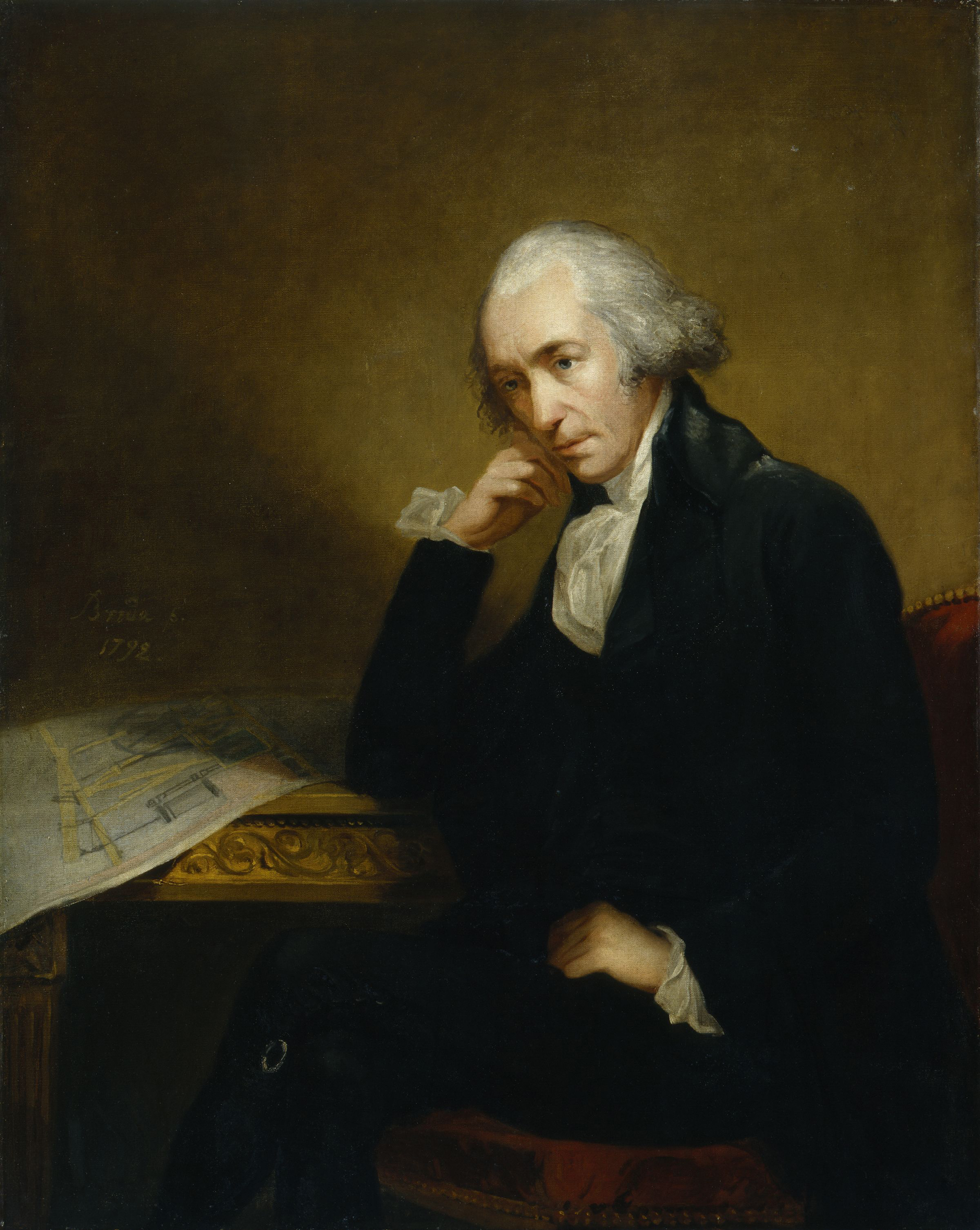
However, I will make a few hints here when concluding this Part 1. Commonly agreed, the start of the last society transition was the invention of Watt steam engine by James Watt. This invention made the foundation of the modern industry, which became the platform of the flow of capital. Hence we should expect a similar invention happened if the vision of Harmonious Age is really sound. Indeed, we have one. The new-time Watt steam engine is called World Wide Web, and the new James Watt is named Tim Berners-Lee. We are going to discuss more in Part 2.