Google.com.cn has been closed
It is now redirected to www.google.com.hk. In its front page, it is said "欢迎您来到谷歌搜索在中国的新家" (or "Welcome to the new home of Google Search in China").
Today must have its unique position in the history of Web evolution.

It is now redirected to www.google.com.hk. In its front page, it is said "欢迎您来到谷歌搜索在中国的新家" (or "Welcome to the new home of Google Search in China").
Today must have its unique position in the history of Web evolution.
Due to my schedule, I do not have time to make intensive posts that explore the news in depth as I used to do. To celebrate the Chinese New Year and Valentine's Day (this year they happen to be in the same day, Feb. 14) together with the Thinking Space readers, however, I would like to share my brief comment on some of them with my friends. Happy holidays! iPad
iPad
iPad represents a remarkable breakthrough in concept. Its current product design is, however, immature. It is a terrible misleading to think of iPad an enlarged iPhone. To see the real intrinsic distinction, let's take a minute thinking of the following comparison.
The innovation of notebook computer brings the Web to people anywhere in the world; the innovation of iPhone brings people anywhere in the world to the Web; the innovation of iPad, on the other hand, makes an instant bridge between a person anywhere in the world and a specialized subset of the Web---his Web of interest. This is the real gap Steve Jobs claimed to fill in the product launching show.
Certainly, the current iPad design has not reached the goal yet. This is why I call it immature. Siri
Siri
Siri on iPhone is a milestone though there is still a long long way ahead to reach a meaningful success.
Believe it or not, Siri and iPad actually belong to the same philosophy---developing a personal assistant. iPad plans to construct a hardware platform of personal assistants. Siri attempts to build a software platform of personal assistants. Compared to iPad, the road ahead for Siri is even tougher.
On the positive side, Siri provides a fascinating environment to experiment many key concepts of the Semantic Web and linked data in the real world. Idehen Kingsley must be interested in exploring his journey with this service. We as normal users, however, still need more time to watch the future progress of this service.  Google Buzz
Twitter but in Google? Maybe. But GBuzz means more.
Google Buzz reveals the GMail users the social communities they implicitly belong. These social communities existed disregarding GBuzz. GBuzz, however, makes them explicit. This is a critical step Google made towards exploring the treasure of the social web. Google has been hesitated on how to step into the social web for long time. Finally it seems the company finds their unique asymmetric strength to enter this market by cashing the popularity of its dominating GMail service. This is remarkable because in comparison Microsoft still does not get how they might exploit their asymmetric strength in this field. Google's Aardvark Acquisition
The innovation of Aardvark is ended. This acquisition is probably a good news to the Aardvark investors and the Mechanical Zoo employees. It is, on the other hand, not so good a news to the evolution of the Web.
In short, Google's ultimate interest contradicts to the eventual potential of Aardvark. Google's ultimate interest is to make itself a super-smart brain while everybody using it may follow it stupidly. The social search services such as Aardvark aims to locate smart people and make people rather than machines be smarter through the social communication. This contradiction in the level of philosophy actually is the intrinsic reason that made the Aardvark designers leave Google several years ago. Although at present the power of money brings them back, it does not solve the fundamental conflict.
I had a phone conversation with Max Ventilla two years ago and we shared quite a few thoughts about what the social search was and how to approach it. I am glad of and sincerely congratulate his achievement in business by sealing this acquisition deal. I am afraid, however, that he will start another journey sooner or later when his original passion catches him again.
In part 1 and part 2 respectively we analyzed what the deal may bring to Yahoo and Microsoft. Yahoo sells the weapon it uses in a lost battle (to the "don't be evil" enemy) by a price (not cheap) to Microsoft, which dreams of reopening the search engine war to against the same enemy based on the gained "scale" the deal assigns. In this post we thus discuss the "don't be evil" buddy---Google.
Should Google be afraid of the "scale" Microsoft pursues and is likely to gain by the deal?
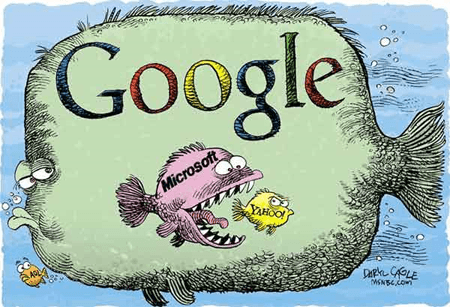
By the first glimpse, Google should. Microsoft will obtain a decent increase in "scale" because of the deal. The combined MicroHoo (Bing) search engine will host 3 out of every 10 Web searches comparing to Google's 6 out of 10. This new figure may persuade the online advertisers investing more on optimizing the results returned by Bing. Google needs to be worried of this trend, doesn't it?
On the other hand, however, Google should feel released. Microsoft has chosen the Google way when coming to the battlefield. Microsoft could have invented revolutionary new business model about Web search by utilizing its superior desktop operating system; but it did not. By contrast, Microsoft looks for fighting in muscle on capital and manpower.
Microsoft has proved successful records in defeating powerful opponents. For example, to defeat Lotus Microsoft utilized its asymmetric advantage on synchronizing the upgrade of the office software with the upgrade of the mainstream operating system (Windows, a Microsoft product). It was impossible for Lotus to catch up the pace. The continuous improvement of the desktop office software demanded heavily on the OS support or otherwise the implementation would be very expensive. With Microsoft's dominating the desktop OS, Lotus simply had no chance to win.
In another example, Microsoft defeated Netscape in the first round of the browser war. This time, however, it was Netscape that made the first mistake by having overlooked the effect of Web evolution. In the late 90s, by still being excited of its success in the first tide of World Wide Web Netscape failed to recognize the fact that the sustainable Web evolution demanded Web browsers to be free. That Web evolution could be sustained is critical to the healthy growth of all the Web companies, including Netscape, even until now. When Netscape finally realized the problem, there was few time left for it to figure out an alternate business model; and apparently Netscape did not accomplish the goal anyway. At the meantime, in his book The Road Ahead Bill Gates foresaw the future of the Web to be the "information highway". The model suggested that free information transportation through the "highway" (i.e. free Web browsing) with the charged information hosting at every exit of the "highway" (i.e. non-free software, especially the operating system, for hosting the information to be transported). Guided by this view, Microsoft started a journey on heavily investing in developing the next stage desktop operating system that well supported the network communication while at the same time it built a high-quality but free Web browser (Internet Explorer) to satisfy the visionary picture. Although history tells us that Gates did not indeed interpret the Web evolution entirely right, the vision at the meantime was superior enough to defeat Netscape. More importantly, Netscape had no way resisting Microsoft's attack because (1) it did not have the experience on developing the cutting edge operating systems, and (2) it could not figure out the real trend of Web evolution better than the vision of Gates.
Both the examples show us that Microsoft won the critical battles because it had creatively utilized its most powerful weapon---Windows operating system. Otherwise, it would be much more difficult, if ever possible, for Microsoft to defeat the powerful top dogs continuously in one and another very much profitable business sector. (In the other words, a legend never is a miracle but a creative work.) In the coming new battle, however, the first time we see Windows playing no role! My question thus is, how would Microsoft be possible to win the battle against a top dog in a very much profitable business sector, again, by without utilizing its most powerful weapon into the battlefield? The gained "scale" actually will do nothing but lead Microsoft deeper and deeper into the racing track Google invents. Since the battle is inevitable anyway, Google must have felt released on to be competed in this way.
Google's new opportunity
Not totally, but I agree to Jeff Jarvis in his Guardian column that "... Microsoft picked the wrong fight" (I tend to disagree on the Yahoo part because I believe Yahoo is the winner of the deal). In the other words, Google is getting a great opportunity to take and consolidate the leading position in the world of information technology because of the mistake Microsoft made.
As I have repeatedly argued, the key is to discover the correct path of Web evolution. No single company, even if it is as great as Microsoft or Google, could resist or detour the flow of Web evolution. History proves that only the ones that follow the Web evolution may succeed or even survive because Web evolution essentially is the aggregated will of all mankind.
Web evolution demands a revolutionary new operating system to distribute the Web resources. This is what Microsoft misses and Google apparently senses. Moreover, Web evolution demands that the end users would benefit from this switch through building up their own mind asset, or even to build up themselves. Web search is only a temporary solution to the demand fitting the current stage of the evolution. It is far less than the eventual resolution. Pitifully, Microsoft, as the dominant giant of desktop operating system, still does not understand this point.
Apparently, however, Google seems get the point. The attempt of creating the Chrome OS is not as simple as competing Microsoft, as many analysts told. It is indeed to move forward to the next stage of Web resource distribution, the stage beyond what Web search may provide.
In conclusion, when Microsoft's main attention has been distracted by this MicroHoo deal and the Bing search engine, Google is getting an extremely precious opportunity to truly lead the world of IT into a new era. This is thus what the deal brings to Google.
 This is the logo shown in Today (Jan. 16, 2009)'s Google China. The logo is painted by a Chinese middle school student Bo Zhang (Chinese: 张博), who is the most recent winner of Doodle 4 Google in China.
It is great to see how brilliant talent our young generation shows. Moreover, it is thrilling to watch how creative our human beings could be.

Intuitively, I agree to Michael Arrington of TechCrunch that Chrome is essentially targeting to "compete head on with Windows."
Chrome is more than a browser. Otherwise, its fate might eventually be the same as described by Hank Williams---"it will be a cause for celebration if I care at all even in 2010." But Chrome is more than a browser.
To this point, Nicolas Carr has an insightful discussion that Chrome is trying to fundamentally shifting the focus of Web browsers from page displaying to application deployment. Be note that in tradition application deployment is a key function of operating system instead of Web browser. This is thus Michael's meaning that Chrome is actually targeting Windows in contrast to Internet Explorer in its long run. Moreover, this is where the value of Chrome is.
Quite a few readers in varied major blog sites asked a common question in their comments: why on earth does Google want to launch Chrome? I would say that it is another sign of Web evolution and, again, Google shows its sharp intuition on catching the flow. (This is why Google keeps on its leading position of World Wide Web.)
I have emphasized many times at Thinking Space and I repeat it again: Web 2.0 is an inevitable Web evolutionary event in contrast to a business hype or a commercial buzz. A fundamental upgrade on the Web brought by Web 2.0 is the prevalence of portable Web services (or Web widgets), a typical Web-2.0-quality resources by my study of Web evolution. Due to this upgrade, the Web actually have shifted from copying data among Web sites to deploying services among Web sites. Service deployment rather than data display has been the central issue of the Web at this new stage. It is clearer and clearer that Web browsers may have to be given certain new meaning to compromise the new essential upgrade. The launch of Chrome, again, show that Google stands in front of many others.
Please allow me using my classic Web evolution analogy to conclude this post. After newborns grow to be pre-school kids, can we still limit them inside the cribs? If cribs no longer be suitable platform for the kids to display their talent, we need to create new facilities for them to show their new talent. This is thus why the revolution brought by Chrome is a new sign of Web evolution.
UPDATE: I edit this sentence using the Google Chrome. I must say that the interface is clean and nice. Thought it seems Chrome still has a few bugs to fix since it did not well display this page very well at first and it still cannot display the plugin of reader locations in Thinking Space. But I still love this new browser.
Referenced resources:
(The previous installment: Web 2.0)
However, does it mean that Google has become invincible? Sramana Mitra has cautiously denied this supposition, and I agree to her. Google is at its peak. The age of Google is passing.
Negative side of Google
Nothing in this world is perfect; so is Google. Inevitably, here are three major negative impacts Google has brought to this age.
1) loss of think
Is Google changing how our brains physically work? Garett Rogers, however, is not the only one who questions it. Nicholas Carr, a well-known thinker and writer on cutting edge technologies, also asked the same question at The Atlantic. The title of his article is: Is Google Making Us Stupid?
"Google's mission is to organize the world's information and make it universally accessible and useful." (Google's corporation mission statement)
Ironically, this divine mission statement of Google is where the problem seats. If we go over the history of mankind, only one another human behavior is comparable to Google's mission, i.e., the behavior of producing fake gods.
Google dreams that one day the interface of google.com might not just be the magic door Ali Baba approached and search queries through the interface would be more than "open sesame." By contrast, the interface would be the Gate towards the God while search queries be individual pleas to the God. When this divine mission would be fulfilled, Google must have had been indistinct to God.
Instructed (implicitly or explicitly) by this philosophy, Google behaves itself like any of the other man-made gods. These man-made gods anesthetize human mind by telling them thoroughly trusting what these gods say. Hence extraordinary, individual thinking becomes discouraged while blind following is encouraged. This is what Nick told that Google is making us stupid since we are losing the intention to think actively because of Google, as many previous man-made gods have done (and are still doing) to us.
2) neglect of individuals
Google's objective Web search policy has overlooked the value of individuals. In general, Google encourages collectivism overtaking individualism.
In the prefect world Google rules, individuals have the right of free speech but their voices may hardly be heard unless the voices have enough large of volume (i.e., enough number of votes on the Web). In general, the Long Tail effect is only applicable to the unpopular topics. To the major popular issues, low voices would simply be neglected as if they are the truly negligible long tails discarding the real quality of content the low voices may have.
The world Google rules is where rich people get richer. Although this philosophy is a common fact in the real world, there is lack of mechanism of balance in the world Google rules to control the spread of the unevenness. In the real world, we have government using its compelling power to make balance between rich and poor. But there is no such a government-like force on the Web Google rules. As the result, the unevenness of Web resource deployment could only be more and more severe. If the age of Google last longer, the Web will be full of all kinds of monopolies while single regular individuals may totally lose (in contrast to gain) their voices.
3) discouragement of creativity
In the world Google advocates, true value is more about popularity than intrinsic personality. That is, it matters less on how valuable the content is. The one that really counts heavily is how much popular a content is linked. Though it is true that many times we may trust public votes from people, which is the secret about the wisdom of crowd, truly novel creation rarely gets popular at the beginning.
In long term, the philosophy represented by the PageRank algorithm is a discouraging factor to human creativity. Many times, we humans indeed intentionally look for unpopular answers to expand our mind. Such a human behavior protects and leverages human creativity. However, Google generally discourages this performance.
Because of the three major negative impacts Google brings, it is unlikely that Google may keep on its incomparable dominance over the Web for long time. Very critically, Google cannot solve these problems by itself because they are based on the fundamental structure of the company. Therefore, the age of Google will pass. It is inevitable.
The future We must save the Web. By saving the virtual world, we save our real world and eventually ourselves. Google has made great contribution for the Web evolution. When time goes on, however, the negative effect of Google is gradually beating its positive impact. Now it is the time to seek for CHANGE.
Change should be done in varied ways. For example, we must encourage users to think more rather than to search more. Moreover, we need to foster individuals and empower some government-like force to stop the ever-increasing trend of monopolization of information distribution on the Web. At last, we look for the renaissance of delicate semantic analysis over content in contrast to the superficial analysis of link popularity, through which novel creation may become more accessible for people looking for innovations.
Subjective search (represented by such as Mahalo and Delver), Semantic-oriented services (represented by such as Hakia and Open Calais), and think-prompting services (represented by such as Imindi) will be the fresh forces in the next evolutionary trend. Look for better balance between subjectiveness and objectiveness (or between individualism and collectivism), better mixture of meaning accuracy and link popularity, and better blend about active thinking and passive searching will be the main melody of the future Web.
We should not regretted of the passing of the age of Google. Google will remain to be a great company as Microsoft is still. However, we need new forces to lead us to walk beyond Google could lead us. After the age of Google, we will only obtain a new age that is more brilliant.
Referenced resources:
(The previous installment: open sesame)
Google is a legendary company of Web search. However, it would not have been a legend if there were no Web 2.0. On the other hand, Web 2.0 might not have been so phenomenal if there were no Google. Google and Web 2.0 are twins. If we watch closer to the rise of Google, its path synchronizes with the rise of Web 2.0.
Because of Google, Web 2.0 rapidly catches the mainstream attention. Because of Web 2.0, Google grows to its full potential.
Web 2.0
Even until now, Web 2.0 is still a debating issue. Despite of its great success at the industrial realm, many academic researchers (even a few high profile industrial leaders) still doubt of its real value. They still think Web 2.0 to be just a hype, a buzzword, an illusion, or solely a marketing term.
I had previously a thoughtful post about what Web 2.0 is. In the post, I analyzed varied discussion of Web 2.0 and concluded that Web 2.0 actually tells World Wide Web to being at the second major stage of its evolution. At this new stage, the Web digitalizes humans participation through collective intelligence, explicit ownership declaration over Web resources, and portable Web services. At the front-end, Web 2.0 is a Read/Write Web. At the back-end, Web 2.0 is a web of platforms.
From all these analysis, we can tell that Web 2.0 has rich and concrete intent and it is measurable. Therefore, it is definitely not just a hype of business cycle or an illusion. Web 2.0 is an inevitable stage of Web evolution that we cannot bypass.
From AJAX to GMail
At the previous installment, we mentioned one side of Google's success---PageRank. As I said, PageRank started the legendary journey of Google. But it is another factor that finally pushed the company into the list of legends. This second factor is AJAX, the core technology of Web 2.0.
AJAX solves the problem of asynchronously processing varied resources in one Web page. In short, AJAX eliminates the processing overhead of enforced synchronizing of multiple resources in the same page. Because of AJAX, the Web has been decomposed from pages as resource units to portions of pages as resource units. Informally, we may also say that AJAX makes the Web evolve from a web of URLs to a web of URIs. Such an evolution makes the Web be very different from before.
Although GMail is not the first AJAX application, it is the first influential AJAX application at the global scale that demonstrates the power of AJAX. By the success of GMail, AJAX caught the mainstream attention. With the wide adoption of AJAX, the rise of Web 2.0 became unstoppable.
GMail is a phenomenal product. The use of AJAX makes GMail be an interactive platform. Unlike the traditional email services such as Hotmail or Yahoo Mail (the versions before GMail), GMail let users feel that they are performing a regular desktop functions since the page refreshing issue has been nearly eliminated. Therefore, the first time in history two email users feel that they are using a shared desktop and interactively messaging each other. GMail becomes a platform for emails users more than simply an email service. This fundamental upgrade to the intent of email makes GMail immediately be popular among the Web users, let it alone the significant larger storage spaces GMail promised for its users.
The success of GMail brings tremendous number of volunteered advocates of Google. Since GMail, "powered by Google" starts to be a trademark of novelty, modern style, and cutting edge.
By this sense, we would rather say that it is GMail instead of Google search that indeed makes Google be outstanding out of all the others. The new Web search competitors may clone every detail of Google search. However, none of the competitors would be able to clone the success of GMail because it is an issue of timing. Once we have passed the timing of the Web 2.0 initiative, it would not come back again.
Extra Words
Google's legend began with the timely objective, link-oriented Web search methodology. But it was the adoption of AJAX that finally titled Google the forerunner of Web 2.0.
After GMail, Google continuously produces new Web-2.0 products such as Google Map, Google Talk, and, more importantly, AdSense and AdWords. Moreover, by quickly acquiring a few leading Web-2.0 services such as Blogger and YouTube and merging them into the Google framework, Google enhances its leading position about Web-2.0 resource production. Therefore, Google and Web 2.0 have become nearly indistinguishable. As long as Web 2.0 continues, no other companies might have the chance to pull Google down from the seat.
For new startup companies that are ambitious to be the next legend after Google, there are many lessons they can learn from Google's story of success. No matter whatsoever, however, there is one critical point any new startup must learn, i.e., the timing of Web evolution! Though Google is the king of Web 2.0, it would unlikely be the king again at the next stage of Web evolution. Companies that truly understand Web evolution and are capable of recognizing the timing of a new stage would have a much better chance of being a new legend after Google.
The success, however, does not matter the particular business done by the companies. Google is indeed first of all a Web-2.0 resource producer and then secondarily a Web search service provider. AdSense and AdWords are typical examples. Through Web 2.0, Google utilizes Web search. It is not, however, that through Web search Google utilizes Web 2.0. The key here is Web 2.0. Through Web 2.0, a company can utilizes many things other than Web search.
On the other hand, for the ones that still deny to honor Web 2.0 even until now, they would not have a chance of being the next legend because Web evolution would only award to the ones who respect it, just as Google has done.
Do all of these declare that Google is unbeatable? In the next installment, I will share the weaknesses and limit of Google. Google is certainly far away from truly invincible. But we must first know the art of combat.
(Next installment: the future)
Referenced resources:
(the previous installment: The Age of Google (1)) It is an old Arabic story. By accident, a poor Arabic young man named Ali Baba overheard a message spoken by a group of thieves---forty in total. From the message, he learned a tremendous amount of treasure hidden in a cave. The magic spell to open the cave was "Open Sesame." Ali Baba thus entered the cave with the secret spell and took some of the treasure home.
World Wide Web is the cave full of treasure. The search engine sites are the magic doors. The user-specified keywords are, however, the "open sesame."
Among all the magic doors, Google is the most marvelous one. Google has standardized the way of ranking online information. Before Google, we had diverse standards to rank the relevancy of information on the Web. Because of Google, the standards converged. This convergence is an important sign about the age of Google.
Subjective ranking vs. Objective ranking
In primary should ranking be subjective or objective? This was (and probably is still) a crucial debate in the realm of Web search. The issue is not only a technological argument but also a business decision.
Technologically, in the time before Google the performance of subjective ranking was generally incomparable to the performance of objective ranking. Yahoo was providing significantly better relevancy in its search results than the other search engines which performed objective ranking methods. Although due to the subjective policy Yahoo's execution expense was higher, its superior quality of search results made the cost worthy.
On the side of business execution, from the beginning Web search was coupled with the online advertising business model. Popularly, Web search engines were selling their first few related search results to certain advertisers; such a policy was once the basis of online advertisement. The subjective ranking search engines apparently executed the policy better than their objective competitors because the former ones selected relevancy subjectively anyway. There was nearly no extra cost for subjective search engines to embed the business model into their framework. On the contrary, the objective search engines might have to execute two policies in parallel to reach both the technological goal and the business goal. Therefore, the overhead of subjectively deploying advertisement reduced the advantage of objective ranking in its low cost of execution.
Google cleverly resolved the dilemma on the side of objective ranking. As the result, objective ranking declared the victory over subjective ranking, at least until the present. (Be note that now the subjective search strategy is striking back. Represented by Mahalo, the subjective search policy is reclaiming its momentum. I will analyze this phenomenon in the following installment of this series when discussing the challenge Google faces.) Another consequence of the resolution is what we all know: the victory clinched Google's championship on Web search over the previous leader Yahoo.
What Google did was actually on two folds. One fold was at the technological side on which Google implemented a brand new objective ranking policy that significantly improved the performance. We will discuss this fold a little bit later in this post.
The other fold was the revision of the online advertising business model. We have known that the previous online advertising business model favored subjective search. Since Google's technology belonged to objective search, the company was trying to discover a new business model that was more compatible to the objective search. Finally, Google invented AdSense and its sister program AdWords. There have been many discussions about the two programs. In fact, at the next installment I will discuss the two programs again. At here, however, the discussion is solely on the impact of the two programs to the combat between the subjective search and the objective search.
AdSense and AdWords reshaped the online advertising business model from the subjective judgments made by the search engines to the objective decisions made by the run-time mapping between search queries and advertising words. Please be note that this change did not indeed have improved the performance of advertising in the sense of technology. It, however, brought two critical improvements for online advertising business: (1) it decreases the unit cost of deploying an advertising word, hence by spending the same amount of money advertisers may now ask for more advertising words associated to their advertisement; and (2) it is implicitly empowered by the effect of the long tail since objective search automatically associates any unpopular deployment of the advertising words to the advertisement.
In order to thoroughly exploring the advantage of objective ranking, Google made another great decision. Google abandoned mixing the search results with advertisers' product links. Google displays all search results in order purely by their objective ranks. By contrast, advertisers' links are laid separately in such as the side bar of the page of the related search results. By this revision of advertisement deployment, Google won the name of integrity and objectiveness on Web search. This fame has been a crucial part of the foundation for Google's business success.
Cluster weighting vs. Link popularity
Another debate of Web search is between ranking by cluster weighting and ranking by link popularity.
In short, ranking by cluster weighting is to classify documents based on the measurement between typed keywords and predefined clusters of information. The implementation of the methodology may be machine learning or the mathematical analysis of vector computation. Ranking by link popularity, however, is to measure the relevancy of documents based on how popular the document is linked in the Web. More popularly linked ones are assigned greater value of relevancy.
Certainly, as many of us know, Google is a supporter of the latter policy. The PageRank algorithm is a famous representative of the thought.
In theory, however, we should expect that cluster weighting must be superior to link popularity on ranking search results. Essentially, cluster weighting methodology directly looks for the content relevancy, while link popularity just indirectly reveals the favorite of relevancy through human activities. In the other words, the truth itself is always more correct than people's vote of the truth. If we can directly reveal the truth, we do not need to rely on the secondary votes to guess the truth.
The problem is, however, whether we are truly able to compute the truth or even if we could, how much the computation would cost. This is where the problem of ranking by cluster weighting is.
The beauty of PageRank is to greatly avoid the complexity of vector computation between search keywords and content keywords. The mentioned computation is very costly in both of run-time execution and off-time optimization requirement. By investing the same amount of money to store and analyze the topological structure of World Wide Web, Google believes that it might gain more reward than investing on cluster weighting computation. Indeed, Google proves itself.
In essence, public voting is probably the most cost-efficient way to approach the truth when the truth is unknown. Public voting does not always reveals the truth. But if the truth is too expensive to be revealed, public voting is what most of the people accept and it generally reveals something that is close to the truth. This is the same philosophy of democracy. So actually Google was excising Web 2.0 implicitly even before Web 2.0. In person, I believe this is an important reason that Google eventually became an early leader of Web 2.0.
But ranking by cluster weighting is not dying. The policy is actually preparing its strong fightback now. Semantic search is the modern mutation of this traditional policy. As many people suggest and expect, semantic search (if it be realized) would certainly outperform the current search executed by Google. But how to reduce the execution cost remains to be a grand challenge. We will discuss more about semantic search in the following installments.
Open Sesame
In summary, Google's "open sesame" is to explicitly execute low-cost objective ranking over implicit, free, subjective ranking (link popularity) performed by regular Web users. This is a model putting "objectiveness" on top of "subjectiveness of the crowd."
However, the business success of this "open sesame" was still not enough for Google to be an age. Google might have been just another successful company if nothing else happened. There is another crucial reason that eventually pushed Google from a successful company to a legend. At the next installment we are going to discuss it.
(The next installment: Web 2.0)
Referenced resources:
If we have to pick just one company of our age, it could only be Google. Google to us is more than a phenomenon. It is our daily life. To many of us, using Google search is like spelling Ali Baba's "open sesame." By just typing a few simple keywords, a magic door opens and tremendous value of treasure on the Web becomes available. Indeed, however, Google is beyond just a gate to treasures. Google itself is also another extraordinary treasure maker. We are at the age of Google.
By being the symbol of our time, two years ago at The New York Times Google was questioned by Richard Siklos with "GOOGLE: mate or menace?" After two years, however, the question remains. Hence we may want to ask:
1) What has Google brought to us?
2) Is Google truly invincible?
3) How much longer will this Google legend last?
By focusing on answering these three questions, I start this new short series (comparing to the length of the series of Web evolution). I expect the series to bring us better understanding on not only the strengths of Google and the benefits the company has brought to us, but also the weaknesses of Google and the negative impacts the company has taken to the mankind.
Discarding whatever the conclusion I may draw at the end, Google is a modern marvel. The goal of the series is not to question Google. By contrast, it is to question us whether we may pass beyond the height Google reaches. Only by learning from the history, we may have better chances to advance beyond the forerunners.
(the next installment: Open Sesame)
Referenced resources:

First of all, Knol is about authorship. Any Web user can author a knol about what he/she is passionate on. The philosophy behind is that everyone is an expert of something and thus everybody is qualified to author something. Moreover, Google declared that Knol is (or will be) equipped with powerful community tools so that it would not be solely the original author(s) but also anybody who has the same passion to contribute to the knowledge composition. So far it seems that Knol is just another Wikipedia. But the following improvement not only distinguishes Knol from being the Wikipedia II, but also put Knol into a category of revolutionary products ever.
Google decides to provide the Knol authors with a revenue share through the AdSense program.
Readers may be confused on why this is a revolution. Isn't AdSense already a program for years and with millions, if not billions, subscribers? Certainly, it is. But this time, combining AdSense with Knol means different.
By its original design, AdSense is just an advertisement service to prompt Google's leading position in the online advertisement market. By joining the AdSense program, Webmasters may receive a few unexpected, extra money from hosting their original sites. Though this service is a great exploration about Web business models, it is a little bit flattery to call the service revolutionary in its initial thoughts.
By combining AdSense with Knol, some magic chemistry happens. The first time in history, explicitly abstract knowledge (despite of its shallowness) is immediately converted to be monetary asset. The rise of mind asset---this is what the revolution really is about.
In this modern age, children start to learn knowledge even before they go to school. Then they continuously develop their mind in various aspects during growing up. Eventually, however, only a small portion of their mind may bring them monetary payback, i.e., the so-called professional knowledge---the portion of mind related to their professional work or paid jobs. Most of the other mind is simply wasted. People may have spent much time and money to build up the unprofessional portion of mind (and these mind may be very much valuable to the other people). But until now very few people can really receive physical benefit (especially monetary benefit) from the unprofessional portion of mind. The announcement of Knol starts to change this situation.
Before Knol, people have already been able to freely embody their mind, either the professional portion or the unprofessional portion, online. From Wikipedia to squidoo, many sites have been profitable by asking for the free contribution of user generated content. On the other hand, the human volunteers at these sites receive nothing but a few questionable "fame" by embodying their mind online. Certainly, the value between the generation of mind and the embodiment of mind is imbalanced. Human mind has never been seriously treated as worthy personal asset that has its monetary value.
After coupling Knol with AdSense, Google admits (no matter it is intentionally or unconsciously) that any human mind is worth of certain amount of money. Moreover, Google evaluates the amount of equivalence between embodied mind and currency money through AdSense. In the other words, AdSense plays as a standard to measure how much money certain embodied mind is worth. Popular embodied mind (such as Britney Spears) may be evaluated by Google be more valuable than the others since they are searched and viewed more frequently. Despite people may argue whether such a measurement of the value of embodied mind is fair or it might be improved, this progress itself is revolutionary because it realizes a concept---mind is a type of circulating asset the same as capital!
Google has made a small step, but human world has made a great step. In a previous post, I have predicted the rise of mind asset in the progress of Web evolution. Knol is a concrete signal that this prediction is coming true. Through Knol and AdSense, we are still far away from measure the fair value of human mind, let it alone to produce high-quality mind asset so that it may worth more. But this is still an exciting beginning, when any mind (discarding its shallowness) is generally seen as an asset.
A few more thoughts I wonder
Competing to get the authorship of popular topics in Knol is a way to make extra income, especially for somebody who is knowledgeable. Unlike setting up a random personal site, embodying mind in Knol is guaranteed to be popular if the content is popular (watch the story of reaching Page 1 on Google in 24 hours). Make money by your own knowledge, this is a divine intuition.
Comparing to Knol, Microsoft's Live Search cashback is so clumsy a program. Though both companies try to get more user engagement by paying users, Google pay users to grant for their knowledge---a honorable and bright side of humanity, while Microsoft tries to amplify the greediness of users for paying less to obtain more---a dark side of humanity. "Don't be evil", I am glad to see that Google proves its informal corporate motto again.
Many current analysis focuses just on Knol and Wikipedia. In fact, however, the first sacrifice of Knol might be squidoo, a company whose motto is "Everyone’s an expert on something!". Wikipedia is still too popular and powerful to be shaken by this new initiative. But for little niche players such as squidoo, its time may come to the end. This action is another sign that niche-domain companies must try to either grow up faster or sell themselves quicker to the big brothers. Or otherwise they may not survive long even if once they are seemly to be successful.
At last, Adam Lindemann, Galen Kaufman, and I are thinking of producing a variety of mind asset for end users. Imindi, a company full of genuine products, is going to amaze the world. One of the key mission of Imindi is to help ordinary people build their mind asset. Google Knol has shown us a positive example of mind asset construction. We believe that during the Web evolution, any mind of ordinary people will eventually be some sort of general-purpose asset that can be shared, delivered, and transacted among people.

I have been at Redmond face-to-face talking with a few Microsoft Live Search top engineers two months before. None of them, however, seemed sympathetic to the coming of Semantic Web. At the same time, however, Microsoft people did emphasize that they expected to walk in a different way from Google because Google is too powerful in its research capability to compete. Does this newest acquisition mean Microsoft suddenly changed its mind and decided to compete Google by adopting Semantic Web? I don't think so. In order to discover the secret behind this acquisition, we may need to look at and think of the following coincidental events related to the acquisition.
1) PowerSet went live to the public only at May 12.
Paul Miller thought "$100million seems like a poor return for those Powerset investors" since the investors have "injected their $12.5million way back in 2006." I agree to Paul's argument based on the assumption that Powerset is a novel semantic search engine full of potential. A question is, however, whether the Powerset approach is indeed full of potential despite of its novelty.
The ones who know the best of the answer to the previous question should be the Powerset investors mentioned by Paul. Especially after Powerset has already been public, its long-term potential must have already been thoughtfully studied by the investors. We can be confident that all of these investors are bright and knowledgeable; and moreover, they are not philanthropists. If all of these analysis are sound, there is only one conclusion we can draw---the potential of Powerset is limited.
Until now, the application domain of Powerset is limited to Wikipedia. As other technology analysts also pointed out, the Wikipedia pages are consistent in their format and there are people dedicating to polishing the English writing of many pages. Powerset's self-limitation of its service only to such a special external site indicates the existence of severe technology difficulty in its approach and it is hard to conquer. I, myself, is a Semantic Web researcher (and particularly on semantic annotation). Thus I very much understand the problem encountered.
With all the concerns, unless Microsoft really thinks of taking Semantic Web as its long-term strategy (which, however, might not be a bad idea), this acquisition is questionable to Microsoft's short-term goal. Hence it becomes confusing---is Microsoft really thinking of going long or going short? Or, maybe, Microsoft plans to take both since it just has too much money.
The investors of Powerset are not foolish, and nor should we assume Mr. Ballmer of Microsoft be so. Then what did Mr. Ballmer think when he made the decision of acquisition?
2) This deal came after the break of Microsoft-Yahoo deal.
By looking for acquiring Yahoo, Microsoft was planning to hit Google in the front. After the attempt failed, Microsoft finally decided to attack Google from the back by acquiring Powerset. This is the real story behind the scene.
Microsoft is looking for the market of online advertisement, everybody knows it. The dominator of the market at present is Google. In order to compete Google, the fastest and also the most effective way for Microsoft is to buy the company in the second place of that market, which is Yahoo. But Yahoo defended insistently to Microsoft's acquisition. Should Mr. Ballmer then abandon the plan? No, or otherwise he must not be the Ballmer. Here thus comes the acquisition of Powerset.
3) Yahoo's SearchMonkey opened up for developers at May 15.
I have said that SearchMonkey is Yahoo's strategy to come back. Although I also predicted negative to the full success of this ambitious project (partial success is however believable), Microsoft has no patience to wait for the natural death of it.
The best way to accelerate the death of SearchMonkey is to defeat the plan directly. By acquiring Powerset, Microsoft may launch a competitive Semantic Web service for SearchMonkey. SearchMonkey itself is already too ambitious. By short of volunteered developers all over the world, the date of its failure thus could be counted. At that moment, Microsoft may go back to the table and buy Yahoo in a much cheaper value. The difference would certainly be greater than $100 million.
4) Google declines to bid for acquiring PowerSet.
In the whole story, Google's situation is quite subtle. From one hand, Google certainly does not expect Microsoft to acquire Yahoo. Hence Google would not be willing to see Microsoft acquiring Powerset.
On the other hand, however, Google does not believe in Semantic Web either. Competing price of Powerset with Microsoft is meaningless for Google. The reason is simple. Neither Microsoft nor Google is really interested in Semantic Web. Microsoft buys a Semantic Web company only to attack Google from the back. If Google attends the competition, Microsoft may just raise the bid and let Google win it. Then Microsoft can simply go for another Semantic Web company. Powerset is surely not the only one who does Semantic Web technology! Google has no chance to win this battle unless it buys all of the Semantic Web companies, which is totally nonsense for its lack of interest in Semantic Web.
I have to say that Microsoft's strategy is very brilliant. The strategy directly hits Google and Google has no effective way to fight back. Now the only pity sacrifice is Yahoo again. But probably it may beg Google to save it once more.
In summary, by acquiring Powerset Microsoft has done an excellent move towards the next acquisition of Yahoo and eventually be closer to beat Google. How would Google and Yahoo take this challenge? The story is to be continued ...

Jerry Yang has his passion that has led him found Yahoo and also keeps him on the position of Chief Yahoo at present. Yahoo's mission statement tells the passion being to connect people to their passions, communities, and the world’s knowledge. This is what Yang wants Yahoo to be and he has done all he could to keep Yahoo on this direction. A very recent action on executing the passion is the announcement of SearchMonkey, the center of Yahoo's newest Y!OS effort. Surely, I have argued whether such a Y!OS effort is realistic enough on the basis of the current status of Web evolution. Unquestionably, however, the dream is beautiful and it is worth of trying.
In comparison, what is the passion of Microsoft? Bloody money. Bill Gates steps down and rumors tell that he would never come back to Microsoft administration again. After the leaving of its visionary founder, Microsoft has become a giant machine of money maker and only a money maker. It may not be a bad news for Microsoft stockholders. But it is a bad news for passionate Web innovators.
The deal with Yahoo and Microsoft would sentence the instant death of Yang's passion for the company from the beginning. It is something intolerable for long-sighted visionary leaders. Yang is willing to be the CEO of Yahoo with $1 annual salary because of his passion. Hence he will never allow the passion being a joke, at least not a joke when he still has the controlling power.
The Google-Yahoo deal is a different contract. By this deal, Yahoo reserves its right to continuously look for its dream (though for limited time period) by formally surrendering to Google on the current Web search market.
There are two critical keywords I emphasized in the previous sentence. The first one is surrendering. Michael Arrington has ceaselessly addressed that the difference between Microsoft-Yahoo deal and the Google-Yahoo deal is only the difference between instance death sentence and suspended death sentence, and he does have overemphasize the term "death" but forgotten the meaning of "suspended". To me, the suspended death sentence means more about "surrender" than about "death". By either "surrender" or "suspended", Yahoo still has its chance to come back. By "instance sentence", however, Yahoo will not have any more chances at all.
The second keyword I want to address is current. As I always advocate and I advocate it once again, the Web is evolving and it evolves faster than many of us think. Google may not be the leader of Web search forever. The SearchMonkey and Y!OS are Yahoo's announced strategy to come back. But Yahoo needs time to execute the strategy. The suspended sentence brought by the Google-Yahoo deal provides the time. Though we don't know whether the length of time might be long enough, at least the passion and dream of Yahoo have survived from the instant death at present.
In summary, Jerry Yang is taking a swing between his passion and the crude reality of capitalism. The swing is currently on the side of passion and Yang has done all he could to protect the dream of Yahoo. Be honest, it is also the dream of any free thinkers on the Web. Let's pray for Yahoo and Yang.

About the Trip
In general, the trip is full of pleasant. The Microsoft recruiting team have organized a wonderful event. It is warm, joyful, and with exciting surprises. Thank you, Erin Bucholz (my direct contact recruiter), Jared Singer, Rondell Honcoop, Ben Mercer, and others (sorry I am not good at memorizing names).
Each of the 28 candidates is a selected one with a particular background that is related to Web search. For instance, there are candidates with the background of query optimization, distributed computing, image processing, data mining, natural language processing, and so on. My particular background is labeled Semantic Web. Moreover, I found that I was the only candidate invited to this event with the primary background as Semantic Web. It is exciting to be in a group of young scientists of varied disciplinary areas while at the same time with a focused general theme.
Microsoft has arranged most of the candidates (including me) staying at Westin Bellevue, a modern 5-star hotel that is adjacent to upscale shopping centers. The general environment of the hotel is superior. The guestrooms are luxuriously furnished in modern style---clean, simple, straight, and with modern decor.
At the very morning of the interview day, Microsoft sent a limousine (a 14-passenger Navigator model I believe) to pick up the candidates to the campus. It was a slight surprise to everybody and we were joking to attend a party rather than an interview event.
The Interview Event
In this interview event, the Live Search team has scheduled three group discussions and four-round individual interview for every candidate. All the three group-discussion leaders are well-known Web researchers from Microsoft Research. They are Yi-Min Wang, Chris Burges, and Paul Viola. There are totally more than 10 individual interviewers. Each of them is a program leader with a particular focus on Live Search. Microsoft was indeed serious to this event.
After the brief start, the rest of the session was focused on questioning and answering. In particular, when answering a question Wang described his experiences on fighting to fake Web pages, which was once reported by The New York Time. This topic also led to many discussions of a broader issue of the online advertisement business model and the risk of this popular business model.
I asked a question to Wang how he thought of the factor of humans in his described grand picture of Web search. His answer was primarily focused on the user interface issue. Nevertheless did I agree with his points, he had neglected mentioning the connections between Web resources (such as data, services, and links) and the humans who create or own these resources. I thought that the factor of these connections should at least be another critical issue with respect to my question. But time for question answering was limited and thus he might just not have enough time to expand his discussion. 
The addressing of "beating Google" does not mean at all, however, that Google is bad or evil. It is only about that we need competition to improve Web search better and better. Eventually Web users will be the biggest winners. With the same purpose, I have shared my viewpoints with the CEOs of Mechanical Zoo and Imindi (two ambitious startup companies but with great potential) in the last two weeks. Max Ventilla (Mechanical Zoo), Adam Lindemann (Imindi), and I have shared this common belief---by not following the Google way, we may approach alternative fascinating solutions for Web search and Web knowledge reorganization. Again, I shared this motto with Burges and he told me that it was also exactly what he believed.
Burges did a brief slide show for us about his new role at the Web search team and the Microsoft Live Search ranking algorithm. After his talk, I asked how he would compare the Microsoft ranking to the famous PageRank algorithm used by Google. He replied that the real ranking algorithm used by Google has already not been the original PageRank for long time. The very core of the Google ranking algorithm is a top secret. But Microsoft is catching up.
I agree with Burges. The PageRank algorithm is too raw for real-world products. To get high quality search results, Google must have done a significant revision of this general algorithm. The revision might have been so great that the eventual Google ranking used now may actually no longer be named the PageRank in its standard sense.
On the other hand, however, the PageRank algorithm reflects the Google's philosophical vision of World Wide Web. Google evaluates the Web to be a network of linked nodes where the importance of individual nodes is primarily determined by the linking popularity inside the entire network. This philosophy is the fundamental of "the Google way." Hence by "not following the Google way" it means that we need to think of the Web in a fairly different picture from the one Google thinks. I have such a different picture described. Adam Lindemann of Imindi shares a very similar vision as mine. But what is the picture that Microsoft thinks? Burges had not directly addressed an answer, and neither had Wang. Unfortunately, I have not gotten another chance to explore this issue deeper with another Microsoft developer or researcher in this trip. 

All the interviewers are excellent leading developers and researchers at Live Search. They are very well experienced and more important, they all have the passion on what they are doing (at least for the four who had interviewed me).
The four-round individual interview is scheduled into four main topics---research background discussion, coding, algorithm, and design issues. At each round, a candidate got to talk to an interviewer for about 45 minutes. In general, I have done a fair but not an excellent interview. I have described my thoughts to them, written a few lines of code, and solved some problems. At the same time, however, there was a problem I could not figure out the final answer to the end. I had tried to think of it from all angles except of the angle the interviewer looked for (and it is not a familiar territory of mine, what a pity).
In short, I had emphasized two points about the future of Web search: (1) the switch from the "God" role to the "Guru" role of search engines, and (2) the importance of "proactiveness" in the next-generation Web search. I emphasized to the last interviewer (a kind lady) that we were not just searching the Web. By contrast, we are searching the evolving Web; and this is a key when thinking of beating Google. If Live Search can think of the Web evolution a step further beyond Google, Live Search would get a better chance to beat Google.
Final Address
The final decision of this interview event will come to me in few days. No matter whatever, however, I appreciate this oppotunity and it gives me a chance to hear the first-hand opinions about the future of Web search from the most frontier industrial developers and researchers as well as from many peer PhD candidates all over the North America, let it alone that I had a wonderful journey at Seattle.

Yahoo was a phenomenon, but no longer. What is its problem? Jeff Jarvis had a fairly good summary about Yahoo's mistake by comparing the declining Yahoo and the rising Google. He pointed out that "Google is a platform. Yahoo is a portal. Google is a network. Yahoo is a destination. Google is a tool. Yahoo is a thing."
Yahoo still follows an old and out-of-date philosophy---controlling web resources and making profit based on the dominating power. Yahoo tries to be a portal, through which normal web users can access the public web. Yahoo at present is still trying to win back its dominating position of being the leading portal that web users can get best information from the Web only if they pass through the gate of Yahoo. Unfortunately, however, this dream is out of date.
In short, portals are out of date. This claim is, however, not the same as Jeff's "portals are dead." Out-of-date at here means that constructing portals is hardly still a good way to make money. For non-profit purposes, however, building portals certainly remains being a simple and convenient solution.
Portals are out of date because they are "destinations" and "things" rather than "networks" and "tools." By being either destination or thing, a portal is a site that is independent to users' participation. For example, Yahoo plays like a dictating nanny who believe that she could fully represent all the babies. As an web-entry portal, Yahoo answers user requests and barely facilitating mutual information exchange between information requesters and providers. This is a standard Web-1.0 style of design.
With emergence of Web 2.0, Google has started changing its role from a traditional web-entry portal to a central hub at a distributional network. Google continuously provides new services to allow web users building their own sites and facilitating information exchange among these sites. As the result, Google develops a network of Google users. The ones who join this network automatically make Google to be the central hub due to that Google is the service provider, but not because Google is the gate to the public web. This role change makes Google be more user-friendly. In users' eye, Google is not a dictating nanny, but a kind big brother. Users are happy to join and share information using this friendly network. This is a typical Web-2.0 style of strategy.  Old institutions die hard. Certainly Yahoo is still one of the leading web companies at present. But if its basic strategy about who it is would not be upgraded soon, its leading position is going to be shaken greater and greater. Using an old Chinese idiom, a big bug with one-hundred legs must not die soon. Unless something deadly happens inside its body, one can hardly kill such a bug in real. This strategic mistake, however, is a deadly internal reason to Yahoo.
(Revised at Sept. 29, 2007) If investing on web technologies is buying jewelry, web search technology is the most brilliant diamond on top of these jewelries. A recent post about Top 17 Search Innovations Outside Of Google at Read/WriteWeb attracted hundreds of click and dozens of comments again. Google or Post-Google, this question attracts eyeballs.
New companies may beat Google, but not by the Google way. At present, this claim represents not only innovation of search technologies, but also revolution of basic web search strategies. As I discussed in an earlier post, unlikely we can build another, more advanced "semantic Google" to beat the current Google. To defeat Google in real, the basic strategy of web search must experience a revolutionary change.
The current web search strategy can be summarized as the oracle-based web search. When web users search information, they look for oracles from the "Gods of the Web." These "Gods" are search engines, which are assumed knowing about the Web way more than us as normal persons know. Among these "Gods" the greatest one is Google. In the current WWW, Google is the "God." We beg for the oracles from it to access expected web resources. If there are no answers from Google, by convention we just believe that there are no answers to our question on the Web. This scenario typically shows how much we have trusted and relied on this "God." Although nearly all of us know that Google often makes mistakes and even Google can only search a comparatively small portion of all web resources, we indeed have barely better choices. To many companies, competing a better Google rank is a premier task. Isn't it a pity to make the life miserable because of some non-existing "God?"
This is not the first time in history we humans have this experience. In almost all the ancient countries, our ancestors had worshiped various non-existing Gods and begged for vague oracles from them. During the period of these dark days, formal education was not prevailed. Knowledge was primarily holden in the hand of few priests who were "servants" to the various Gods. These priests produced vague oracles using the names of these non-exiting Gods to control the mind of people. If even priests could not answer a question, normal people at the meantime had to believe that there were no answers to the question. Asking priests was the primary way to access knowledge of the unknown world. This scenario is exactly the reflection to the current stage of web search. How did our ancestors get out of this darkness? The answer is one word --- education! The prevalence of formal education liberated humans out of the control of vague oracles. When knowledge education was prevailed, people found new ways to look for the unknown. Rather than to be new priests who generally know everything, the new knowledge education system educated normal persons to be specialists of various domains. Therefore, people no longer needed to look for vague oracles from priests. In contrast, they looked for much more clear and precise advices from particular domain specialists. They no longer laid the hopes on the shoulder of the man-made Gods. They started learning to help each other by sharing individual knowledge. This was the great Renaissance. Such a formal education and social system became the basis of our modern society.
The evolution of web search will follow a similar path. Sooner or later, the "Gods of the Web" will gradually step down from the stage. Though the algorithms about centralized web search are improving, the speed of knowledge accumulation is much faster than the improvement of the algorithms. This was the essential reason why in old days the priests could no longer pretended to be Gods. The set of knowledge was simply become too much to be holden by small groups. Educating everyone became the sole solution, and it did work.
What is an educated web? The educated web is the Semantic Web. To build this educated web, we need to prevail the cognition of eduction. On the Web, it means the cognition that we need to educate machines. The progress of constructing semantic web is not to build a system. No, we do not build a system; but we educate individuals and the network of these individuals automatically is an educated web.
The specialist-based search (i.e. a combination of vertical search and collaborative search) will gradually replace the oracle-based search. Engaged with more and more user-generated tags, the web is moving towards this direction. What is still lacking now is advocates of web education of machines. But we are certainly on the right track.
Final Address
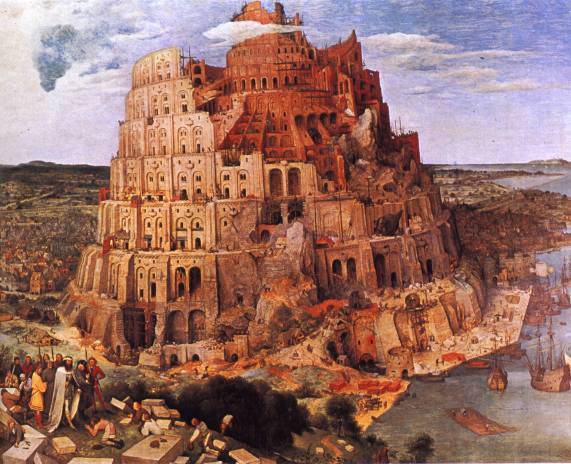
Don't try to build another Tower of Babel. Our ancestors had tried once, and the attempt was failed. If the physical tower failed, could we succeed in building a mental Tower of Babel? I doubt it strongly. Constructing the Semantic Web is not to build a Tower of Babel. It is to simulate our modern human society. It is impossible to achieve "Semantic Google." But Semantic Web will still be available. At the day, however, there are no noble seats reserved for an oracle-announcer Google.
For readers who like to know more about this vision of web evolution, the Part 2 of the web evolution article is an old but coherent version of the view. A newer version is in this blog, the series of "A View of Web Evolution." (Follow the tag web evolution and you can get it.) Any comments are far more than welcomed.
Trackback:
Saravanan's post: Beat Google!
(updated Dec. 21, 2007)
 Google enters deeper and deeper into the realm of Microsoft. Yesterday at Web 2.0 Expo, Eric Schmidt was interviewed by John Battelle. During the interview, Eric announced a new launched presentation feature for Docs & Spreadsheets. Together with the previously released Google Apps, Google is now right on the track to fight against Microsoft, another great battle since Google versus Yahoo. In common, in both of the battles Google is the challenger.
The battle between Google and Yahoo was thought as a search-engine war; and many current observers watch the coming battle between Google and Microsoft as a word-processing war. These beliefs are, however, nearsighted. In fact, both of the battles are consequences of web evolution. They are about one issue: whether we want to leverage producing new quality resources or to supplement methods of operating old quality resources. Let's take the Google-Yahoo battle as the example to explain this viewpoint. In this battle, Google represented the leveraging of new-quality resources and Yahoo represented the supplementing of old quality resources.
One thing we have to clarify before approaching. The reason that Yahoo lose the battle to Google was not completely due to the PageRank algorithm. The PageRank algorithm had helped Google grow to be Yahoo-scale and it helped Google declare the war to Yahoo. But Yahoo was not defeated by this algorithm. By contrast, it was the rise of Web 2.0 that finally defeated Yahoo and prompted the rise of Google.
Web 2.0 provides a new collaborative solution to operate web resources. Consequently, it demands new quality resources that can further leverage its ability of collaboration. This is the pattern: collaborative methods ---> collaboration-friendly resources ---> more collaboration-friendly resources. Google caught this trend and led the revolution of producing new quality resources, such as GMail, Google Map, Google Earth, Google Apps, etc. These products not only provide old-style services (such as supporting emails or map search), but also enable users to collaboratively customize the services into their own frameworks. As the result, by using these products people produce more new-quality collaboration-friendly resources, which could be hardly produced (and thus used) on the pre-2.0 Web. At the meantime, Yahoo, however, still aimed to facilitate its old production line to prompt the production of old quality (generally collaboration-unfriendly) resources. It is this difference that caused the inevitable decline of Yahoo.
Will the history repeat itself again? Will Microsoft repeat the failure of Yahoo in this new battle? Maybe. This new battle is on the realm of word-processing, but indeed it is again about web evolution. They are about whether we will produce more new quality (Web-2.0 quality) documents or produce more old quality (Web-1.0 quality) documents. Web-2.0 quality documents can be easily shared, edited, and collaboratively edited on the web, as Google is projecting. Web-1.0 quality documents, however, are continuing being edited offline primarily. Though we may augment these Web-1.0 documents with the ability of online sharing, as Microsoft is proposing, collaborative editing is certainly more difficult to be implemented if the developers still want to preserve its fundamental functions on the offline side. Since Microsoft has already invested so much on its Office product and been succeeded so far, it is really difficult for Microsoft to start over again in another path that directly competes to one of its most successful and profitable products. As a result, Google will win the battle again.
But there is a problem Google needs to be aware. In yesterday's San Francisco Chronicle, Dan Fost wrote another article about this interview. In the article, there was an interesting paragraph.
The main problem with the Google approach, as Forrester Research analyst Josh Bernoff pointed out just before the speech, is "if you're on an airplane or anywhere else where you have no connection, it doesn't work. They need to make it like Outlook, where you can compose offline and then when you get online, it syncs up."

 Online or offline, is it a critical issue? In fact, several others have already pointed out: after some point of time, there will be no offline unless someone particularly wants to be. Though apparently at this moment we still may encounter the offline problem, it is indeed not a critical issue for a long term.



 visits since Oct. 1, 2006.


 English to Chinese BETA
 English to French
 English to German
 English to Italian
 English to Japanese BETA
 English to Korean BETA
 English to Russian BETA
  English to Spanish