
Programming The Universe, Part Two
Equivalence between Information, Mass, and Energy
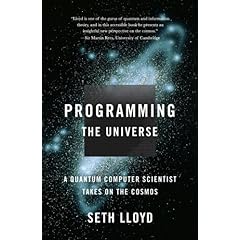
The central theme of the book is that "all physical systems register and process information." In the other words, information is "a fundamental physical quantity" in the world as well as several other fundamental physical quantities such as energy and mass. If it is true, from the claim we may draw several interesting conclusions.
For long time and especially after the industrial revolution from 18th to 19th century, we have customized to the thought that energy drives the world while mass dominates product. Energy and mass are the two most fundamental physical quantities in the world. A representative abstraction of this belief is in Einstein's famous question---E=mc².
In his book, Seth, however, implicitly challenged this belief by showing the fundamental of information. Based on Seth's claim, we may derive a controversial point: there is equivalence between not only mass and energy, but also mass and information. We may perform physical transformation from one of them to another in quantity. Like that we have been able to perform the transformation between energy and mass through nuclear fission and fusion, quantum computing may eventually be the bridge of transformation between information and mass. Hence quantum computing is not just an advanced computational mechanism. Instead it might be a new sort of power that we have never thought before.
Why is the second law of thermodynamics true
At the same time, this potential equivalence among mass, energy, and information may also explain a long-lasting question: why the second law of thermodynamics is a truth. For long time, scientists have accepted the truth of this law but continuously questioned why. It is intuitively strange that when the total amount of mass and energy is constant, something called "entropy" generally increases. In the other words, entropy must be neither energy nor mass, or otherwise its existence has already violated the first law of thermodynamics. By Seth's statement, we may draw that "entropy" is indeed information.
When the total amount of mass and energy keeps constant, indeed the mass and energy unstoppably compute themselves. Although this type of universal computation in nature would never result in more mass or energy production in quantity, it generally produces new information about the progress of computation itself. This increase of total amount of information is thus the, or at least part of the, secret of entropy that is mysterious to us.
Then we have drawn two outcomes from Seth's theory. First, transformation between information and mass (or between information and energy) exists. Second, the total amount of information ever increases in contrast to that the total amount of mass and energy keeps constant. If the two outcomes are hold simultaneously, we may conclude that the mass/energy occupation per information unit (or per bit of information) is ever decreasing. In the other words, in average a bit of information holds less and less amount of energy or mass with the progress of time (or in average a certain amount of mass or energy registers more and more bits of information with the progress of time). Note that this conclusion is actually very intuitive since with time we have to use more bits to describe the ever-increasing history of a substance. Such a phenomenon, however, may have explained why it is much more difficult to make conversion from information to mass/energy than from mass/energy to information.
Energy, Mass, and Information Production
Another interesting derivation is about the relation between production and the three basic natural elements. In tradition, we have learned that energy is the driving power of production and mass is both of the sources of production and the consequence of production. In essence, a production process conducted by humans consumes substance in the form of energy to produce substance in the form of mass. Energy is consumed (in fact, the total quantity of energy never reduces while the amount workable energy decreases, i.e., the entropy increases) and mass is produced (the total quantity of mass indeed never grows while the variety of mass increases, i.e., again, the entropy increases). However, information brings a new relationship to production.
In contrast to energy or mass, Seth's research discovered that information computes by itself. It means that essentially information production could be energy free when its output does not involve mass/energy production. Entropy increase does not necessarily require energy consumption. By this mean, information industry may demand consuming much less energy than we are at present on the stage of mass production industry, if only we may figure out the right way of computation (such as possibly the right process of quantum computation). This derivation could be very significant for the progress of economy into the future.
Reconciliation of Materialism and Idealism
For long time, there is intensive debate between the correctness of materialism and idealism. When materialism insists that the only thing that can be truly proven to exist is matter, idealism advocates that thought or mind is more essential than physical matter. While in history idealism once was dominating in human society, materialism has generally dominated the modern society especially after the industrial revolution with the rise of modern science. The new discoveries stated by Seth, however, bring more thinking about the two objects and the evidences seemly point to that the two contradictory philosophical viewpoints may actually be reconciled just like the wave-particle duality.
Information and Spacetime
By rephrasing John Wheeler's statement that "Matter tells space how to curve, and space tells matter where to go," Seth formulated that "Information tells space how to curve; and space tells information where to go." Although Seth formed this statement to prompt his research of quantum logic gates, it is quite interesting to me how it may be applied to the research of World Wide Web.
In fact, the Web is a space where information is stored, shared, and communicated. Meanwhile, the time on the Web may eludes in a different rate from what it does in the real world. Hence World Wide Web indeed constitutes special spacetime that is varied to the spacetime we are living in real life. Moreover, on the Web we may construct not just another one spacetime. We can actually build many different spacetime by various perspectives. By this sense, the statement made by Seth becomes extremely illuminating on how we may build proper Web spaces for the evolution of World Wide Web.
Complexity of computation
Ever-lasting computation inevitably leads to greater complexity in the computational space. This is the last conclusion Seth presented in his book.
In the book, Seth tried to explain the emergence of life through natural computation. Nevertheless do I disagree to his example, I am indeed very much keen to his claim that complexity is an inevitable consequence of ever-lasting computation.
In my study of Web evolution, I have actually stated that the ever-increasing production of Web resources will inevitably lead to the emergence of higher quality Web resource, which is the signal of stage transition on Web evolution. In fact, higher quality Web resources always refer to more complex in both of its external presentation and its internal essence. In the other words, higher quality Web resources has greater complexity than their lower quality siblings. This is a fact in all the evolutionary progresses.
In similar to the natural universe we are living, World Wide Web by design is another self-organizing computational spacetime. Therefore, the conclusion drawn by Seth can be well applied to the Web. On the Web we must gradually have new-generation resources in more and more complex ways. From another angle, it shows the integrity of my study of Web evolution.
A careless thought in Seth's book
At last, I want to point out a careless thought in Seth's remarkable book.
In the book, Seth has made a great analogy that the computational universe is actually closer to that a few monkeys are randomly typing to a great computer than typing to a typewriter. The difference is that if the universe is a computer, what monkeys type become programming instructions since computers can compute truth through these instructions. Otherwise if the universe is just a typewriter, what monkeys type must be the truth itself since typewriters cannot compute.
The previous model has very well explained the essence of quantum computing in universe. It, however, leaves a grand question, i.e., where does the rendition of the universal instructions come from at the first place if the universe is a computer instead of a typewriter? The only explanation must be that there exists the God who has designed the universal instruction systems just like we humans have designed the instruction interpretation mechanism in our computers. The universal computation may not even be able to get started from the Big Bang if the certain universal instruction rendering mechanism does not exist.
The previous thought, however, seemly contradicts to Seth's belief of natural evolution of human life. To me, this implicit self-contradiction is probably the only flaw of the book. It reflects the struggle of a human being between his integral scientific judgment and his emotional religion expectation.
Referenced resources:
- Programming The Universe, Part One (Thinking Space)
- Programming The Universe (Amazon)
- Web Space (Thinking Space)
- Web Evolution (Thinking Space)

 visits since Oct. 1, 2006.


 English to Chinese BETA
 English to French
 English to German
 English to Italian
 English to Japanese BETA
 English to Korean BETA
 English to Russian BETA
  English to Spanish