Showing posts with label web evolution. Show all posts

Monday, August 08, 2011

Computing, a new public utility of the 21st century, Part 2

From the economic, the web evolutionary, the societal, and the technological perspectives, the computing as a utility has already begun.

This is the part 2 of a three-installment mini-series.

Part 1: a broad view of public utilities

Part 2: another thinking of the mobile web and the apps


The rise of the mobile web and the prevalence of the mobile apps combine to be the most significant phenomenon about the Web since the hype of Web 2.0. Based on a recent report from TheNextWeb, 31% of the 5 billion mobile phone users in 2010 accessed the web through their phones. The analysts predicted that in as early as 2014 the total number of global mobile Internet users would be equal to the total number of desktop Internet users. According to the data by Business Insider in March, from June 2009 to March 2001 the number of iPhone apps increased 7 times and reached the total number of 350K. During the same time period the number of apps on Android increased 50 times and reached beyond the total number of 250K.

What does this phenomenon represent? Among the many people have explained it based on four typical perspectives.

Economically the mobile web rises due to the economic need. Fred Wilson declared that "the mobile economics will trend toward Web economics". The mobile web business is what the Web business extends itself to the mobile phones for the convenience of the customers. Although cautiously I disagree to Wilson's corollary that "the business models that don't work well on the web will not work well in mobile in the long run", sincerely I am inclined to his prediction that the size of the mobile web business will be "even bigger and more exciting" than the desktop web business we have experienced.

Evolutionarily the Internet demands new types of links to grow. Chris Anderson and Michael Wolff claimed that the rise of the mobile web was one indicator to "the Web is dead". "The rise of machine-to-machine communications", Anderson wrote, "... is all about control." Web 2.0 brings the Web users closer to each other. The mobile web, by contrast, brings the users' computing closer to the respective service computing providers. Through the mobile apps the direct links between the service providers and the service consumers are established and enhanced. With these new strong connections the Internet was woven to be more diverse in the style of its links.

Societally we are able to get to the more delicate details of our society through the mobile apps. Ed Schipul emphasized that the mobile web equaled to a new way of communication in his public presentation "Mobile Web: How the impact of the iPhone will change Communications". Through the mobile web, the unspeakable living context is added to the social networks. The mobile web is a natural extension of Web 2.0 that is dedicated to the discovery and enhancement of the interpersonal relationships in our society.

Technologically it is a new gadget revolution that makes us live better. The prevalence of the mobile apps has updated the vision from software as a service (SaaS) to mobile as a platform. The quick adoption of iOS and Android indicates us a new era of information technology. They are not another operating system. They represent a technological revolution that liberates us from the sole binding to the computers for knowledge calculation.

Behind the four explanations it is the shift of computing from the local computers to the cloud as an utility.

Because of the computing as an utility, we are able to invent the new, less-powerful gadgets such as the smart phones to handle the more and more sophisticated demands of information calculation. This is the technological impact.

Because the new information-computing gadgets are smaller and less powerful, which means cheaper, more users are actively involved into the tide of information creation. More delicate details of our social life are digitized by the small gadgets. This information is then sent to the more powerful cloud and executed by the utility. This is the societal impact.

Because the demands are generated by the gadgets while the solutions are provided by the utility, the Internet is evolving toward an enhanced web whose new links directly connect the demands and the solutions. This is the web evolutionary impact.

And at last, because of all of the above computing becomes more efficient and more effective by the form of being an utility. In consequence we can use it to produce more output that satisfies our economic needs. This is the economic impact.

The cloud computing at present is still on its very early stage. Let it alone the computing as a utility in its ultimate form. But as we discussed in this post, the process of computing to be a utility is already inevitable by the mean of technology, by the mean of societal influence, by the mean of web evolution, and by the mean of economy. It is only a matter of when in contrast to a matter of whether or not.

Summary

In the first installment of the series we studied that in theory computing is eligible to be a utility. In the second installment we discussed how the process of computing being a utility had already begun. In the next installment we will then share how the world and our life would be after the computing as a utility comes true.

Monday, June 27, 2011

About the Rise of the Knowledge Market

Due to the personal schedule I seldom blogged technologically in the recent months. Today, however, an article from Forbes caught my attention and pushed me to blog again. The title of the article is The Rise of the Knowledge Market. The topic represents a very important phenomenon in our modern society. In fact, I believe it is indeed the soul of the ongoing information revolution, which is the greatest event in human society since the industry revolution. The information revolution is fundamentally reconstructing our life in nearly all the levels and all of the aspects.

More than two years ago, for Internet Evolution I wrote an article titled User Generated Content, Revisited. In the article I pointed out a fundamental problem inside the model of Web 2.0---to the content creators UGC (User Generated Content) is about fame generation in contrast to the exchangeable value creation. The success of implementing the social network explained why Web 2.0 rises. The failure of bringing up a system of the individual valuation would be, however, the cause to the sunset of Web 2.0. The next day in Thinking Space, I thus coined the term UGA (User Generated Asset) and emphasized that the Web evolution urged us upgrading UGC production to be UGA production. With such a transition, the Web will evolve from a social playground to be a social marketplace in which people sell and purchase knowledge (more precisely, it shall be some type of the embodied knowledge) from each other. When we come to the Web, we no longer just browse or socialize through the Web. We use the Web building up our mind asset and trading it on the Web.

Apple's App Store is a great example of UGA production. When the developers create a third-party App and sell it through the App Store, Apple actually provides these developers a way of embodying their knowledge and selling the embodiment through the platform it designs. The success of Apple and its App Store has demonstrated us the power of the UGA business.

But the model of App Store is not even close to the ultimate vision of the UGA production. Right now one must first of all be a professional software developer so that he can take the advantage of this UGA business. Otherwise, the UGA business is simply an illusion no matter how creative a thinker he is or how compelling his mind truly may be. The model must be improved and simplified! By doing so successfully, a tremendous power of production will be released from people and a new golden time of the global business comes. Without a question the world will then be out of the recession.

Another related recent news is J.K. Rowling's decision that she will sell her electronic books directly to the readers but bypassing all the publishers. Although J.K. Rowling is likely too famous to be a typical example for the discussion of the UGA business, this decision is a sign showing the broken of the traditional knowledge trading business models, gradually but indefinitely. In tradition one have to be VERY much knowledgeable in order to earn the eligibility of entering the knowledge market. With the evolution of the Web, however, such a barrier is loosening and eventually it is going to be torn down.

As Jennifer said in her Forbes article, one may start to trade his limited knowledge as long as their is a buyer. The reason? The advancement of the Web has significantly lowered the cost of embodying human's knowledge and making it exchangeable.

This is the trend for the new-generation Web business! And this is where the Web is evolving toward at present.

Friday, March 04, 2011

The Art of Immersion, the magic of storytelling

Life is storytelling. Or let's say it alternatively---writing a story is constructing a life. On the Web we tell stories, our own stories. Some of them are professional, some of them are personal. What in the stories are the lives embodied. These stories altogether constitute the Web. By the constitution the Web becomes us and we are immersed into it since it is indeed our lives. The ways of utilizing the storytelling is therefore the art of immersion.

I just finished reading a new 20ll book authored by Frank Rose, a writer and contributing editor at Wired. The title of the book is The Art of Immersion. The book is well written with solid and rich content. I am afraid, however, that the content is so rich and the theme is so profound that the author has not fully disclosed the potential of the topic in spite of the over 300-page length of the book. Nevertheless, I highly recommend the book to whoever is interested in learning how the Web has fundamentally revised our society. In particular, how may we start thinking of the art side of the Web? Make ourselves be immersed and become part of the Web in contrast to being the gods of the Web.

Story

What is a story? In the Prologue Rose wrote, "Stories are recognizable patterns, and in those patterns we find meaning. We use stories to make sense of our world and to share that understanding with others. They are the signal within the noise."

This description of stories is insightful. To a Web researcher such as myself, the term "recognizable pattern" has a few unique interpretations. For example, a recognizable pattern often means a well-defined semantics that machines can identify. Following this interpretation, a story is a meaningful arrangement of data that machines may logically render. Therefore, may we say that the ultimate goal of the Semantic Web is indeed to have data presented in stories? Data without story is a string of digits; but data within a story becomes a reusable product. Isn't the Semantic Web to assign every piece of data a context of story so that we (and machines) can speak of it with emotion? By the way, have I mentioned emotion? What the hell is that?

Storytelling

Through the art of immersion, we can use WWW to drill down as deeply as we like about anything we care. Many Semantic Web people are enthusiastic about the creative consumption of the linked data. I am wondering, however, whether such a linked-data initiative is an art of storytelling indeed. Linked data by themselves are boring. But to speak of them into various stories is fascinating. To me, this is probably the ultimate meaning of the Semantic Web.

But there is another point. Through the storytelling what do we really look for? There is a difference between to explore the characters and to explore the stories. The characters are us, or more precisely the embodied ourselves. The stories are the embodied thoughts and behaviors of us. The difference is as the following. If the storytelling is about to explore the deeper inside of each of us, the data must be annotated in the sense of subjectiveness. On the contrary, the data shall be annotated in the sense of objectiveness when the storytelling is about to explore the objective extent of each of us. This delicate difference is an often neglected point in the exercises of the Semantic Web.

If life is true and art is construct, is a virtual world such as the Web a truth or an illusion? This is a tough question. To me, a virtual world such as the Web is about experience. In particular, it is about the embodied human experience. When we are immersed in the Web, we do not simply put ourselves into a fiction, but into an embodied fiction. A fiction is not real. But it is surreal to have embodied fictions, such as the Disneyland. The Web is a surreal existence that is the embodiment of the countless storytelling.

The wonder of being immersed (and embodied)

In the book Rose frequently referred to an example that is the success of the produce of Mad Men, an AMC's Emmy and Golden Globe-winning series. There is a question. Who shall control a story such as the story of Mad Men---the story writer or the fans?

Accompanied the rise of Web 2.0, there is the crisis of the authorship of the story writers. The prevalence of the social networks makes the communication between the authors and the audience become in dual ways. The storytelling is no longer a single direction activity from the author to the audience. By contrast, more and more audience have participated into the storytelling that is imitated by any author, especially the popular and well-known authors. (Am I doing an editing of the story told by Frank Rose right now?) Especially to the fictions, the audience are revising the characters the author created. The ownership of the characters is no longer solely belong to the author, but to the public collectively. The author creates the characters and the situation they find themselves in. The audience, however, complete the drawing of the characters within the scenario. This is one consequence Web 2.0 has brought to us. Its impact into our society is deeper than we ever have imagined.

But even just this effect has other deeper meaning. If we are embodied in the Web and the embodiment of ourselves is not totally controlled by each of the individuals, the Web actually reveals a deeper resemble of our society, which is beyond we could have thought of before.

How much value and how much reality to be a fictional character online after we are immersed? This is another grand question. The answer to this question could be the motivation to Web 3.0, the next generation of the Web.

Back to the real life

"Life is a constantly functioning information exchange." Rose wrote in the book.

The statement is profound. It tells that a virtual life must also be a constantly functioning information exchange. That is, the Web composed by the virtual lives shall primarily be the aggregation of services in contrast to the ontological layout of concepts. It matches what I foretold the Semantic Web must not be realized until it would be more than a web of data.

In the book, Rose described a four-piece composition of storytelling in the real life. A successful storytelling shall consist of the narrative (one who tells story), the conceptual (one who creates the theme), the stylist (one who decorates the story), and the systemic (one thinker who constructs and directs the distribution of the story). According to the author, the last component is brand new to us due to the emergence of Web 2.0. Moreover, the nature of online distribution is the "serendipitous discovery on a global scale". Unless we start to learn more about this new pattern of storytelling, it will be difficult to lead to the next true leap forward in the Web evolution.

What a deep-thought book it is!

Wednesday, February 23, 2011

How much will a domain name be worth in the next decade?

This summary is not available. Please click here to view the post.

Sunday, February 06, 2011

Free from Being Controlled

In his book Weaving the Web, Tim Berners-Lee argued:

Philosophically, if the Web was to be a universal resource, it had to be able to grow in an unlimited way. Technically, if there was any centralized point of control, it would rapidly become a bottleneck that restricted the Web's growth, and the Web would never scale up. Its being "out of control" was very important.

It is a great insight and Web evolution proves it. At the beginning, we had lots of the so-called web portals such as Yahoo, AOL, and MSN. Unless through them the regular users would hardly get to the Web. Very quickly these portals became the bottleneck of Web evolution and thus they were faded. The Web does not need entry points to be entered.

Then we had the second-generation Web portals---social portals such as Facebook, LinkedIn, and Twitter. In similar, gradually they become the bottleneck of Web evolution for they are dragging a type of general public resources, which is supposed to be free, to their private interest. Therefore, a new type of barriers has been constructed to block the expansion of the Web. To the end, the social Web does not need entry points to be entered either.

There is always a difference between what need to be controlled and what must be free by the nature. The reason of the fallen of the Web portal business model was not that the portals were evil or nobody wanted to get to it (actually until today Yahoo.com is still one of the most popular Web sites according to the number of visitors daily). It was due to that the portals wanted to hold a type of free public resources, i.e. the right of free accessing to the public knowledge, and took benefit from it indefinitely. Such a greedy intention is conflict to the evolution of World Wide Web.

The social portals will fall by the same reason. The right of free accessing to the friends and their thoughts is by nature a type of free public resources that must not be controlled. No one can take benefit from such a type of control indefinitely. It is, again, conflict to the evolution of World Wide Web.

Friday, February 04, 2011

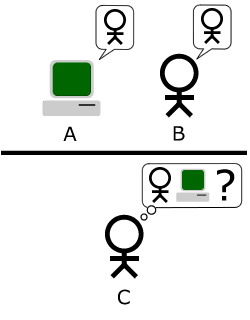
Turing Test and Web Evolution

Machines may have will, but it is not free will.

In 1950, Alan Turing challenged if machines could ever deceive a human judge from being identified non-human by answering questions indistinct to the real human responses. This proposed experiment is now well-known as the Turing Test, an essential concept in the philosophy of artificial intelligence. Now computer scientists generally agree that the Turing Test in a single standalone computer is likely unfeasible. With the rise of World Wide Web, however, people quickly revise the question by asking whether the collectivity of all computers in the world may eventually pass the Turing Test. May a network of computers do the trick? Or, a little bit more dramatically, may one day WWW evolve to be the Skynet?

To pass the Turing Test machines need to prove they may answer questions by free will, a unique character of the living creatures especially humans. In definition, free will is the putative ability of making choices discarding constraints. Constraints generally exist in any situation. The trick of free will is that independent to any other agent's prediction the agent may determine whether or not his decision is bound to any of the constraints. Free will means the ability of breaking rules with no limit and warning. Then a question follows: may we be able to assign this ability to the machines (discarding whether we will if we can)?

Here is my thought to the answer. If we continue building the computers based on the current computer architecture and programming them using the current type of the programming languages, there is no hope of inventing machine free will no matter of the standalone intelligence or the collective intelligence. The reason? The computer architecture and the programming languages themselves have already settled a set of rigid logic constraints. The machines built upon the architecture and programmed by the languages will not work correctly unless obeying these constraints. Please be aware that working incorrectly due to the technology problem is not a free will. Therefore, no true free will can be realized. In theory, we can always develop a set of questions that can cause trouble by the rigid set of logic to distinguish a machine from the real humans.

Now let's retreat half a step. May the machines have will despite it is not free? I believe, however, that the Web evolution is approaching this goal.

Recently in Wired Magazine, there is an article titled "Algorithms Take Control of Wall Street". In it the authors shared how the robots hired by the Wall Street traders instead of the traders themselves are controlling the stock prices. This scenario is a classic example on how the machines start having will, which is programmed by their human masters. In the article the authors also mentioned how some tragical events had happened due to the machines' will, which, the authors argued, was not really humans' expectation or intention. I think the authors may have underestimated the greedy nature of human beings. Behind the numerous rules there sits a word called "greed". Any single rule must be fair. The overall is, however, the consolidation of the greed. So it was not that the machines suddenly fell into greediness by their free will, the tragedies were nothing but the revealing of the overall greed in Wall Street. "There be no beasts." (quoted from Lois Lowry's Gathering Blue)

With the evolution the Web starts embodying the wills of not only the Wall Street traders but also many of us as the regular Web users. For example, the Google robots silently execute your will every time you press the search button. The Web starts being filled with the embodied wills and the machines claimed the ownership. That machines have will is already a fact.

With will, the machines now can do something fantastic. Also with will, the machines someday may do something horrible than we could imagine. The Wall Street tragedies mentioned by the Wired Magazine article are warnings. There is no any single rule that is particularly evil. It is the overall of all the rules/wills (established by the humans but) executed by the machines that causes the problem. If overall all of us are with good, positive intention, the embodiment of our wills overall will only lead our society and our world to becoming better and better. On the contrary, the tragedies will be inevitable. A little bit "harmless" greed by each of us can be accumulated by the machines that claim the embodied wills to become a great evil overall. Which future and which type of the Web we want it to be? The decision is in the hand of everyone of us. Now!

To the end, let's remember it. Machines may have will, but it is not free will. The future is in the hands of the free-thinking people, who are you and me. Let everyone of us uses the Web with good intention and thus the Web will be good to us. Otherwise, the tragedies will not just happen in the Wall Street.

Wednesday, January 12, 2011

Another Timeline of World Wide Web

1969, the first two nodes of ARPANET were connected
[egg meets sperm]

1985, the first commercial Internet domain name (.com) was registered
[the baby in the tummy was ready to be born]

1989, nodes (hyptertext) and links (hyperlink) of World Wide Web were invented by Tim Berners-Lee, the physical Web came to the world
[the birth]

1994, Netscape Navigator was released
[the grand baby shower, the new-born was well received!]

1995, Yahoo was incorporated
[the mutual communication between the baby and us started]

2000, Google started running search for Yahoo
[baby grew and owned self characters; no longer did we tag her only, she sorted herself]

2003, Apple opened iTune Store, which eventually led to App Store in 2008
[we began to be part of the baby, which had been a small kid then]

2006, Facebook opened to everyone of ages 13 and older with a valid email address
[the small kid started walking around where we were her feet]

20??, what is the next?

Comment

It took 20 years for the Web to get birth from its very beginning. It then took another 20 years for the baby to be able to walk. What an amazing history! But the truly intriguing questions is, however, what the next big step is!

A few explanation about the timeline I share.

(1969) Any web was started by linking the first two nodes.

(1985) When people started to ask the first commercial domain name, the concept of World Wide Web had already been mature.

(1989) Of course, a real birth must demand the completion of the physical body; TBL accomplished the quest.

(1994) With Netscape an ordinary Tom got to touch the mysterious World Wide Web first time in his life, physically. What a wonderful creature it was!

(1995) Netscape allowed the Web came to us; Yahoo, on the other hand, let us talk to the Web.

(2000) The Web had formed its own ecosystem. Then it was the number of links, instead of the category of pages, that mattered more, Stupid!

(2003) We needed to enter the new ecosystem ourselves! And we did.

(2006) Inside the ecosystem we started tasting our second life; and the Web travels when we travel.

(20??) Can you make a sentence by following this trend? Please try it. Maybe you ARE the next great inventor in this line!

Tuesday, January 11, 2011

Data, Mind, A Web of ?

The advance of technology should always make us smarter.

Data and a web of data

When it is related to computing, data is information in a form suitable for use with a computer.

Data owns many merits. Data is honest, objective, and long-lasting. Data is convenient to be connected, shared, copied, manipulated, consumed, transported, bought, and sold. And in general data is inexpensive to be created and stored.

But data is also with some weaknesses. Data does not think. Data cannot interpret itself. Data could be confusing. Data is easy to be abused. And after all data does not produce. Data is consumable goods like grains or coal in contrast to tools such as lathe or electric generator. Data is for the Wall Street traders and retail salesmen to trade in contrast to for the manufacturers to produce.

What is going to be if the Web truly becomes a web of data, or more precisely a web of linked data? It will be a paradise for salesmen and Wall Street traders. The Web becomes a super supermarket. Wonderful! Bravo! Done. A new age of mankind arrives ...

But wait! Is there anything wrong? Imagine a society where the salesmen and traders dominate everything but the producers and manufacturers are second-class, may the society be sustainable? Oh, maybe it is the United States now.

Mind and a web of mind

Mind is the aspect of intellect and consciousness experienced as combinations of thought, perception, memory, emotion, will, and imagination, including all unconscious cognitive processes. This definition is too long. In a short version, a mind is how a human interprets the world, and his result interpretation. In the sense of computing, mind is the methods/procedures for manufacturing data, and the manufactured output.

Mind also has a few merits. Mind is creative, genuine, active, and exciting. Mind flows by itself. Mind produces. A mind never stops interact with the other minds. Mind grows. Mind is alive.

Despite of all the merits, mind has terrible weaknesses too. Mind is subjective. Mind could be selfish or with unspeakable bad intention. Mind could be deceived. It is more difficult to share or connect minds because they could own their own identity that claim to be uncompromisable.

A web of mind is like a world of factories. Everybody debates, competes, and even fights each other. Such a world is like a mess such as a troubled third-world country you can imagine.

Contrast

But there is a very interesting discovery if we compare the two very different Webs more carefully. In the world of the data web, humans are outsiders, observers, or at most the communicators to the world. Or let's speak the fact in another way, humans are not part of the world though they do business with the world. On the contrary, in the world of the mind web, humans are part of the world because it is THEIR mind and it is THEM who fight each other on such web in contrast to through such web. We are becoming part of the Web.

Such a distinction is crucial since the goal of our Web development must not be teaching computers to think and make them smarter and smarter. By contrast, the right and indeed ever-lasting goal for any of the human creation must be to make us, human beings, be smarter and smarter over time. We should be using computers to help humans think and create value instead of the opposite. When we are part of the Web, we become smarter when the Web gets smarter. When we are outside of the Web, we tend to be more stupid when the Web gets smarter. Only if we can correct our intention of Web development to the right track, the eventual enthusiasm of the general public will be invoked into this, possibly great ever, achievement of all mankind.

We need data and we need mind. The future of World Wide Web demands the both, simultaneously and being balanced.

In the last year, I witnessed the final death (corrected by the founder, it was in hibernation instead of being given up) of an early-born baby that donated itself to the mind Web. It is sad but the hopes remains. Myself have learned many lessons for this attempt, and I am certain the founders must have learned more. However, I am fully confident that it is still the correct path forward. The next footstep after Netscape, Yahoo, Google, Apple, and Facebook will be on this path. Human and human mind being the driving force in (instead of "to") the Web is the next great invention about the Web.

Monday, January 10, 2011

Apple and a Mutant of Web it Creates

Holding an Apple product such as an iPhone or an iPad has been a fashion, let it alone the usefulness of the devices themselves. I am not a fashion speaker. However, what has driven me very excited about Apple is a mutant of the Web Apple creates. Intentionally or subconsciously Apple makes us a web backed by a different thinking. Due to the company's great success in business the thinking has already invaded into the mind of many of us though few might have noticed it. In this post I share my viewpoint about this Apple-created mutant and its relation to the eastern style of thinking we discussed in the last post.

The Web invented by Sir Tim Berners-Lee was conducted by a classic western style of thinking. The Web was composed of many nodes where each node represents a molecular object. Then there are hyperlinks connecting these nodes arbitrarily. In general every node of the Web has a name (typically a page title) while the hyperlinks are anonymous. This distinction is both essential and crucial. With name a thing declares its tangible intent and identity. Without a name, on the contrary, the intent of a thing is intangible. Therefore, by this design the Web is a world of objects/data and their categorization---the typical western style thinking. The initial Yahoo search was based exactly on this thinking in order to disclose the complete hierarchical structure of the Web, and in the first few years of the Web age the attempt succeeded more or less.

The fallen of Yahoo search and the rise of Google search was a remarkable event in the history of Web evolution. Besides all the other meanings, it tells that the Web had evolved by itself and broken the initial foundation upon the western style of thinking. Google's success showed that it was links instead of categories of the pages that mattered more when sorting the Web. The ones without name were more essential than the ones with name when we explored the topological structure of the Web. If only we think of this discovery once more, isn't the message itself shocking enough?

Then there was Apple.

Unlike Google who sorts and organizes the Web, Apple simply wants to use the Web. Unfortunately, like many other Web-based companies in the beginning Apple might have found that the Web was not very friendly for being consumed. Information on the Web is highly tangled and the traditional thinking of knowledge categorization is too slow to untangle the mess. Unlike an academic research institute, a company cannot wait since money never sleeps! So Steve thought of a solution.

At old days the ancient Chinese had faced the same problem but about the real world. Unlike the more idealistic ancient Greek who were enthusiastic in exploring the world knowledge bottom-up from the foundation, the ancient Chinese were more materialistic (or more practice-oriented; and until now they still are indeed). The ancient Chinese chose a middle-out way to explore the world. Neglecting object categorization and even logic, the ancient Chinese chose the methods of practice be the solution. Once one might have grasped a method of practice, he could apply the method universally to solve the other similar problems in the world. This is a core of the ancient Chinese philosophy. Note that when the "similar" in Chinese's mind is quite different from the "similar" in a westerner's mind. The westerners normally assume "similarity" within a common domain/category while the easterners (especially the ancient Chinese) generally do not have this hypothesis. Due to the difference it is not uncommon for a Chinese character being assigned multiple varied meanings in different (could even be mutually excluded) domains, and it is not unusual to find a Chinese character but with the absolute opposite meaning by simply being assigned a varied context. This type of word interpretation is rare in the western languages such as English, which generally pursue the preciseness and uniqueness on term definition. By focusing on grasping and utilizing the methods of resolutions in contrast to understanding the essence of the causes of problems, the ancient Chinese advanced the civilization faster than the western competitors in the early ages of human society. Apple adopted a similar solution as the ancient Chinese did.

Apple conducted a web of methods. Apple created a space so that people could implement their methods of consuming the Web and publish them. In contrast to selling information, Apple sells information-consuming methods. After buying an App, the users can decide how to use the method and which resources to be consumed. Through the AppStore, Apple creates a mutant of the Web in which the Apps (methods) are the main threads where objects are context.

Apple's methodology brings the company tremendous success in business. Have Apple added more regulation to the Web? Hardly any. Unlike the Semantic Web project, Apple's approach does little help for the Web to become a better organized place. But like what ancient Chinese did, through this methodology Apple gives the layman users the greatest freedom of utilizing their knowledge. In the ancient Greek society, knowledge was only on the hand of the intellects because it was studied in such an academic way. Comparatively people without much knowledge could learn a method and then applied it in their own life through their own human creativity by nature in the ancient Chinese society. It was an important reason that ancient China grew faster than the civilization in the western society. Now Apple cloned the similar methodology in its business.

Summary

Without the western style of thinking, we would not have invented World Wide Web. It was the objects and the links that constructed the skeleton and made the Web live. After the Web became alive, however, it is a much more complicated creature than a hierarchical category. Like the real world from which it is imaged, very quickly the virtual world is tangled. It is hopeless to untangle the mess from bottom-up or from top-down within short time of period. In order to facilitate the usage of the Web at this stage we need to borrow ideas from the eastern philosophies. At last, however, we still need the methodology in the western philosophy to finally solve the mess and invent the real science of the Web. It is like that eventually the long-lasting fundamental study in the western society made fruits from which we had the modern science and engineering. By contrast, the ancient Chinese civilization stopped growing eventually due to its lack of the fundamental study of the nature. It was the human history; and it will be the Web history.

Monday, January 03, 2011

The Geography of Thought and the Web

During the last Christmas break, I finished a book titled The Geography of Thought. The subtitle of the book says "How Asians and Westerners Think Differently ... and Why," which well describes its theme. The book is interesting and informative despite the author often repeats the same thought here or there in book. One Amazon book reviewer called it "Interesting, but could have been so much better" and I am very much leaning towards the comment. The idea presented by the book is deserved to be thought again and again hundreds of times.

The book itself is worth of being recommended. But my interest of this post is on how the thought difference caused by the geography may have affected the construction of the Web and how it may continue to impact the Web evolution.

A phrase in the book that caught me is "Is the World Made Up of Nouns or Verbs?" In the eye of a computer scientist, this is neither a philosophical nor a linguistic question but a concrete question of engineering. To see it, allow me substitute only one word in the former question---Is the Web Made Up of Nouns or Verbs? The Web is an image of our world, isn't it?

In the book, Richard Nisbett (author) argued that the westerners tend to think of the world based on the distinction of objects. One object is certainly not another object. Wood is certainly not table. Airplane is certainly not iron. The world is made up by objects and it is a network of objects. Isn't the thought natural to us? Surely it is, especially to most of the Thinking Space readers I believe (since most of you are westerners).

On the other hand, Nisbett argued that the easterners actually think of the world differently. According to the easterners, the world is a tangled place of substances. One cannot even really name an object until he has comprehensively recognized all the substances that not only compose the object but also compose the context of the object, such as its position and the interaction with the adjacent substances. One cannot immediately judge a wood being not a table without context. This is somehow odd to the western style of thinking because westerners can hardly image a situation where a name indeed means nothing until the context of the name must have been well established. In the other words, it is a world that extent suppresses intent.

Unlike the westerners who generally believe objects (in its sense of abstraction) being the fundamental building blocks of the world, for long time the easterners perceive relations being the true construction blocks of the world. The westerners think a noun holding its uniqueness regardless of the application, while the easterners think of a noun indeed with few uniqueness until we recognize its application environment. The easterners think verbs being unique since they describe the ways of tangling while nouns are the things happen to be tangled.

I was born and grown up in China where I was very deeply influenced by the classic eastern philosophies. Then I came to United States continuing my graduate study and work. Till now I have lived in the western society continuously for more than 12 years. Hence I feel myself be eligible to say that Nisbett truly has done a very good job on recognizing a key difference between the eastern and western societies.

From my childhood I am very much interested in and eventually become very familiar to the eastern style of thinking. Later it becomes both a blessing and a curse on me. My classic eastern style thinking allows me to untangle very complicated events that few others can do. On the other hand it often pulls me to situations over-complicated. This contradiction has annoyed me for long time. The book helps understand my own problem better and leads me to some potential solutions as well.

Now let's turn to World Wide Web. As we all know, the Web is designed by and primarily developed in the western society. Therefore, without surprising the Web today is a product of the western style of thinking. Due to this type of thinking the Web today is composed of nouns/objects, no matter whether we view it as a Net, a Web, or a Graph. World Wide Web is a network of objects. Nevertheless, the Semantic Web community, a primary W3C achievement, claims the future of the Web to be more and more a web of data. It means a network of more fine-grained nouns.

Despite of the success of the Web so far, a question is, however, that whether the western style of thinking is the only way that may lead the Web forward. Or, more importantly, will the Web continuously evolve only in the track of this style of thinking? Will it eventually be a bottleneck if we do not start to think of another route for Web evolution?

A problem already starts to emerge. The Semantic Web as a web of data (or a web of objects) is progressed slower than expected, especially when we compare it to the other industry-lead movements such as Web 2.0. The Web seems reluctantly deeper into the realm as a network of nouns. At the same time, the Web becomes more and more active when "services" spread.

Compared to data, a service is closer to be a verb on the Web. Phrases such as "google the term", "amazon the price", "ebay the item" point out that the verbs we created on the Web are very well received by the public. Unlike what Semantic Web perceiving the future of the Web to be a network of more fine-grained nouns, the Web 2.0 movement demonstrates that the Web demands more verbs than nouns in growing. Don't the verbs tell us anything?

We may need to take the eastern style of thinking to think of the Web. But, how? I will continue this topic in the next post in which I discuss how we may learn from the way Apple thinks of the Web.

Monday, November 23, 2009

Is Murdoch mad?

A recent news told that News Corp. was going to work with Microsoft/Bing to take down Google, which Jeff Jarvis named it Murdoch madness. Jeff is a great journalist, researcher, and thinker. His recent book What Would Google Do? is very much thoughtful and I am reading it now. Despite all the respect I am to Jeff, however, I tend to think of this issue in a different way. I fully understand Jeff's passion, especially his being an enthusiastic Google-advocate. On the other hand, my own theory of Web evolution makes me think of the issue in another angle.

Repeatedly I have mentioned, a major problem of Web 2.0 is the lack of production in exchangeable value. Web 2.0 surely has engaged lots of people. But it does not have a general answer on how we may convert the human engagement to value that is exchangeable and consumable. The advertisement business model is a solution to the no-solution. Such a business model is insufficient in representing the recent achievement in Web technology. Some real breakthrough is expected.

Murdoch is trying to figure out a solution. What I agree to him is that the value of the knowledge of professional journalists surely must be greater than zero. It thus means their work is worth of being paid, probably even being worth of being decently paid. How to make a balance between the value of profession and the call for the free knowledge, this is a great challenge to all of us. I would rather not fully agree to Murdoch's action in specific. But I certainly understand his action and partially support the action under the condition that he must have had a smart execution plan.

We need to create user-generated asset instead of the straightforward user-generated content only. This is my argument and it is also Murdoch's intention. Although I also feel that the action itself seems a little bit too trivial, this News Corp./Microsoft deal likely has started a new page in the history of the Web. Web content with creative thoughts is a type of asset that is worth of being paid.


Recently I received several comments and emails encouraging me to continue blogging. I sincerely appreciate these messages. I, however, am very busy in a personal issue in these two months. Hence I have to say sorry to my readers. But I will come back regular blogging in the beginning of the next year. Thanks all who love this blog and look forward to your continuous support.

Saturday, October 24, 2009

Big Switch

Nicholas Carr is one of my favorite technology authors. His blog is always worth of reading. His book could only be better.

In Big Switch, Nicholas Carr expressed a key point: computing is turning into a new type of utility, which will bring the world the change as great as what the prevalence of electricity had done to us.

The claim is bald. But it is reasonable after carefully thinking of it. As well as electricity breaks the barrier of energy deliverance, the modern Web-based computing is breaking the barrier of information transmission. As I expressed in my book review for Programming the Universe, information along with mass and energy is another fundamental element that constitutes the universe. We thus may categorize the invention of modern Web-based computing along with the invention of electricity and the invention of wheel being the top three greatest inventions that fundamentally evolve our society.

The invention of wheel breaks the barrier of mass transportation; the invention of electricity breaks the barrier of energy deliverance; and the invention of modern Web-based computing breaks the barrier of information transmission. This path is the big switch we talk about.

Our human society began with consuming natural product, which is made of mass. Hence the primary demand from the beginning was to transport mass more efficiently. The invention of wheel overcame the gravity obstacle that in nature mass is to us. In consequence, the invention allowed humans to transport heavy-weight product in long distance and therefore we were able to live close to each other in which was away from where natural product grew. The invention of wheel enabled the formation of human society and its early evolving.

Natural product soon became insufficient due to the increased human population. We must produce man-made product to keep on the growth of the society. Energy forges mass to new product of mass, which is essential to human production. The problem of energy consumption emerged.

For long time, energy could not be delivered except of in the form of mass. We had to transport things such as wood and coal instead of delivering the directly useable energy in distance. The problem became extreme severe in the industrial revolution. Suddenly the demand to energy consumption was over what the regular local providers could support in general. The cost of energy deliverance soon became the bottleneck to the further growth of human society.

The invention of electricity overcame the distance obstacle that in nature energy is to us. Unlike mass, energy indeed does not have to occupy space; the gravity obstacle thus was not natural to energy. The distance obstacle does apply, however, because normally where energy is generated is varied from where energy is consumed. Electricity allowed energy being delivered in long distance at low cost by avoiding transporting them in the form of mass.

The further evolution of human society demands more improvement in the rate of production. The importance of information in production gradually became a major issue. Energy forges new product of mass, but it is information that guides how energy can be effectively used to forge the product of mass. The faster information can be spread, the more rapid information can be computed and analyzed, the better product rate we can achieve. After resolving the gravity obstacle and the distance obstacle of man-made production in general, the next major obstacle to overcome is the time obstacle. The modern Web-based computing is the solution.

Unlike mass and energy, information does not have the distance obstacle. Even if we have to physically deliver books, a mass product that records information, it is still not a problem at all if we compare it to the transportation of mass or energy in form of mass. The real problem of information transmission is time. Humans need to learn information, think of information, understand information, and then finally apply information. The process takes time. And time does matter critically in production. This problem became crucial after the general problems of mass transportation and energy deliverance had been conquered.

The modern Web-based computing constructs an environment that information can rapidly shared and computed before somebody consumes it. It significantly shortens the time needed for information learning, information understanding. Many times, we can directly jump to the stage of information application by skipping the previous stages of information consumption. Therefore, it overcomes the time obstacle in production.

Wheel --- mass --- the gravity obstacle
Electricity --- energy --- the distance obstacle
Modern Web-based computing --- information --- the time obstacle

This is the big switch we are experiencing at this moment.

Nicolas Carr’s book describes more details of what were truly happening in the last switch. The book is knowledgeable and I recommend it to whoever is interested in the future of our human society evolution.

Saturday, August 29, 2009

Core Interest

Interest is something with the power of attracting or holding one's attention. When one claims a thing being his core interest, however, he scarifies everything else to protect his holding of the thing of interest.

Dai Pingguo (Chinese: 戴秉国), a State Councilor of China, talked about the core interests of China in the recent US-China Strategic Economic Dialogue. He stressed that China’s core interests were "safeguarding its basic systems and national security, maintaining its sovereignty and territorial integrity as well as ensuring its sustained economic and social development." I will not comment on this statement. But let's think of what Hillary Clinton might have said if she had had to address the same question. What would have happen if she had said that the core interests of United States being security, territorial integrity, and economic growth?

Core interest is different from the most urgent issue to be solved.

Now let's think of another question. Were World Wide Web a nation, what would be its core interests? In the other words, what are the decisive reasons that drive the Web evolution?

I have a very short list in the following, and you may comment on your own opinions.

(1) A healthy environment of growing up that any new Web node may be popular by a definite period of time and by a definite amount of effort.

This is essential to the evolution of the Web. If the Web is solely a place where the rich gets richer, it can hardly evolve. There must be ways of balancing. It is not only because people want to be social that social networking becomes such a critical technology in the Web. The Web itself demands the technology for its evolution. The technology of social networking allows any newly produced Web resource (distinctive to the humans who produce the Web resource) to grow up being popular in definite period of time. It thus fosters the healthy growth of the Web.

The same philosophy is beneath the other key technologies in the current Web such as Web search and Web syndication. In the other words, the Web always demand the invention of new technologies that helps the growing popular of newly produced Web resources. Or we may interpret it in another way. If a company wants to abuse the technologies to formulate a pure rich gets richer pattern in the Web, it will fail in definite time of period as well.

(2) A fair environment of competition that the unpopular resources have chances of being popped up without the prerequisite of having been popular.

Believe it or not, unpopular represents creativity and innovation. The Web needs to foster the technologies that allow people to access the unpopular resources that may be kept unpopular forever.

This is a crucial topic especially to the society of Semantic Web or the community of linked data. A well linked web of data does not means the every piece of data in it is weighted evenly or can be accessed equally. When we request a semantics, some time we expect to get the most popular resources of the semantics and some other times we do not. More importantly, don't we need to add a layer of the innovative potential over all the linked resources so that it may facilitate the access to the innovative but unpopular mind?

Tuesday, August 18, 2009

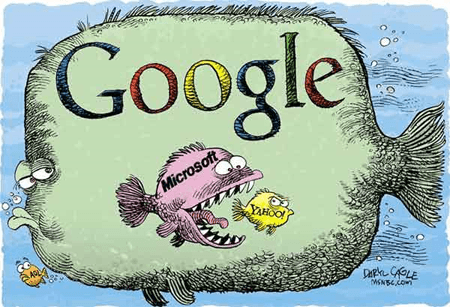
The Microsoft-Yahoo Deal, Part 3 (the chapter of Google)

In part 1 and part 2 respectively we analyzed what the deal may bring to Yahoo and Microsoft. Yahoo sells the weapon it uses in a lost battle (to the "don't be evil" enemy) by a price (not cheap) to Microsoft, which dreams of reopening the search engine war to against the same enemy based on the gained "scale" the deal assigns. In this post we thus discuss the "don't be evil" buddy---Google.


Should Google be afraid of the "scale" Microsoft pursues and is likely to gain by the deal?

By the first glimpse, Google should. Microsoft will obtain a decent increase in "scale" because of the deal. The combined MicroHoo (Bing) search engine will host 3 out of every 10 Web searches comparing to Google's 6 out of 10. This new figure may persuade the online advertisers investing more on optimizing the results returned by Bing. Google needs to be worried of this trend, doesn't it?

On the other hand, however, Google should feel released. Microsoft has chosen the Google way when coming to the battlefield. Microsoft could have invented revolutionary new business model about Web search by utilizing its superior desktop operating system; but it did not. By contrast, Microsoft looks for fighting in muscle on capital and manpower.

Microsoft has proved successful records in defeating powerful opponents. For example, to defeat Lotus Microsoft utilized its asymmetric advantage on synchronizing the upgrade of the office software with the upgrade of the mainstream operating system (Windows, a Microsoft product). It was impossible for Lotus to catch up the pace. The continuous improvement of the desktop office software demanded heavily on the OS support or otherwise the implementation would be very expensive. With Microsoft's dominating the desktop OS, Lotus simply had no chance to win.

In another example, Microsoft defeated Netscape in the first round of the browser war. This time, however, it was Netscape that made the first mistake by having overlooked the effect of Web evolution. In the late 90s, by still being excited of its success in the first tide of World Wide Web Netscape failed to recognize the fact that the sustainable Web evolution demanded Web browsers to be free. That Web evolution could be sustained is critical to the healthy growth of all the Web companies, including Netscape, even until now. When Netscape finally realized the problem, there was few time left for it to figure out an alternate business model; and apparently Netscape did not accomplish the goal anyway. At the meantime, in his book The Road Ahead Bill Gates foresaw the future of the Web to be the "information highway". The model suggested that free information transportation through the "highway" (i.e. free Web browsing) with the charged information hosting at every exit of the "highway" (i.e. non-free software, especially the operating system, for hosting the information to be transported). Guided by this view, Microsoft started a journey on heavily investing in developing the next stage desktop operating system that well supported the network communication while at the same time it built a high-quality but free Web browser (Internet Explorer) to satisfy the visionary picture. Although history tells us that Gates did not indeed interpret the Web evolution entirely right, the vision at the meantime was superior enough to defeat Netscape. More importantly, Netscape had no way resisting Microsoft's attack because (1) it did not have the experience on developing the cutting edge operating systems, and (2) it could not figure out the real trend of Web evolution better than the vision of Gates.

Both the examples show us that Microsoft won the critical battles because it had creatively utilized its most powerful weapon---Windows operating system. Otherwise, it would be much more difficult, if ever possible, for Microsoft to defeat the powerful top dogs continuously in one and another very much profitable business sector. (In the other words, a legend never is a miracle but a creative work.) In the coming new battle, however, the first time we see Windows playing no role! My question thus is, how would Microsoft be possible to win the battle against a top dog in a very much profitable business sector, again, by without utilizing its most powerful weapon into the battlefield? The gained "scale" actually will do nothing but lead Microsoft deeper and deeper into the racing track Google invents. Since the battle is inevitable anyway, Google must have felt released on to be competed in this way.

Google's new opportunity

Not totally, but I agree to Jeff Jarvis in his Guardian column that "... Microsoft picked the wrong fight" (I tend to disagree on the Yahoo part because I believe Yahoo is the winner of the deal). In the other words, Google is getting a great opportunity to take and consolidate the leading position in the world of information technology because of the mistake Microsoft made.

As I have repeatedly argued, the key is to discover the correct path of Web evolution. No single company, even if it is as great as Microsoft or Google, could resist or detour the flow of Web evolution. History proves that only the ones that follow the Web evolution may succeed or even survive because Web evolution essentially is the aggregated will of all mankind.

Web evolution demands a revolutionary new operating system to distribute the Web resources. This is what Microsoft misses and Google apparently senses. Moreover, Web evolution demands that the end users would benefit from this switch through building up their own mind asset, or even to build up themselves. Web search is only a temporary solution to the demand fitting the current stage of the evolution. It is far less than the eventual resolution. Pitifully, Microsoft, as the dominant giant of desktop operating system, still does not understand this point.

Apparently, however, Google seems get the point. The attempt of creating the Chrome OS is not as simple as competing Microsoft, as many analysts told. It is indeed to move forward to the next stage of Web resource distribution, the stage beyond what Web search may provide.

In conclusion, when Microsoft's main attention has been distracted by this MicroHoo deal and the Bing search engine, Google is getting an extremely precious opportunity to truly lead the world of IT into a new era. This is thus what the deal brings to Google.

Monday, June 15, 2009

The Internet, a bordered or borderless world?

I have just finished reading Who controls the Internet?: Illusions of a Borderless World written by Jack Goldsmith and Tim Wu. The book addresses a serious question---does the evolution of the Internet make itself be more bordered or more borderless a world? The authors then answered it by leading the readers' attention to a traditionally overlooked side of the Internet, i.e., the physical coercion by the local governments to the Web resource producers. The book is very well written and I recommend it to not only the ordinary readers who are curious on how the Internet grows, but also the entrepreneurs who plan to start up a Web company.

"... physcial coercion by government---the hallmark of a traditional legal system---remains far more important than anyone expected." This is the central point of the book.

The Internet, more precisely the World Wide Web, is not a self-governing society. Without the coercive power by all kinds of the local authorities at the invisible (or watchable) back, the seemly self-organizing Web may actually not sustain any longer. Anybody, especially the Web businessperson, who misses the point will eventually pay for the misconception.

When I was starting to think of the evolutionary model of the Web, I envisioned the Web being an actively growing extension of our real society in contrast to a passively progressive product of human beings. By this mean, the Web naturally must have inherited all the major factors in our real human society instead of being a counter force to fundamentally rebuild the world. The revolution brought by the Web is primarily on how the real world is extended to the virtual worlds. With the virtual extensions, we humans could duplicate the existence of selves in arbitrarily many times and thus might multiply the production of the individuals indefinitely. In spite of the revolution, the Web only gradually evolves in contrast to substantially rewrites the basic structure of human society.

We will continuously live in the bordered world into the foreseeable future of the Web age.

Friday, April 24, 2009

From GeoCities to MySpace, another side of Web Evolution

Recently, there are two news, seemly unrelated but actually told a common story, that have been buzzed over the Web. The first is that Yahoo is shutting GeoCities down. The second is that MySpace is in trouble, if not dead yet. The two news show us the progress of Web evolution on another side.

GeoCities and MySpace are nearly identical to each other according to Web evolution. In fact, MySpace is GeoCities 2.0. GeoCities offered the Web-1.0 generation a free place to set up their homespaces in Web 1.0 as well as MySpace offered the Web-2.0 generation a free place to set up their homespaces in Web 2.0. Despite the superficial difference between the two sites such as their graphic layouts and embedded services, they share a common mission and march on the Web in the identical way. The role GeoCities played in Web 1.0 is exactly the role MySpace plays in Web 2.0. The rise of either of the sites represented the rise of a particular stage of the Web (respectively Web 1.0 and Web 2.0), while the decaying of the sites represented the sunset of the respective stages.

As how GeoCities decays, the problem of MySpace is the same. GeoCities has never figured out a way to enter a new age, especially after it was acquired by Yahoo. Yahoo had proved itself a resistant of Web 2.0 for long time. In similar, MySpace is lost in Web 2.0. After it is acquired by the News Corp., the future of MySpace becomes dim. It is unquestionable that the leaders of News Corp. know how to make money. What these executives do not know is, however, that to a cutting-edge Web service, losing the ability of continuously evolving on the Web equals to be dead. A dead service certainly can make money no longer no matter how superior it is managed. History, again, shows us how repeatable it is disregarding the "smartness" of human beings. We cannot be against to the objective laws! And this is why the research of Web evolution is truly valuable.

Sunday, March 22, 2009

"Every true history is contemporary history"

"Every true history," said Benedetto Croce, "is contemporary history."

Croce is an idealist philosopher who scorned the materialist theorists like Karl Marx and Friedrich Hegel. Normally, the materialists attempt to reduce history to a few objective principles; hence not only that history has one unique truth, but also that we may look into the future of the history by tracing the path of the truth. By contrast, the idealists such as Croce and Rousseau believe that history is a series of lies. The written history is thus whatever we CHOOSE to be the closest to the truth.

Basically, my view of history is materialist. In fact, my model of Web evolution is grounded on the assumption that there exist objective laws guiding the growth of World Wide Web.

On the other hand, however, I agree to Croce's famous quote, especially when we look at it in another angle. When Croce said every true history is contemporary history, I would rather assume his emphasis was that history truly repeated itself. Moreover, any contemporary history is nothing but a repeated cycle that has happened before. This is indeed another implicit thought behind my model of Web evolution. In the model, I have analogized the evolution of the Web to the growth of mind of human beings. Web evolution is a piece of contemporary history, while the growth of mind of human beings is something that happened before (and now also of course). There is indeed nothing really new under the sun with respect to history.

Friday, March 13, 2009

World Wide Web, 20 years

20th20 years, it is just a short time period in history. But when we look it back, it is hard for us to imagine how we lived 20 years ago without all the convenience we have now. This last 20 years is one of the most revolutionary 20-year periods (if not the most revolutionary period) in human history. Numerous influential innovations and remarkable events occurred during the period just because of one meanwhile-insignificant invention---World Wide Web.

Happy anniversary, Web!


World Wide Web was born in a computer in somewhere Europe. However, someone predicts it to become a "big machine" again in the future.

WWW has others names. By the inventor, WWW may also be called III (International Information Infrastructure) or GGG (Giant Global Graph). Probably you may get a few inspiration out of these alternatives.

World Wide Web may also been watched differently. It is a network of computers, a platform of computation, a society of communication, and a factory of information production. Moreover, it will be a market of mind asset.

World Wide Web is growing, evolving, advancing. When it evolves, growing are also our intrinsic selves. It is not only that we are upgrading the Web; the Web is changing us.

Friday, February 06, 2009

From UGC to UGA, and the limitation of Web 2.0


Yesterday, at ThinkerNet I posted "User Generated Content (UGC), Revisited", which led to interesting and constructive discussion. More or less, all of the discussion pointed to a broader issue implicitly mentioned by the original post, i.e., the limitation of Web 2.0.

To really understand it, however, we may need to review a few of the basics of economy. How is capital generated? When we say that our hard work produces capital, what does it mean? Is capital freely convertible to certain amount of labor and vice versa, or there is something more in the formula?

Capital generation demands labor. No new capital could be generated without labor. But labor only is not sufficient to produce capital. For example, throwing bottles to strangers is a labor, but hardly can it produce capital. To make the labor result be capital, the labor work must produce things that are exchangeable. The internal value of a product is measured by the amount of labor to produce the product; its true commercial value (i.e. the product as a piece of capital or asset) is, however, eventually determined by the degree of exchangeability of the product in the market. The commercial value of a nonexchangeable product is close to zero no matter how much the internal value of the product is.

By this mean, we have capital flow. Things that cannot exchange cannot flow; things that are hard to exchange are hard to flow; and so on. Exchange causes capital flow, and capital flow generates the wealth in our society. When a type of economy can consistently produce wealth to the society, it is a sustainable business model; otherwise it is not.

The essential UGC-based Web 2.0 business model is not sustainable because it does not produce enough exchangeable product. This is the limitation of Web 2.0.

In the post, I revisited a few fundamentals of UGC. From the study, I found that UGC primarily produces attention. Nevertheless does attention contain value, it is not a highly exchangeable product. The connection/attention generated by Web 2.0 help capital exchange rather than itself being capital. Therefore, the businesses built upon this model can hardly walk in a long journey into the future. We need to invent new models to build the real user-generated asset (UGA), or probably we may call it the exchangeable mind asset. By doing so, we will enter a new age of the Web---Web 3.0.

There is one more argument that is interesting. People used to say that nobody would like to pay to read a blog or a message. This is true. But there is actually one more sentence which should follow the previous one. That nobody is willing to pay is because Web 2.0 itself has not really produced anything that is worth of being purchased! Again, it tells the main limitation of Web 2.0.

There are many things we are willing to buy using money. For example, gold, a TV set, or even a pencil. Why do you want to buy them? They have internal value, AND they have exchangeable value, which makes them be asset more or less. Web 2.0, on the other hand, is poor on converting human's knowledge to be exchangeable capital/asset, despite it does help exchange capital in the other forms. This distinction tells the strength as well as the weakness of Web 2.0.

Anyway, from UGC to UGA is not trivial. It demands a great deal of ability of innovation to accomplish the request. But, at least, now we know where we should approach, don't we?

Wednesday, February 04, 2009

Evolution, a topic uneasy

February 12th of this year is the 200th birthday of Charles Darwin, one of the greatest biologists and philosophers in history. Darwin left us one of the most magnificent (and debated) treasure of human mind --- the theory of biological evolution.

It is ironic. I do not believe the biological evolution from one species to another. I believe God creation. At the same time, however, I concord on the theory of natural selection that the form (but not the DNA) of the species must evolve with the change of the environment (or the other external reasons). But such an evolution could not cause the emergence of any new species.

My proposed model of World Wide Web evolution is a reflection of this viewpoint of evolution. By default the Web evolution model exclaims the existence of the creators on the Web (such as the Web researchers) who take the responsibility to invent new types of Web resources whenever there is an accumulated qualitative transition. The innovated new types of Web resources could emerge only by creation instead of by evolution. After the creators have invented a new type of Web resources, the Web automatically evolves through the quantitative accumulation of the Web resources and demands the next invention when the amount of accumulation reaches threshold. Therefore, a main issue of Web evolution is to study the subtle and sophisticated relations between the creation and the evolution on the Web. Darwin, on the other hand, disclaimed the existence of creation in his theory.

An issue that is asynchronous to Darwin's model of evolution is the Second Law of Thermodynamics, which claims that any isolated system cannot move towards a higher degree of order without the interruption of the external forces. The Darwinian scholars explains it by saying that the biological system we witness is an open instead of isolated system. The problem is, however, that even an open system may not automatically reach a higher degree of order unless there is an intentional external force added upon the system. A room may keep neat because there is someone clean it up intentionally; water may flow from low to higher place because there is a pump intentionally pull it up; and so on. Mathematically and statistically, we know that without intentional design the entire accumulated external forces to a system generally still makes the system move to a state of greater entropy (i.e., lower degree of order). Then there is the question, who does maintain the "intention"? The Darwinian biological evolution could occur only if existing a great "intentional" (and also natural and automatic) external force that itself has to last at least hundreds of centuries and maintains unchanged. I have to say that the faith (instead of the so-called "scientific evidence") needed to believe this Darwinian evolution is absolutely no less than the faith to believe in God creation.

But, Darwin's theory of evolution is still, indeed, a great contribution to mankind.

From one side, it totally discloses the sinful nature of human beings. Without God, our human society is exactly what Darwin observed---a society of natural selection. Only the stronger deserves of surviving while the weaker should, would, and need to be eliminated. By this theory, many truly "unnatural" behaviors such as race termination become "scientific" and "natural" because these people say that it is due to natural selection. Because of this theory, to help the weak strangers becomes a virtue instead of a responsibility of human being. Because of this theory, we are self-excused from many of our evil behaviors since they are nothing but some natural inheritance from our animal ancestors. It is unsurprising that Darwin's theory is so much welcomed. A theory that excuses our sin by costing us nothing cannot be unpopular.

On the other hand, Darwin's theory is a true summary of our present real world. We are in a Darwinian world and many of the rules in this world obeys Darwin's theory. Hence, Darwin's theory is scientific, I agree.