Showing posts with label Microsoft. Show all posts

Tuesday, August 18, 2009

The Microsoft-Yahoo Deal, Part 3 (the chapter of Google)

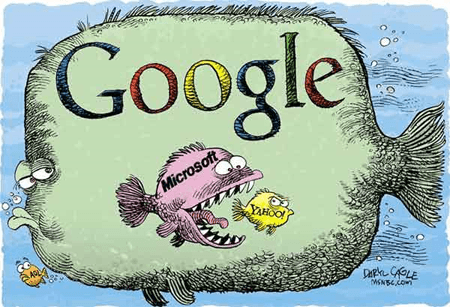
In part 1 and part 2 respectively we analyzed what the deal may bring to Yahoo and Microsoft. Yahoo sells the weapon it uses in a lost battle (to the "don't be evil" enemy) by a price (not cheap) to Microsoft, which dreams of reopening the search engine war to against the same enemy based on the gained "scale" the deal assigns. In this post we thus discuss the "don't be evil" buddy---Google.


Should Google be afraid of the "scale" Microsoft pursues and is likely to gain by the deal?

By the first glimpse, Google should. Microsoft will obtain a decent increase in "scale" because of the deal. The combined MicroHoo (Bing) search engine will host 3 out of every 10 Web searches comparing to Google's 6 out of 10. This new figure may persuade the online advertisers investing more on optimizing the results returned by Bing. Google needs to be worried of this trend, doesn't it?

On the other hand, however, Google should feel released. Microsoft has chosen the Google way when coming to the battlefield. Microsoft could have invented revolutionary new business model about Web search by utilizing its superior desktop operating system; but it did not. By contrast, Microsoft looks for fighting in muscle on capital and manpower.

Microsoft has proved successful records in defeating powerful opponents. For example, to defeat Lotus Microsoft utilized its asymmetric advantage on synchronizing the upgrade of the office software with the upgrade of the mainstream operating system (Windows, a Microsoft product). It was impossible for Lotus to catch up the pace. The continuous improvement of the desktop office software demanded heavily on the OS support or otherwise the implementation would be very expensive. With Microsoft's dominating the desktop OS, Lotus simply had no chance to win.

In another example, Microsoft defeated Netscape in the first round of the browser war. This time, however, it was Netscape that made the first mistake by having overlooked the effect of Web evolution. In the late 90s, by still being excited of its success in the first tide of World Wide Web Netscape failed to recognize the fact that the sustainable Web evolution demanded Web browsers to be free. That Web evolution could be sustained is critical to the healthy growth of all the Web companies, including Netscape, even until now. When Netscape finally realized the problem, there was few time left for it to figure out an alternate business model; and apparently Netscape did not accomplish the goal anyway. At the meantime, in his book The Road Ahead Bill Gates foresaw the future of the Web to be the "information highway". The model suggested that free information transportation through the "highway" (i.e. free Web browsing) with the charged information hosting at every exit of the "highway" (i.e. non-free software, especially the operating system, for hosting the information to be transported). Guided by this view, Microsoft started a journey on heavily investing in developing the next stage desktop operating system that well supported the network communication while at the same time it built a high-quality but free Web browser (Internet Explorer) to satisfy the visionary picture. Although history tells us that Gates did not indeed interpret the Web evolution entirely right, the vision at the meantime was superior enough to defeat Netscape. More importantly, Netscape had no way resisting Microsoft's attack because (1) it did not have the experience on developing the cutting edge operating systems, and (2) it could not figure out the real trend of Web evolution better than the vision of Gates.

Both the examples show us that Microsoft won the critical battles because it had creatively utilized its most powerful weapon---Windows operating system. Otherwise, it would be much more difficult, if ever possible, for Microsoft to defeat the powerful top dogs continuously in one and another very much profitable business sector. (In the other words, a legend never is a miracle but a creative work.) In the coming new battle, however, the first time we see Windows playing no role! My question thus is, how would Microsoft be possible to win the battle against a top dog in a very much profitable business sector, again, by without utilizing its most powerful weapon into the battlefield? The gained "scale" actually will do nothing but lead Microsoft deeper and deeper into the racing track Google invents. Since the battle is inevitable anyway, Google must have felt released on to be competed in this way.

Google's new opportunity

Not totally, but I agree to Jeff Jarvis in his Guardian column that "... Microsoft picked the wrong fight" (I tend to disagree on the Yahoo part because I believe Yahoo is the winner of the deal). In the other words, Google is getting a great opportunity to take and consolidate the leading position in the world of information technology because of the mistake Microsoft made.

As I have repeatedly argued, the key is to discover the correct path of Web evolution. No single company, even if it is as great as Microsoft or Google, could resist or detour the flow of Web evolution. History proves that only the ones that follow the Web evolution may succeed or even survive because Web evolution essentially is the aggregated will of all mankind.

Web evolution demands a revolutionary new operating system to distribute the Web resources. This is what Microsoft misses and Google apparently senses. Moreover, Web evolution demands that the end users would benefit from this switch through building up their own mind asset, or even to build up themselves. Web search is only a temporary solution to the demand fitting the current stage of the evolution. It is far less than the eventual resolution. Pitifully, Microsoft, as the dominant giant of desktop operating system, still does not understand this point.

Apparently, however, Google seems get the point. The attempt of creating the Chrome OS is not as simple as competing Microsoft, as many analysts told. It is indeed to move forward to the next stage of Web resource distribution, the stage beyond what Web search may provide.

In conclusion, when Microsoft's main attention has been distracted by this MicroHoo deal and the Bing search engine, Google is getting an extremely precious opportunity to truly lead the world of IT into a new era. This is thus what the deal brings to Google.
Friday, August 07, 2009

The Microsoft-Yahoo deal, Part 2 (the chapter of Microsoft)

The part 1 tells how I believe that the deal actually offers Yahoo a chance to be reborn. In part 2, let's turn to Microsoft, the other side of the deal.

On the contrary to what they think of Yahoo, many analysts gave Microsoft more or less the positive evaluation about the deal. The mainstream opinion is that the deal will give Microsoft "the scale", which the company eagerly looks for but lacks until now, in order to compete Google. In a BoomTown interview by Kara Swisher, Satya Nadella, the SVP of Research and Development at the Online Services Division in Microsoft, confirmed the point. "[Search] is a game of scale," Nadella said.

Nadella is right; so are the many analysts. Web search is a game of scale. The problem is, however, how to approach the scale in contrast to simply purchase to a greater scale. Scale itself is not the panacea. The way of scaling, or how to scale, is really the issue. It is this "how", however, that makes me feel hesitate to congratulate Steve Ballmer enthusiastically.

Microsoft gains scale from the deal. Because of the gained scale, however, Microsoft is likely trapped itself into a Google-directed game. Forgive me repeating myself again. You can never defeat Google by executing in the Google way; even though it is Microsoft. This is the core of the problem.

To express my point better, let's take a look at the issue in two folds.

(1) Let's study how Google is invading the Microsoft territory, in particular MS Office and Windows.

Within their own dominant territory, Microsoft and Google are conceptually exchangeable. It is safe to say as well that "you cannot defeat Microsoft by executing in the Microsoft way." Both Microsoft and Google are the rule designer and the rule maintainer in their own territory. Nobody may seriously threat, let it alone defeat, them in their own field if the challenger is competing in the rules created by these monopolies themselves.

Google understands this point. Hence Google says, "well, let's play the game in some new rules." With this thinking, Google turns the Office software to a set of Web services whose basic and the most frequently used functions are free to the public. The plan is that it may gain a large enough user base by the free services, Google can thus provide the users more sophisticated data processing or analyzing services (which will not be free in either the sense of user subscription or the sense of advertisement augmented) surrounding the user-generated data, which is produced by the free services.

The plan tells that Google has invented an important game-changing point. The behind story is that Google decides to replace the service-oriented monetizing strategy on the Office software (which Microsoft controls) by the new data-oriented monetizing strategy. In the new strategy the service to produce data becomes free, while the services that consume the produced data will NOT be free.

After the initial (still moderate so far) success, Google is continuing the invasion into the deeper core of Microsoft---the Windows operating system. Again, Google realizes that it is impossible to compete Microsoft directly in the rules Microsoft executes. Therefore, Chrome OS is a very different operating system. It likely will not support operating many of the desktop-oriented tasks. In exchange, Google pays nearly the entire attention to improve and facilitate the way of utilizing the Web resource consumption from any arbitrary terminal. By providing the users a free operating system that can access and consume the Web, what Google plans is to grasp the control of directing and managing the flow and distribution of the Web resources to the end users. Once (or if) Google reaches the goal, we may not even imagine at present how great the new market will be. This is, again, a game-changing policy.

Google proves its creativity in competing against Microsoft. It competes but not follows the rules Microsoft controls. Now we may understand better why Microsoft is doing wrong (or at least not as good as Google).

By publishing Bing and dealing with Yahoo, Microsoft plays like a game chaser instead of a game changer. Yes, there are tactical inventions within Bing. By studying the Bing architecture from 5000 feet high, however, we find that Microsoft has indeed invented nothing but to copy the success of Google search in insignificantly different ways. Microsoft, or the combined MicroHoo, search is certain to generate a few buzz. But to defeat Google, or even to battle a significant decent share out of the mouth of Google, it will be unlikely.

(2) Let's study again the "scale".

Scale does not equal to make profit, at least it does not necessarily be immediate to generate revenue. Twitter is a typical example. Despite we do not deny the potential of the service, in reality it has taken the Twitter investors long time to look for a proper business model, and they are still seeking.

Certainly, however, Web search is a much more mature field. Microsoft believes that it has already fully understand how to monetize Web search as long as it gains enough size in scale. The method is the business model Google invented and is executing now. Thus by "scale" Microsoft means is to gain a large enough base of the daily visitors to its search engine so that the number could be large enough to ensure decent profit to the advertisers in the Microsoft search platform.

The thought is reasonable and actually has no problem at all if it is thought by anyone else except Microsoft. Pitifully, Microsoft might have forgotten one thing---what Microsoft lacks the least is the scale in terms of the number of users. Microsoft has a product whose user base is greater than any other software product or service, and its name is Windows. In contrast to dealing with Yahoo and then trapped itself into the running track Google trademarked, what Microsoft really needs to do to reach a compelling, Google-scared, scale is to convert its own users instead of to purchase the Yahoo users. By doing so, however, it really requires innovation that Microsoft probably lacks.

Let's take a back look of what Microsoft has done. During the first tide of Web hype (the years prior to the dotcom bubble), Microsoft had seen the business opportunity on user consuming the Web resources. At the mean time Microsoft believed Web browser be the answer. It seems that it was the Web browsers that connected the users to the expected Web resources. By this vision, Microsoft created Internet Explorer.

At the same time, however, the Google founders saw the things differently. (As well as the Yahoo founders, but Jerry Yang's vision was too much ahead of its time, unfortunately.) Larry and Sergey noticed that it was not the browsers that directed the traffic; it should be search engines that are independent to the browsers. The understanding changed the entire game. Soon search engine replaced Web browser becoming the most profitable business model on helping user consuming Web resources.

History repeats. Still the same issue of user consuming Web resources. This time Microsoft believe it finally got the point: search engine matters more than browser. But again, the recognition is too late because the Web does not stop in its origin; the Web evolves forward uninterruptedly. By the passing of Web 2.0, the most glorious time of the traditional Google-style Web search is passing. Ironically, Google itself actually has shown us a little bit hint by announcing the light-weighted Chrome OS, which could be independent to the search engines. Indeed the issue is much more profound than simply Web OS. But I would rather not tell too much in this post since it is distracting.

The main point here is that Microsoft misses the key. The key is not search; the key is to help the Web resources be properly consumed. Or even a step further, to help ... [omitted intentionally] (I bet Google might know what I had not typed here but Microsoft must not.) Search, the same as browse back in 90s, is only a path to the gold mine instead of the gold mine itself. Web evolution is driving us closer and closer to the golden mine itself, by which means that we must always be ready to adjust our strategy whenever a milestone of Web evolution is passing.

To seek for scale is not problem. That Microsoft seeks for the scale in this way is pitiful.

Afterword

In the May 2008, I was invited to be interviewed by the Live Search team along with 27 other PhD students in US and Canada. Before the interview, I had already some thoughts on leveraging the Live Search to compete against Google. In addition to the post I wrote on April 29, I also had produced a private PowerPoint slide that was sent to the Live Search team (which was never discussed ever after, however). In the slides, I briefly introduced the Live Search team a broad picture on why and how Microsoft might win the battle against Google. Now when I look at the slides again, it is still fresh to myself though certainly I could do the slide much better after another year of studying and thinking of the issue.

Unfortunately, after I reached Redmond I found that actually Microsoft was not looking for genuine ideas but to find fresh mind who could help implement their made-already plot (or even to excuse themselves that their plot was the right approach to go for). I did not fit the suit since my thought could not syndicate with theirs.

Until today, however, I still felt regretted of the trip. Microsoft is truly the one that may overtake Google. But it is not in this way as the MicroHoo deal told. Microsoft has overlooked a critical value in itself, which I would rather not share in public. Now with the Yahoo deal, it seems that the last chance is taken away.

The deal grants Yahoo a chance to be reborn. At the same time it seals probably the last chance for Microsoft to defeating Google.

Sunday, March 22, 2009

"only three things on the Internet that have made money"

A recent New York Times Technology article reports an interesting interview with Steve Ballmer, the chief executive of Microsoft. Yet the article does not really address much news that is truly new to us, I am particularly interested in a sentence spoken by Mr. Ballmer.

"There are only three things on the Internet that have made money: Amazon, eBay and Google."

Mr. Ballmer intuitively recognized what I mentioned about Web evolution. There are three basic types of Web resources that are accumulated in the evolution of the Web---data, services, and links. A successful Internet business is the one that can embody one type of human mind to a form of valuable asset on the Web. Coincidentally, I have also used Amazon, eBay, and Google as the examples that have successfully embodied static mind asset (data), dynamic mind asset (service), and connective mind asset (link) respectively. So, I have a few last words to tell Mr. Ballmer: please, the successfulness is not because search leads to money, but due to implementing a successful way of constructing profitable mind asset.

Friday, December 05, 2008

Some quick thoughts on Qi Lu's new appointment

Qi Lu, a former high profile Yahoo, joined Microsoft to help the traditional software giant fighting against the newly rising Google. I have a few quick thoughts of this news in the following. Readers who are interested in learning more of this news can read more reports from TechMeme. In particular, Kara Swisher at BoomTown had a unique interpretation of Ballmer's email.

(1) Congratulation to Qi! Great move, personally. Especially as a Chinese myself, I sincerely wish him the best being a great China-born technology leader.

(2) Will Live Search be reformed under the new leadership and be able to compete to Google? Cautiously, I doubt. Allow me be straight. If Qi has not led a compelling plan to compete Google under the visionary leadership of Jerry Yang, could he accomplish this hard assignment under the practical leadership of Steve Ballmer? Unquestionably Qi is a great Guru in the realm of search engine design and operation. However, it is impossible to defeat Google by following the Google way (i.e. the traditional thinking of Web search). Is the experiences that Microsoft lacks at this moment? I question it. Microsoft does not lack of experiences; and experiences can hardly help Microsoft fight Google. What Microsoft lacks is, ironically, the opposite, i.e., the less-experienced fresh soul of innovation. We have to be realistic that there are not many Steve Jobs in this world. Therefore, though I am pleased of Qi's appointment and believe in Qi's contribution to Live Search, this appointment is less than enough for Microsoft to threat Google.

(3) Microsoft seems having abandoned the plan of purchasing the Yahoo Search. It is good for Microsoft; and it is good for Yahoo. I am still looking forward to the newest experiments of BOSS and Search Monkey Yahoo is performing. The worst thing is that they might become another PowerSet.

Wednesday, July 02, 2008

The Secret behind Powerset Acquisition

So it has been. Finally, Microsoft and PowerSet reached an agreement of acquisition. It is a deal about $100 Million in total. A question is, however, why does Microsoft acquire Powerset?

I have been at Redmond face-to-face talking with a few Microsoft Live Search top engineers two months before. None of them, however, seemed sympathetic to the coming of Semantic Web. At the same time, however, Microsoft people did emphasize that they expected to walk in a different way from Google because Google is too powerful in its research capability to compete. Does this newest acquisition mean Microsoft suddenly changed its mind and decided to compete Google by adopting Semantic Web? I don't think so. In order to discover the secret behind this acquisition, we may need to look at and think of the following coincidental events related to the acquisition.

1) PowerSet went live to the public only at May 12.

Paul Miller thought "$100million seems like a poor return for those Powerset investors" since the investors have "injected their $12.5million way back in 2006." I agree to Paul's argument based on the assumption that Powerset is a novel semantic search engine full of potential. A question is, however, whether the Powerset approach is indeed full of potential despite of its novelty.

The ones who know the best of the answer to the previous question should be the Powerset investors mentioned by Paul. Especially after Powerset has already been public, its long-term potential must have already been thoughtfully studied by the investors. We can be confident that all of these investors are bright and knowledgeable; and moreover, they are not philanthropists. If all of these analysis are sound, there is only one conclusion we can draw---the potential of Powerset is limited.

Until now, the application domain of Powerset is limited to Wikipedia. As other technology analysts also pointed out, the Wikipedia pages are consistent in their format and there are people dedicating to polishing the English writing of many pages. Powerset's self-limitation of its service only to such a special external site indicates the existence of severe technology difficulty in its approach and it is hard to conquer. I, myself, is a Semantic Web researcher (and particularly on semantic annotation). Thus I very much understand the problem encountered.

With all the concerns, unless Microsoft really thinks of taking Semantic Web as its long-term strategy (which, however, might not be a bad idea), this acquisition is questionable to Microsoft's short-term goal. Hence it becomes confusing---is Microsoft really thinking of going long or going short? Or, maybe, Microsoft plans to take both since it just has too much money.

The investors of Powerset are not foolish, and nor should we assume Mr. Ballmer of Microsoft be so. Then what did Mr. Ballmer think when he made the decision of acquisition?

2) This deal came after the break of Microsoft-Yahoo deal.

By looking for acquiring Yahoo, Microsoft was planning to hit Google in the front. After the attempt failed, Microsoft finally decided to attack Google from the back by acquiring Powerset. This is the real story behind the scene.

Microsoft is looking for the market of online advertisement, everybody knows it. The dominator of the market at present is Google. In order to compete Google, the fastest and also the most effective way for Microsoft is to buy the company in the second place of that market, which is Yahoo. But Yahoo defended insistently to Microsoft's acquisition. Should Mr. Ballmer then abandon the plan? No, or otherwise he must not be the Ballmer. Here thus comes the acquisition of Powerset.

3) Yahoo's SearchMonkey opened up for developers at May 15.

I have said that SearchMonkey is Yahoo's strategy to come back. Although I also predicted negative to the full success of this ambitious project (partial success is however believable), Microsoft has no patience to wait for the natural death of it.

The best way to accelerate the death of SearchMonkey is to defeat the plan directly. By acquiring Powerset, Microsoft may launch a competitive Semantic Web service for SearchMonkey. SearchMonkey itself is already too ambitious. By short of volunteered developers all over the world, the date of its failure thus could be counted. At that moment, Microsoft may go back to the table and buy Yahoo in a much cheaper value. The difference would certainly be greater than $100 million.

4) Google declines to bid for acquiring PowerSet.

In the whole story, Google's situation is quite subtle. From one hand, Google certainly does not expect Microsoft to acquire Yahoo. Hence Google would not be willing to see Microsoft acquiring Powerset.

On the other hand, however, Google does not believe in Semantic Web either. Competing price of Powerset with Microsoft is meaningless for Google. The reason is simple. Neither Microsoft nor Google is really interested in Semantic Web. Microsoft buys a Semantic Web company only to attack Google from the back. If Google attends the competition, Microsoft may just raise the bid and let Google win it. Then Microsoft can simply go for another Semantic Web company. Powerset is surely not the only one who does Semantic Web technology! Google has no chance to win this battle unless it buys all of the Semantic Web companies, which is totally nonsense for its lack of interest in Semantic Web.

I have to say that Microsoft's strategy is very brilliant. The strategy directly hits Google and Google has no effective way to fight back. Now the only pity sacrifice is Yahoo again. But probably it may beg Google to save it once more.

In summary, by acquiring Powerset Microsoft has done an excellent move towards the next acquisition of Yahoo and eventually be closer to beat Google. How would Google and Yahoo take this challenge? The story is to be continued ...

Saturday, June 28, 2008

Ahead The Road Ahead

It is now the time to say goodbye to a legendary person who has made our world be different. Bill Gates, founder of Microsoft, left his Redmond office (possibly forever) at Friday, June 27, 2008. I could not help myself picking up an old book written by him---The Road Ahead. What would be the road ahead of what Bill had already accomplished? I would like to ask this question.

Bill is a great visionary. Along with Paul Allen, he imagined a time when computers would be affordable to most of the people and software would do amazing things. From 1970s to early 1980s, such a dream "seemed very crazy." But Bill realized it through Microsoft. When we are now talking about how World Wide Web is bringing human society a great new transition, we must not forget that it is Bill Gates who has made computers be personal. Without the prevalence of PC, there would be no World Wide Web.

What was the road ahead? In his book, Bill told us that he had dreamed of the question "What if computing were nearly free?" Microsoft Windows was his answer. By providing users affordable and easy-to-manipulate operating system, the use of personal computers entered normal people's life. Also in the book, Bill asked the second question, which was his road ahead at the meantime, "What if communicating were almost free?" From the time to now, Microsoft was trying to make itself the leader of the so-called information highway. Unfortunately, however, after more than 10 years we have to say that Microsoft has not been so successful on this goal as it had succeeded in the previous one. An important reason of this failure is the imprecise vision of Internet. Primarily, Internet is an information net in contrast to an information highway system. Due to this confusion of Internet modeling, Microsoft missed the timing of Web 2.0. Google, instead, stole the oppotunity. Now, Gates and Ballmer have to confess that Web search would be the future of the company. This statement finally exclaims that Microsoft no longer seeks for the role of highway patrol but to look for the new role of librarian.

In Bill's two questions, he has particularly emphasized a word---"free". Unquestionably, free is a great feature especially when we would try to engage as many users as possible for a new product. After the product being popular, however, things start to change, especially when the product itself becomes the base of new production lines. The role of Web users is in a transition from mainly as consumer and viewer to be also as producer and publisher. The ones who consume a publisher-oriented Web are information consumers. The ones who consume a viewer-oriented Web are information producers. This important switch of roles appeals a new trend on the Web---"paid" instead of "free".

This switch of roles is actually easy to explain. When you are a consumer, you expect products be free. Once you become a producer, however, you expect your product not to be free. In fact, you expect to make profit out of your knowledge and your hard work. Hence when normal Web users start to realize that they are producers in addition to consumers of information on the Web, they will gradually accept the concept of "paid mind" (not free) on the Web. Web resources thus become mind asset.

Farewell, Bill. You have done excellent work and you will always be remembered as one of the greatest visionaries ever in human history. But there is still much road ahead of the road you have already walked. We will continue the journey and make our world be better and better.

Saturday, June 14, 2008

A Swing between Passion and Reality

Is Yahoo dying? A recent post by Michael Arrington has caused fierce debate among readers. Firm supporters such as Jason Kolb agreed that "Yahoo is now a dead company." Optimistic analysts such as Tim O'Reilly disagreed by accusing Michael to be too narrow-minded to having overemphasized the importance of Web search. I believe, however, that Yang's decision about dealing with Google or Microsoft is his tough swing between passion and reality.

Jerry Yang has his passion that has led him found Yahoo and also keeps him on the position of Chief Yahoo at present. Yahoo's mission statement tells the passion being to connect people to their passions, communities, and the world’s knowledge. This is what Yang wants Yahoo to be and he has done all he could to keep Yahoo on this direction. A very recent action on executing the passion is the announcement of SearchMonkey, the center of Yahoo's newest Y!OS effort. Surely, I have argued whether such a Y!OS effort is realistic enough on the basis of the current status of Web evolution. Unquestionably, however, the dream is beautiful and it is worth of trying.

In comparison, what is the passion of Microsoft? Bloody money. Bill Gates steps down and rumors tell that he would never come back to Microsoft administration again. After the leaving of its visionary founder, Microsoft has become a giant machine of money maker and only a money maker. It may not be a bad news for Microsoft stockholders. But it is a bad news for passionate Web innovators.

The deal with Yahoo and Microsoft would sentence the instant death of Yang's passion for the company from the beginning. It is something intolerable for long-sighted visionary leaders. Yang is willing to be the CEO of Yahoo with $1 annual salary because of his passion. Hence he will never allow the passion being a joke, at least not a joke when he still has the controlling power.

The Google-Yahoo deal is a different contract. By this deal, Yahoo reserves its right to continuously look for its dream (though for limited time period) by formally surrendering to Google on the current Web search market.

There are two critical keywords I emphasized in the previous sentence. The first one is surrendering. Michael Arrington has ceaselessly addressed that the difference between Microsoft-Yahoo deal and the Google-Yahoo deal is only the difference between instance death sentence and suspended death sentence, and he does have overemphasize the term "death" but forgotten the meaning of "suspended". To me, the suspended death sentence means more about "surrender" than about "death". By either "surrender" or "suspended", Yahoo still has its chance to come back. By "instance sentence", however, Yahoo will not have any more chances at all.

The second keyword I want to address is current. As I always advocate and I advocate it once again, the Web is evolving and it evolves faster than many of us think. Google may not be the leader of Web search forever. The SearchMonkey and Y!OS are Yahoo's announced strategy to come back. But Yahoo needs time to execute the strategy. The suspended sentence brought by the Google-Yahoo deal provides the time. Though we don't know whether the length of time might be long enough, at least the passion and dream of Yahoo have survived from the instant death at present.

Is Yang's passion unfair to Yahoo's shareholders, especially to Mr. Carl Icahn? In short term, definitely. In long term, we do not know. As I said before, "capital is near-sighted." The lack of short-term profits can easily kill a long-sighted visionary capitalist without a question. Jerry Yang is current taking this pressure. As a peer thinker, I sincerely wish him the best of his luck to be able to survive from the crudeness of capital.

In summary, Jerry Yang is taking a swing between his passion and the crude reality of capitalism. The swing is currently on the side of passion and Yang has done all he could to protect the dream of Yahoo. Be honest, it is also the dream of any free thinkers on the Web. Let's pray for Yahoo and Yang.

Wednesday, May 21, 2008

Pay you to Live Search, brilliant?

Both TechCrunch and VentureBeat reported that Microsoft would announce a new search advertising model, which pays users who use the Live Search engine to search and eventually finish an online transaction. Is this a brilliant idea? Or not?

One week ago, I was at Redmond with the Live Search team. In Live Search, there is a group whose job is "to explore all the crazy ideas." The group picked me to interview and asked about my "crazy ideas". Unfortunately, however, I did not have any crazy idea except of a fairly novel vision suggested for Microsoft to compete with Google. In short, my suggestion was a totally un-Google Web search strategy that the Live Search crazy-idea people could not catch where my craziness was. As the result, they were not impressed by idea that did not sound crazy. Now I see what the Live-Search-craziness is.

The philosophy beneath this "crazy" idea is straightforward: when there are two sites from which we could buy the same product, we often choose the site that gives me more discount when checking out. Since Microsoft has lots of money, why not directly buy searchers from Google?

Is the idea "crazy"? Crazy, indeed.

I would like to quote a comment written by a reader (Tyler Wright) of TechCrunch. He has made a very cute analogy that points to the problem of this "crazy" idea---

"GM and Ford offer cash back to buyers, and they’re on their way out - and losing credibility daily.. Sounds kinda similar."

Ah-ha, this is the problem. GM and Ford often do more discount and promotion than Honda or Toyota does. But the discount and promotion seem do not really save their fate. Why does Microsoft believe that discount and promotion would save it from Google?

A deeper thought behind this strategy is that "online search" and "online transaction" are actually two varied phases. At the online-search phase, we look for a good search engine that can help us find what we want quickly and conveniently. During this phase, we also frequently look for advertisement provided by the search engine. By contrast, at the online-transaction phase, we simply want to finish the transaction as quick as possible. But at the same time, an extra bargain is alway appreciated. Very few people, however, will continue looking for product advertisement when they are checking out (because they are tired of long-time shopping).

By the former analysis, I cannot see why I should abandon Google for being my search engine, while at the same time I can use Live Search to check out. If many Web users adopt this simple strategy to maximize their benefits, I cannot see how much Live Search may gain by this scenario. To the end, Live Search could gain a few net-flow from Google due to the final check-out transaction. The problem is, however, this extra net-flow gained by Microsoft does little help for prompting advertisement in Live Search. This is thus the key of the entire issue.

Sorry, I am still too calm to be crazy.

Sunday, May 11, 2008

Return from Microsoft

The past weekend I attended a special event organized by the Microsoft Live Search team. The Live Search team invited 28 up-to-graduate PhDs from US and Canada to come to an on-site interview. The uniqueness of this event is that nearly none of the 28 candidates have been telephone interviewed by the team before and many candidates (including me) even have not submitted a resume to Microsoft before being invited. The Live Search team searched out these candidates (probably through the Live Search) and invited us. The theme over the event is straight and clear---beat Google!

About the Trip

In general, the trip is full of pleasant. The Microsoft recruiting team have organized a wonderful event. It is warm, joyful, and with exciting surprises. Thank you, Erin Bucholz (my direct contact recruiter), Jared Singer, Rondell Honcoop, Ben Mercer, and others (sorry I am not good at memorizing names).

Each of the 28 candidates is a selected one with a particular background that is related to Web search. For instance, there are candidates with the background of query optimization, distributed computing, image processing, data mining, natural language processing, and so on. My particular background is labeled Semantic Web. Moreover, I found that I was the only candidate invited to this event with the primary background as Semantic Web. It is exciting to be in a group of young scientists of varied disciplinary areas while at the same time with a focused general theme.

Microsoft has arranged most of the candidates (including me) staying at Westin Bellevue, a modern 5-star hotel that is adjacent to upscale shopping centers. The general environment of the hotel is superior. The guestrooms are luxuriously furnished in modern style---clean, simple, straight, and with modern decor.


At the very morning of the interview day, Microsoft sent a limousine (a 14-passenger Navigator model I believe) to pick up the candidates to the campus. It was a slight surprise to everybody and we were joking to attend a party rather than an interview event.

limousine exterior
limousine interior

The Interview Event

In this interview event, the Live Search team has scheduled three group discussions and four-round individual interview for every candidate. All the three group-discussion leaders are well-known Web researchers from Microsoft Research. They are Yi-Min Wang, Chris Burges, and Paul Viola. There are totally more than 10 individual interviewers. Each of them is a program leader with a particular focus on Live Search. Microsoft was indeed serious to this event.

Yi-Min Wang is a passionate speaker. He has a strong passion on competing Google. At the beginning of his session, Wang briefly introduced himself and described a general paradigm of Web search from the industrial point of view. In short, Web search is about finding a matching between billions of Web pages and billions of search queries, while at the same time the numbers of both pages and queries are increasing.

After the brief start, the rest of the session was focused on questioning and answering. In particular, when answering a question Wang described his experiences on fighting to fake Web pages, which was once reported by The New York Time. This topic also led to many discussions of a broader issue of the online advertisement business model and the risk of this popular business model.

I asked a question to Wang how he thought of the factor of humans in his described grand picture of Web search. His answer was primarily focused on the user interface issue. Nevertheless did I agree with his points, he had neglected mentioning the connections between Web resources (such as data, services, and links) and the humans who create or own these resources. I thought that the factor of these connections should at least be another critical issue with respect to my question. But time for question answering was limited and thus he might just not have enough time to expand his discussion.

The session with Burges was slightly different from the previous one. Burges began by asking every candidate why they came to this event. I answered by quoting myself a motto---"We may beat Google, by not by following the Google way." Microsoft is thinking of defeating Google on Web search. Hence I am very interested in coming to hear how Microsoft would approach this goal and I am willing to share with Microsoft how I think this goal could be approached. I would be glad to join them towards this goal together.

The addressing of "beating Google" does not mean at all, however, that Google is bad or evil. It is only about that we need competition to improve Web search better and better. Eventually Web users will be the biggest winners. With the same purpose, I have shared my viewpoints with the CEOs of Mechanical Zoo and Imindi (two ambitious startup companies but with great potential) in the last two weeks. Max Ventilla (Mechanical Zoo), Adam Lindemann (Imindi), and I have shared this common belief---by not following the Google way, we may approach alternative fascinating solutions for Web search and Web knowledge reorganization. Again, I shared this motto with Burges and he told me that it was also exactly what he believed.

Burges did a brief slide show for us about his new role at the Web search team and the Microsoft Live Search ranking algorithm. After his talk, I asked how he would compare the Microsoft ranking to the famous PageRank algorithm used by Google. He replied that the real ranking algorithm used by Google has already not been the original PageRank for long time. The very core of the Google ranking algorithm is a top secret. But Microsoft is catching up.

I agree with Burges. The PageRank algorithm is too raw for real-world products. To get high quality search results, Google must have done a significant revision of this general algorithm. The revision might have been so great that the eventual Google ranking used now may actually no longer be named the PageRank in its standard sense.

On the other hand, however, the PageRank algorithm reflects the Google's philosophical vision of World Wide Web. Google evaluates the Web to be a network of linked nodes where the importance of individual nodes is primarily determined by the linking popularity inside the entire network. This philosophy is the fundamental of "the Google way." Hence by "not following the Google way" it means that we need to think of the Web in a fairly different picture from the one Google thinks. I have such a different picture described. Adam Lindemann of Imindi shares a very similar vision as mine. But what is the picture that Microsoft thinks? Burges had not directly addressed an answer, and neither had Wang. Unfortunately, I have not gotten another chance to explore this issue deeper with another Microsoft developer or researcher in this trip.

In the third session, Paul Viola did a formal presentation to all the candidates in lunch. His talk was primarily on how to do a good research particularly in an industrial company rather than in an academic institute. He made several constructive suggestions for young scientists and engineers. The talk is informing and helpful. Due to the time constraint, however, we have no chances to ask him specific questions.

After the lunch, we came to the most fun part of the event---the swimsuit competition (i.e., individual interviews).

All the interviewers are excellent leading developers and researchers at Live Search. They are very well experienced and more important, they all have the passion on what they are doing (at least for the four who had interviewed me).

The four-round individual interview is scheduled into four main topics---research background discussion, coding, algorithm, and design issues. At each round, a candidate got to talk to an interviewer for about 45 minutes. In general, I have done a fair but not an excellent interview. I have described my thoughts to them, written a few lines of code, and solved some problems. At the same time, however, there was a problem I could not figure out the final answer to the end. I had tried to think of it from all angles except of the angle the interviewer looked for (and it is not a familiar territory of mine, what a pity).

In short, I had emphasized two points about the future of Web search: (1) the switch from the "God" role to the "Guru" role of search engines, and (2) the importance of "proactiveness" in the next-generation Web search. I emphasized to the last interviewer (a kind lady) that we were not just searching the Web. By contrast, we are searching the evolving Web; and this is a key when thinking of beating Google. If Live Search can think of the Web evolution a step further beyond Google, Live Search would get a better chance to beat Google.

Final Address

The final decision of this interview event will come to me in few days. No matter whatever, however, I appreciate this oppotunity and it gives me a chance to hear the first-hand opinions about the future of Web search from the most frontier industrial developers and researchers as well as from many peer PhD candidates all over the North America, let it alone that I had a wonderful journey at Seattle.

Tuesday, April 29, 2008

Microsoft Windows: more than operating system

(revised May 3, 2008)

Recent reports (such as this one) tell the drooping of Microsoft Windows in the market of operating system (OS). How should Microsoft react to this slide? There may be several options. For example, (1) to accelerate improving Windows Vista, (2) to speed up the migration towards Windows 7, (3) to buy Yahoo, or (4), as I am going to suggest in this post, to explore the potential of Windows that is more than operating system. In particular, I would rather devote this post to the Microsoft Live Search team. Live Search might become a central piece of the new Windows as I would suggest in the following.

Windows, less of momentum to keep on going?

The progress of Windows seems have been slowed down in recent years. I had once asked myself, should I upgrade the installed Windows XP in my laptop to Windows Vista? At last, I decided to wait for a while because I could not see any emergency of the upgrade. Now it seems that this decision might be smart. Many users do not like Vista and they would rather stay with the old Windows XP even for their new computers.

Besides this Vista story, another thread to Windows is from a competitor of Microsoft---Apple. The increasing influence of the Mac operating system has been gradually severe to Microsoft. When the technology of operating system on PCs is becoming more and more mature now, adopting Mac instead of Windows becomes a more and more persuasive excuse especially when the UI design of Mac is generally thought prettier than that of Windows.

Do Microsoft engineers suddenly lose their mind to create this unsatisfactory Vista product? Or are Apple engineers becoming much smarter to compete to Microsoft? Actually, none of the answers are true. The truth is that any further improvement of OS on PC has become so difficult and there are so few rooms to grow on advanced OS technologies on PC that the version-upgrading strategy executed by Microsoft for years may come to its end if no major change of action would been made. We are actually not complaining of how bad Vista is (in fact, Vista is not a bad product). The real issue is that Vista is not innovative enough to be a new version of Windows. Hence if someone really looks for experiencing a new operating system, switch to Mac is probably a better option than upgrade to Vista. This is thus the problem.

Windows, more than an operating system!

To save Windows from collapsing, buying Yahoo is not the only option as some experts have suggested. Although it becomes harder and harder for Windows to upgrade just as an operating system, Windows is actually more than an operating system.

The term "Windows" represents operating system when we talk about personal computers (PCs). But there is a question: will Windows mean something more when a PC is linked to World Wide Web? This question is crucial.

About Windows and World Wide Web, here are several statements.

1. Windows was born when the Web was infant.
2. Windows is not designed for the Web.
3. Windows is an operating system for PCs but it is not a Web operating system.
4. There are no Web operating systems so far and probably there should never been a Web operating system ever.

But all these statements still do not touch the question we just asked: what does Windows to users mean when a Windows-installed PC is connected to the Web?

To answer this question, we should first look at what a PC becomes when linked to the Web. By linking a PC to the Web, the PC automatically becomes part of the Web. Or more precisely, the storage space on the PC becomes a small portion of the gigantic space of the Web. When Windows manages the space on the PC, the Windows manages part of the Web. Hence in this local environment, Windows plays the role to be a web-resource operating mechanism (WebROM). This is a critical recognition of a new function of PC operating systems.

There is another effect caused by linking PCs to the Web. When PC users explore the Web through their PCs, the user activities on the Web result in a local topology of the Web on the PC. If we connect all the Web nodes navigated by the users of a PC, we can obtain a topology of a typical portion of the Web that reflects the interest of the respective PC users. Therefore, linking a PC to the Web causes not only PCs on the Web but also the Web mapped into PCs.

Based on the discussed we have done in the previous two paragraphs, a PC operating system (such as Windows) is indeed a WebROM of not only a particular Web space (the particular local PC) but also a typical topology of Web resources that are physically stored in other places. This is why Windows is more than an operating system by the traditional mean.

I must emphasize that the last statement just made does not, however, suggests Windows to be a Web OS. As I discussed in an earlier post, a WebROM is fundamentally different from a WebOS. What each Windows manages is a topology of a very small portion of the entire Web. Such a topology is consistently a closed world by contrast to that the entire Web is always an open world. I do not believe in generic Web OS.

Live Search, bring a new life for Windows

One Microsoft product will be crucial if Microsoft decides to explore the new Windows by expanding its ability of Web resource management. The product is Live Search.

According to Web resource operating, a central task is search. Unlike local resources stored in personal computers, PC users do not have the full control over Web resources in general. Many traditional OS issues on PCs such as I/O device management are not critical to the role of WebROM. By contrast, PC users do have the right to SEARCH all Web resources even though they cannot control most of them. The resource search operation thus becomes primary.

Up to the date, Live Search at Microsoft is following a route that Google and Yahoo have experienced successfully so far. Microsoft is developing a generic, centralized search engine that is supposed to have indexed the entire Web for users to search. Yahoo has succeeded with this strategy, and so has Google.

A problem to Microsoft by adopting this "successful experience" is that this strategy makes Microsoft forget its unique and powerful weapon that neither Yahoo nor Google has. The weapon is Windows. By giving up this weapon, Microsoft is just "a three-year-old kid comparing to the 12-year-old big boy Google" on Web search, once said by Mr. Ballmer. However, what might happen if the three-year-old kid decides to pick up a WMD (weapon of mass destruction) on hand? Google will be really afraid when Microsoft starts to assign Windows a new interpretation towards the new Web age.

In addition to the current strategy, Microsoft may think of an alternative strategy of Live Search to defeat Google. In my mind, this new search strategy should have a decentralized paradigm. Based on the network of registered Windows users, Microsoft can develop a novel social-search-style strategy by embedding Live Search into Windows (by contrast to add a Live Search link into Web browsers, I will explain the difference at the end of the post). This new strategy will put Live Search to the center of the new Microsoft Windows.

I will not discuss more details of this new search strategy in this post since it has already gotten be too long. I may start another post on this topic later depending on my time. But I will share the details of my thoughts with Microsoft Live Search scientists and engineers next week at Redmond.

More about the Yahoo Deal

As last, I want to say a little bit more about the Microsoft-Yahoo deal. In an earlier post, I briefly expressed that the deal may hurt Live Search in a long run. But certainly it is not because of Yahoo! Search that Microsoft wants to buy Yahoo.

Microsoft wants to jump into the market of online advertisement and buying Yahoo may be the fastest way to get into it and obtain a decent percentage of market share immediately. Unquestionably there are enough proper reasons for Microsoft to take this action. The problem is, however, that whether the action is really the best option, let it alone the only option, on the table, as some analysts have argued. I think it is not.

Merging with Yahoo could be a huge burden to Microsoft. This action would cost Microsoft both of the time and money to develop new-age Web-resource management strategy that is critical to the next-generation Web search. Anyway, Yahoo is constructed on top of its original successful Web search portal and Google's success on online advertisement is also on top of its successful Web search platform too. Designing a new-age Live Search is much more important for the future of Microsoft than merging Yahoo. Anyway, if Windows can keep on its strength on growing, buying Yahoo is actually much less critical to Yahoo, as the same analysts have implicitly suggested. Let's choose Live Search and new Windows instead of merging Yahoo!

(The binding of Live Search and Windows is not to enforce all the search flow to live.com by Windows. Otherwise Microsoft must get sued immediately by Google and all other search engines. The binding is actually about reinterpreting Microsoft to be a provider of WebROM and Windows is the product. By this reinterpretation, Web search is nothing but another basic function of new Windows such as the other ordinary Windows operations, e.g. creating a new file in PC. By this change, it does not matter who is the default search engine set in a computer. Even if Google is set to be the default search engine in a PC stalled by this new Windows, Microsoft may still gain a big (or probably the greatest) share on online advertisement because Windows is always the default search platform, in contrast to the particular search engine. Windows becomes the manager of the Web.)

Friday, February 01, 2008

Is Microhoo a right movement to the future Web?

A very recent news said that Microsoft wants to buy Yahoo with about $44.6 billion. Although I am recently too busy to blog much, this is a news that I have to say something.

Is Microhoo a right movement to the future Web? This is the question I raise; and my prompt feeling is that this deal, if it ever becomes true, is a bad call.

In short, if Microsoft want to challenge Google in the market of web search, it should look for next-generation search strategies rather than Yahoo. By owning Yahoo Microsoft can immediately get the share of web search that Yahoo occupies at present. But this share is declining. Partial of the declining is due to the bad performance of Yahoo administration; and Microsoft might believe that this problem is the main issue and thus Microsoft can solve this problem. But indeed, from my viewpoint upon web evolution, the decline of Yahoo is due to its fundamental web search strategy that does not match the progress of web evolution. What Yahoo does is always either beyond the trend or behind the trend, and it never hits the right target. By buying such a team would only hurt the future of Microsoft. If this deal would become true, it shows the end of Microsoft search as well.

The Web is evolving rapidly. And very soon completely new thoughts of web search will come to the world to be compatible to the new Web. By buying Yahoo, Microsoft is to buy a huge burden that will soon damage itself in few years.

Wednesday, April 18, 2007

New web battle is announced

(updated Dec. 21, 2007)

Google enters deeper and deeper into the realm of Microsoft. Yesterday at Web 2.0 Expo, Eric Schmidt was interviewed by John Battelle. During the interview, Eric announced a new launched presentation feature for Docs & Spreadsheets. Together with the previously released Google Apps, Google is now right on the track to fight against Microsoft, another great battle since Google versus Yahoo. In common, in both of the battles Google is the challenger.

The battle between Google and Yahoo was thought as a search-engine war; and many current observers watch the coming battle between Google and Microsoft as a word-processing war. These beliefs are, however, nearsighted. In fact, both of the battles are consequences of web evolution. They are about one issue: whether we want to leverage producing new quality resources or to supplement methods of operating old quality resources. Let's take the Google-Yahoo battle as the example to explain this viewpoint. In this battle, Google represented the leveraging of new-quality resources and Yahoo represented the supplementing of old quality resources.


One thing we have to clarify before approaching. The reason that Yahoo lose the battle to Google was not completely due to the PageRank algorithm. The PageRank algorithm had helped Google grow to be Yahoo-scale and it helped Google declare the war to Yahoo. But Yahoo was not defeated by this algorithm. By contrast, it was the rise of Web 2.0 that finally defeated Yahoo and prompted the rise of Google.

Web 2.0 provides a new collaborative solution to operate web resources. Consequently, it demands new quality resources that can further leverage its ability of collaboration. This is the pattern: collaborative methods ---> collaboration-friendly resources ---> more collaboration-friendly resources. Google caught this trend and led the revolution of producing new quality resources, such as GMail, Google Map, Google Earth, Google Apps, etc. These products not only provide old-style services (such as supporting emails or map search), but also enable users to collaboratively customize the services into their own frameworks. As the result, by using these products people produce more new-quality collaboration-friendly resources, which could be hardly produced (and thus used) on the pre-2.0 Web. At the meantime, Yahoo, however, still aimed to facilitate its old production line to prompt the production of old quality (generally collaboration-unfriendly) resources. It is this difference that caused the inevitable decline of Yahoo.

Will the history repeat itself again? Will Microsoft repeat the failure of Yahoo in this new battle? Maybe. This new battle is on the realm of word-processing, but indeed it is again about web evolution. They are about whether we will produce more new quality (Web-2.0 quality) documents or produce more old quality (Web-1.0 quality) documents. Web-2.0 quality documents can be easily shared, edited, and collaboratively edited on the web, as Google is projecting. Web-1.0 quality documents, however, are continuing being edited offline primarily. Though we may augment these Web-1.0 documents with the ability of online sharing, as Microsoft is proposing, collaborative editing is certainly more difficult to be implemented if the developers still want to preserve its fundamental functions on the offline side. Since Microsoft has already invested so much on its Office product and been succeeded so far, it is really difficult for Microsoft to start over again in another path that directly competes to one of its most successful and profitable products. As a result, Google will win the battle again.

But there is a problem Google needs to be aware. In yesterday's San Francisco Chronicle, Dan Fost wrote another article about this interview. In the article, there was an interesting paragraph.

The main problem with the Google approach, as Forrester Research analyst Josh Bernoff pointed out just before the speech, is "if you're on an airplane or anywhere else where you have no connection, it doesn't work. They need to make it like Outlook, where you can compose offline and then when you get online, it syncs up."


Online or offline, is it a critical issue? In fact, several others have already pointed out: after some point of time, there will be no offline unless someone particularly wants to be. Though apparently at this moment we still may encounter the offline problem, it is indeed not a critical issue for a long term.

By contrast, another side of this online or offline problem is much more critical than the problem itself. On the web, online means being public, while offline means being private. No matter how much we have advanced our Internet security protection techniques, offline is always the ultimate solution to protect privacy. In the other words, less online always means greater secure. Online applications will never completely replace offline applications since we always have something that is needed to be private, i.e. will not be shared with others. This is why Google must provide not only online resolutions, but also offline alternatives at the same time so as to maintain a private space for end-users.