Showing posts with label book. Show all posts

Friday, March 04, 2011

The Art of Immersion, the magic of storytelling

Life is storytelling. Or let's say it alternatively---writing a story is constructing a life. On the Web we tell stories, our own stories. Some of them are professional, some of them are personal. What in the stories are the lives embodied. These stories altogether constitute the Web. By the constitution the Web becomes us and we are immersed into it since it is indeed our lives. The ways of utilizing the storytelling is therefore the art of immersion.

I just finished reading a new 20ll book authored by Frank Rose, a writer and contributing editor at Wired. The title of the book is The Art of Immersion. The book is well written with solid and rich content. I am afraid, however, that the content is so rich and the theme is so profound that the author has not fully disclosed the potential of the topic in spite of the over 300-page length of the book. Nevertheless, I highly recommend the book to whoever is interested in learning how the Web has fundamentally revised our society. In particular, how may we start thinking of the art side of the Web? Make ourselves be immersed and become part of the Web in contrast to being the gods of the Web.

Story

What is a story? In the Prologue Rose wrote, "Stories are recognizable patterns, and in those patterns we find meaning. We use stories to make sense of our world and to share that understanding with others. They are the signal within the noise."

This description of stories is insightful. To a Web researcher such as myself, the term "recognizable pattern" has a few unique interpretations. For example, a recognizable pattern often means a well-defined semantics that machines can identify. Following this interpretation, a story is a meaningful arrangement of data that machines may logically render. Therefore, may we say that the ultimate goal of the Semantic Web is indeed to have data presented in stories? Data without story is a string of digits; but data within a story becomes a reusable product. Isn't the Semantic Web to assign every piece of data a context of story so that we (and machines) can speak of it with emotion? By the way, have I mentioned emotion? What the hell is that?

Storytelling

Through the art of immersion, we can use WWW to drill down as deeply as we like about anything we care. Many Semantic Web people are enthusiastic about the creative consumption of the linked data. I am wondering, however, whether such a linked-data initiative is an art of storytelling indeed. Linked data by themselves are boring. But to speak of them into various stories is fascinating. To me, this is probably the ultimate meaning of the Semantic Web.

But there is another point. Through the storytelling what do we really look for? There is a difference between to explore the characters and to explore the stories. The characters are us, or more precisely the embodied ourselves. The stories are the embodied thoughts and behaviors of us. The difference is as the following. If the storytelling is about to explore the deeper inside of each of us, the data must be annotated in the sense of subjectiveness. On the contrary, the data shall be annotated in the sense of objectiveness when the storytelling is about to explore the objective extent of each of us. This delicate difference is an often neglected point in the exercises of the Semantic Web.

If life is true and art is construct, is a virtual world such as the Web a truth or an illusion? This is a tough question. To me, a virtual world such as the Web is about experience. In particular, it is about the embodied human experience. When we are immersed in the Web, we do not simply put ourselves into a fiction, but into an embodied fiction. A fiction is not real. But it is surreal to have embodied fictions, such as the Disneyland. The Web is a surreal existence that is the embodiment of the countless storytelling.

The wonder of being immersed (and embodied)

In the book Rose frequently referred to an example that is the success of the produce of Mad Men, an AMC's Emmy and Golden Globe-winning series. There is a question. Who shall control a story such as the story of Mad Men---the story writer or the fans?

Accompanied the rise of Web 2.0, there is the crisis of the authorship of the story writers. The prevalence of the social networks makes the communication between the authors and the audience become in dual ways. The storytelling is no longer a single direction activity from the author to the audience. By contrast, more and more audience have participated into the storytelling that is imitated by any author, especially the popular and well-known authors. (Am I doing an editing of the story told by Frank Rose right now?) Especially to the fictions, the audience are revising the characters the author created. The ownership of the characters is no longer solely belong to the author, but to the public collectively. The author creates the characters and the situation they find themselves in. The audience, however, complete the drawing of the characters within the scenario. This is one consequence Web 2.0 has brought to us. Its impact into our society is deeper than we ever have imagined.

But even just this effect has other deeper meaning. If we are embodied in the Web and the embodiment of ourselves is not totally controlled by each of the individuals, the Web actually reveals a deeper resemble of our society, which is beyond we could have thought of before.

How much value and how much reality to be a fictional character online after we are immersed? This is another grand question. The answer to this question could be the motivation to Web 3.0, the next generation of the Web.

Back to the real life

"Life is a constantly functioning information exchange." Rose wrote in the book.

The statement is profound. It tells that a virtual life must also be a constantly functioning information exchange. That is, the Web composed by the virtual lives shall primarily be the aggregation of services in contrast to the ontological layout of concepts. It matches what I foretold the Semantic Web must not be realized until it would be more than a web of data.

In the book, Rose described a four-piece composition of storytelling in the real life. A successful storytelling shall consist of the narrative (one who tells story), the conceptual (one who creates the theme), the stylist (one who decorates the story), and the systemic (one thinker who constructs and directs the distribution of the story). According to the author, the last component is brand new to us due to the emergence of Web 2.0. Moreover, the nature of online distribution is the "serendipitous discovery on a global scale". Unless we start to learn more about this new pattern of storytelling, it will be difficult to lead to the next true leap forward in the Web evolution.

What a deep-thought book it is!

Monday, January 03, 2011

The Geography of Thought and the Web

During the last Christmas break, I finished a book titled The Geography of Thought. The subtitle of the book says "How Asians and Westerners Think Differently ... and Why," which well describes its theme. The book is interesting and informative despite the author often repeats the same thought here or there in book. One Amazon book reviewer called it "Interesting, but could have been so much better" and I am very much leaning towards the comment. The idea presented by the book is deserved to be thought again and again hundreds of times.

The book itself is worth of being recommended. But my interest of this post is on how the thought difference caused by the geography may have affected the construction of the Web and how it may continue to impact the Web evolution.

A phrase in the book that caught me is "Is the World Made Up of Nouns or Verbs?" In the eye of a computer scientist, this is neither a philosophical nor a linguistic question but a concrete question of engineering. To see it, allow me substitute only one word in the former question---Is the Web Made Up of Nouns or Verbs? The Web is an image of our world, isn't it?

In the book, Richard Nisbett (author) argued that the westerners tend to think of the world based on the distinction of objects. One object is certainly not another object. Wood is certainly not table. Airplane is certainly not iron. The world is made up by objects and it is a network of objects. Isn't the thought natural to us? Surely it is, especially to most of the Thinking Space readers I believe (since most of you are westerners).

On the other hand, Nisbett argued that the easterners actually think of the world differently. According to the easterners, the world is a tangled place of substances. One cannot even really name an object until he has comprehensively recognized all the substances that not only compose the object but also compose the context of the object, such as its position and the interaction with the adjacent substances. One cannot immediately judge a wood being not a table without context. This is somehow odd to the western style of thinking because westerners can hardly image a situation where a name indeed means nothing until the context of the name must have been well established. In the other words, it is a world that extent suppresses intent.

Unlike the westerners who generally believe objects (in its sense of abstraction) being the fundamental building blocks of the world, for long time the easterners perceive relations being the true construction blocks of the world. The westerners think a noun holding its uniqueness regardless of the application, while the easterners think of a noun indeed with few uniqueness until we recognize its application environment. The easterners think verbs being unique since they describe the ways of tangling while nouns are the things happen to be tangled.

I was born and grown up in China where I was very deeply influenced by the classic eastern philosophies. Then I came to United States continuing my graduate study and work. Till now I have lived in the western society continuously for more than 12 years. Hence I feel myself be eligible to say that Nisbett truly has done a very good job on recognizing a key difference between the eastern and western societies.

From my childhood I am very much interested in and eventually become very familiar to the eastern style of thinking. Later it becomes both a blessing and a curse on me. My classic eastern style thinking allows me to untangle very complicated events that few others can do. On the other hand it often pulls me to situations over-complicated. This contradiction has annoyed me for long time. The book helps understand my own problem better and leads me to some potential solutions as well.

Now let's turn to World Wide Web. As we all know, the Web is designed by and primarily developed in the western society. Therefore, without surprising the Web today is a product of the western style of thinking. Due to this type of thinking the Web today is composed of nouns/objects, no matter whether we view it as a Net, a Web, or a Graph. World Wide Web is a network of objects. Nevertheless, the Semantic Web community, a primary W3C achievement, claims the future of the Web to be more and more a web of data. It means a network of more fine-grained nouns.

Despite of the success of the Web so far, a question is, however, that whether the western style of thinking is the only way that may lead the Web forward. Or, more importantly, will the Web continuously evolve only in the track of this style of thinking? Will it eventually be a bottleneck if we do not start to think of another route for Web evolution?

A problem already starts to emerge. The Semantic Web as a web of data (or a web of objects) is progressed slower than expected, especially when we compare it to the other industry-lead movements such as Web 2.0. The Web seems reluctantly deeper into the realm as a network of nouns. At the same time, the Web becomes more and more active when "services" spread.

Compared to data, a service is closer to be a verb on the Web. Phrases such as "google the term", "amazon the price", "ebay the item" point out that the verbs we created on the Web are very well received by the public. Unlike what Semantic Web perceiving the future of the Web to be a network of more fine-grained nouns, the Web 2.0 movement demonstrates that the Web demands more verbs than nouns in growing. Don't the verbs tell us anything?

We may need to take the eastern style of thinking to think of the Web. But, how? I will continue this topic in the next post in which I discuss how we may learn from the way Apple thinks of the Web.

Saturday, October 24, 2009

Big Switch

Nicholas Carr is one of my favorite technology authors. His blog is always worth of reading. His book could only be better.

In Big Switch, Nicholas Carr expressed a key point: computing is turning into a new type of utility, which will bring the world the change as great as what the prevalence of electricity had done to us.

The claim is bald. But it is reasonable after carefully thinking of it. As well as electricity breaks the barrier of energy deliverance, the modern Web-based computing is breaking the barrier of information transmission. As I expressed in my book review for Programming the Universe, information along with mass and energy is another fundamental element that constitutes the universe. We thus may categorize the invention of modern Web-based computing along with the invention of electricity and the invention of wheel being the top three greatest inventions that fundamentally evolve our society.

The invention of wheel breaks the barrier of mass transportation; the invention of electricity breaks the barrier of energy deliverance; and the invention of modern Web-based computing breaks the barrier of information transmission. This path is the big switch we talk about.

Our human society began with consuming natural product, which is made of mass. Hence the primary demand from the beginning was to transport mass more efficiently. The invention of wheel overcame the gravity obstacle that in nature mass is to us. In consequence, the invention allowed humans to transport heavy-weight product in long distance and therefore we were able to live close to each other in which was away from where natural product grew. The invention of wheel enabled the formation of human society and its early evolving.

Natural product soon became insufficient due to the increased human population. We must produce man-made product to keep on the growth of the society. Energy forges mass to new product of mass, which is essential to human production. The problem of energy consumption emerged.

For long time, energy could not be delivered except of in the form of mass. We had to transport things such as wood and coal instead of delivering the directly useable energy in distance. The problem became extreme severe in the industrial revolution. Suddenly the demand to energy consumption was over what the regular local providers could support in general. The cost of energy deliverance soon became the bottleneck to the further growth of human society.

The invention of electricity overcame the distance obstacle that in nature energy is to us. Unlike mass, energy indeed does not have to occupy space; the gravity obstacle thus was not natural to energy. The distance obstacle does apply, however, because normally where energy is generated is varied from where energy is consumed. Electricity allowed energy being delivered in long distance at low cost by avoiding transporting them in the form of mass.

The further evolution of human society demands more improvement in the rate of production. The importance of information in production gradually became a major issue. Energy forges new product of mass, but it is information that guides how energy can be effectively used to forge the product of mass. The faster information can be spread, the more rapid information can be computed and analyzed, the better product rate we can achieve. After resolving the gravity obstacle and the distance obstacle of man-made production in general, the next major obstacle to overcome is the time obstacle. The modern Web-based computing is the solution.

Unlike mass and energy, information does not have the distance obstacle. Even if we have to physically deliver books, a mass product that records information, it is still not a problem at all if we compare it to the transportation of mass or energy in form of mass. The real problem of information transmission is time. Humans need to learn information, think of information, understand information, and then finally apply information. The process takes time. And time does matter critically in production. This problem became crucial after the general problems of mass transportation and energy deliverance had been conquered.

The modern Web-based computing constructs an environment that information can rapidly shared and computed before somebody consumes it. It significantly shortens the time needed for information learning, information understanding. Many times, we can directly jump to the stage of information application by skipping the previous stages of information consumption. Therefore, it overcomes the time obstacle in production.

Wheel --- mass --- the gravity obstacle
Electricity --- energy --- the distance obstacle
Modern Web-based computing --- information --- the time obstacle

This is the big switch we are experiencing at this moment.

Nicolas Carr’s book describes more details of what were truly happening in the last switch. The book is knowledgeable and I recommend it to whoever is interested in the future of our human society evolution.

Monday, September 14, 2009

Outliers

“人之贤不肖譬如鼠矣,所在自处耳!” (李斯 (Li Si), 280 B.C. - 208 B.C.) [English Translation: Whether a man is noble or ignoble is as if rats live here or there. It is where it lives that determines the fate.]

Finally I finished reading Malcolm Gladwell's Outliers. The book is fabulous in its broadness and depth as well as the writing. In the book, Gladwell argued that the outliers (exceptional winners) succeed because of the environment they grow more than their born genius. To be successful requires only certain degree of goodness (in contrast to absolute superior) in IQ. Really successful stories, however, heavily depend on the luckiness of the individual growing up environment.

Li Si, the Prime Minister of the King of Qin and later First Emperor of China (Qin Shi Huang), once was a minor official taking care of barns in Chu (another kingdom in the meantime China). One day Li Si observed that the rats in the outhouse were dirty, hungry, and scared of any tiny unusual circumstance. At the same time, the rats in the barnhouse were clean, well fed, and much easier to adopt external changes in circumstance. Li Si then asked himself: were these rats born to be so different from each other? To get the answer, Li Si put some barnhouse rats outside and caught a few outhouse rats and moved them inside the barnhouse. After a few days, Li Si found that the original barnhouse rats became dirty, hungry, and scared of any tiny unusual circumstance, while the original outhouse rats became clean, well fed, and started to be easy to adopt unusual external changes. It was then Li Si spoke the sentence we quoted in the beginning of the post. By saying so, Li Si quit the job, left Chu and went to Qin. Eventually he became one of the most well-known Prime Ministers in the multi-thousand-year-long history of China.

Both Li Si and Malcolm Gladwell have emphasized the importance of the growing-up context to one's success. Few people are really incapable of being outliers. Still few, however, truly become outliers. The reason is not due to that the outliers are exceptionally smarter. It is only because the outliers happen to having the right context for their growing up in order to become exceptionally good.

The difference between Li Si and Malcolm Gladwell, however, is also worth of thinking. The former one emphasized that one could always invent a proper context to become outlier. The latter one, instead, emphasized that one should be ready to adopt the right alternate context to be successful. This distinction sets apart the two in their accomplishment. The former one became one of the greatest Prime Minister ever who helped unite China the first time in history. The latter one, on the other hand, become an exceptional writer who is well-known of being able to settle the common rules out of the variety of multiple culture.

Malcolm Gladwell told that one can never be exceptional without the right context. Li Si, by contrast, told that it is always possible to invent the right context for oneself when there is no right context ready for him by nature. Only by taking the two advices interactively, it is a balanced life for any person (not necessarily have to be a well-agreed outlier) so that he would neither be too proud nor be too timid about his accomplishment.

Monday, June 15, 2009

The Internet, a bordered or borderless world?

I have just finished reading Who controls the Internet?: Illusions of a Borderless World written by Jack Goldsmith and Tim Wu. The book addresses a serious question---does the evolution of the Internet make itself be more bordered or more borderless a world? The authors then answered it by leading the readers' attention to a traditionally overlooked side of the Internet, i.e., the physical coercion by the local governments to the Web resource producers. The book is very well written and I recommend it to not only the ordinary readers who are curious on how the Internet grows, but also the entrepreneurs who plan to start up a Web company.

"... physcial coercion by government---the hallmark of a traditional legal system---remains far more important than anyone expected." This is the central point of the book.

The Internet, more precisely the World Wide Web, is not a self-governing society. Without the coercive power by all kinds of the local authorities at the invisible (or watchable) back, the seemly self-organizing Web may actually not sustain any longer. Anybody, especially the Web businessperson, who misses the point will eventually pay for the misconception.

When I was starting to think of the evolutionary model of the Web, I envisioned the Web being an actively growing extension of our real society in contrast to a passively progressive product of human beings. By this mean, the Web naturally must have inherited all the major factors in our real human society instead of being a counter force to fundamentally rebuild the world. The revolution brought by the Web is primarily on how the real world is extended to the virtual worlds. With the virtual extensions, we humans could duplicate the existence of selves in arbitrarily many times and thus might multiply the production of the individuals indefinitely. In spite of the revolution, the Web only gradually evolves in contrast to substantially rewrites the basic structure of human society.

We will continuously live in the bordered world into the foreseeable future of the Web age.

Tuesday, September 02, 2008

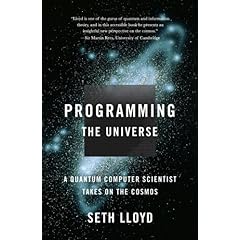
Programming The Universe, Part Two

I have finally finished reading the remarkable "Programming the Universe" by Seth Lloyd, a professor of Mechanical Engineering at MIT. Unlike the Part One that is more or less a philosophical description of quantum computing, in Part Two Seth focuses more on the mechanics of quantum computers. The writing is extremely illuminating and may bring readers much think. Hence here are a few of my thoughts and questions about the second part of the book.

Equivalence between Information, Mass, and Energy

The central theme of the book is that "all physical systems register and process information." In the other words, information is "a fundamental physical quantity" in the world as well as several other fundamental physical quantities such as energy and mass. If it is true, from the claim we may draw several interesting conclusions.

For long time and especially after the industrial revolution from 18th to 19th century, we have customized to the thought that energy drives the world while mass dominates product. Energy and mass are the two most fundamental physical quantities in the world. A representative abstraction of this belief is in Einstein's famous question---E=mc².

In his book, Seth, however, implicitly challenged this belief by showing the fundamental of information. Based on Seth's claim, we may derive a controversial point: there is equivalence between not only mass and energy, but also mass and information. We may perform physical transformation from one of them to another in quantity. Like that we have been able to perform the transformation between energy and mass through nuclear fission and fusion, quantum computing may eventually be the bridge of transformation between information and mass. Hence quantum computing is not just an advanced computational mechanism. Instead it might be a new sort of power that we have never thought before.

Why is the second law of thermodynamics true

At the same time, this potential equivalence among mass, energy, and information may also explain a long-lasting question: why the second law of thermodynamics is a truth. For long time, scientists have accepted the truth of this law but continuously questioned why. It is intuitively strange that when the total amount of mass and energy is constant, something called "entropy" generally increases. In the other words, entropy must be neither energy nor mass, or otherwise its existence has already violated the first law of thermodynamics. By Seth's statement, we may draw that "entropy" is indeed information.

When the total amount of mass and energy keeps constant, indeed the mass and energy unstoppably compute themselves. Although this type of universal computation in nature would never result in more mass or energy production in quantity, it generally produces new information about the progress of computation itself. This increase of total amount of information is thus the, or at least part of the, secret of entropy that is mysterious to us.

Then we have drawn two outcomes from Seth's theory. First, transformation between information and mass (or between information and energy) exists. Second, the total amount of information ever increases in contrast to that the total amount of mass and energy keeps constant. If the two outcomes are hold simultaneously, we may conclude that the mass/energy occupation per information unit (or per bit of information) is ever decreasing. In the other words, in average a bit of information holds less and less amount of energy or mass with the progress of time (or in average a certain amount of mass or energy registers more and more bits of information with the progress of time). Note that this conclusion is actually very intuitive since with time we have to use more bits to describe the ever-increasing history of a substance. Such a phenomenon, however, may have explained why it is much more difficult to make conversion from information to mass/energy than from mass/energy to information.

Energy, Mass, and Information Production

Another interesting derivation is about the relation between production and the three basic natural elements. In tradition, we have learned that energy is the driving power of production and mass is both of the sources of production and the consequence of production. In essence, a production process conducted by humans consumes substance in the form of energy to produce substance in the form of mass. Energy is consumed (in fact, the total quantity of energy never reduces while the amount workable energy decreases, i.e., the entropy increases) and mass is produced (the total quantity of mass indeed never grows while the variety of mass increases, i.e., again, the entropy increases). However, information brings a new relationship to production.

In contrast to energy or mass, Seth's research discovered that information computes by itself. It means that essentially information production could be energy free when its output does not involve mass/energy production. Entropy increase does not necessarily require energy consumption. By this mean, information industry may demand consuming much less energy than we are at present on the stage of mass production industry, if only we may figure out the right way of computation (such as possibly the right process of quantum computation). This derivation could be very significant for the progress of economy into the future.

Reconciliation of Materialism and Idealism

For long time, there is intensive debate between the correctness of materialism and idealism. When materialism insists that the only thing that can be truly proven to exist is matter, idealism advocates that thought or mind is more essential than physical matter. While in history idealism once was dominating in human society, materialism has generally dominated the modern society especially after the industrial revolution with the rise of modern science. The new discoveries stated by Seth, however, bring more thinking about the two objects and the evidences seemly point to that the two contradictory philosophical viewpoints may actually be reconciled just like the wave-particle duality.

Information and Spacetime

By rephrasing John Wheeler's statement that "Matter tells space how to curve, and space tells matter where to go," Seth formulated that "Information tells space how to curve; and space tells information where to go." Although Seth formed this statement to prompt his research of quantum logic gates, it is quite interesting to me how it may be applied to the research of World Wide Web.

In fact, the Web is a space where information is stored, shared, and communicated. Meanwhile, the time on the Web may eludes in a different rate from what it does in the real world. Hence World Wide Web indeed constitutes special spacetime that is varied to the spacetime we are living in real life. Moreover, on the Web we may construct not just another one spacetime. We can actually build many different spacetime by various perspectives. By this sense, the statement made by Seth becomes extremely illuminating on how we may build proper Web spaces for the evolution of World Wide Web.

Complexity of computation

Ever-lasting computation inevitably leads to greater complexity in the computational space. This is the last conclusion Seth presented in his book.

In the book, Seth tried to explain the emergence of life through natural computation. Nevertheless do I disagree to his example, I am indeed very much keen to his claim that complexity is an inevitable consequence of ever-lasting computation.

In my study of Web evolution, I have actually stated that the ever-increasing production of Web resources will inevitably lead to the emergence of higher quality Web resource, which is the signal of stage transition on Web evolution. In fact, higher quality Web resources always refer to more complex in both of its external presentation and its internal essence. In the other words, higher quality Web resources has greater complexity than their lower quality siblings. This is a fact in all the evolutionary progresses.

In similar to the natural universe we are living, World Wide Web by design is another self-organizing computational spacetime. Therefore, the conclusion drawn by Seth can be well applied to the Web. On the Web we must gradually have new-generation resources in more and more complex ways. From another angle, it shows the integrity of my study of Web evolution.

A careless thought in Seth's book

At last, I want to point out a careless thought in Seth's remarkable book.

In the book, Seth has made a great analogy that the computational universe is actually closer to that a few monkeys are randomly typing to a great computer than typing to a typewriter. The difference is that if the universe is a computer, what monkeys type become programming instructions since computers can compute truth through these instructions. Otherwise if the universe is just a typewriter, what monkeys type must be the truth itself since typewriters cannot compute.

The previous model has very well explained the essence of quantum computing in universe. It, however, leaves a grand question, i.e., where does the rendition of the universal instructions come from at the first place if the universe is a computer instead of a typewriter? The only explanation must be that there exists the God who has designed the universal instruction systems just like we humans have designed the instruction interpretation mechanism in our computers. The universal computation may not even be able to get started from the Big Bang if the certain universal instruction rendering mechanism does not exist.

The previous thought, however, seemly contradicts to Seth's belief of natural evolution of human life. To me, this implicit self-contradiction is probably the only flaw of the book. It reflects the struggle of a human being between his integral scientific judgment and his emotional religion expectation.

Referenced resources:

Sunday, July 27, 2008

Programming The Universe, Part One

I have just finished reading the Part One of a remarkable book by Seth Lloyd, a professor of Mechanical Engineering at MIT. The title is Programming the Universe. Although it says "programming" in title, readers, however, do not really need to know how to program before they may understand the content. The book introduces some newest progress on quantum computing in an illuminating way. Despite of the easiness of reading, the book shows compelling mind of the author that may lead advanced readers into deep thinking of the future about not only the computers but also the Web.

Here are a few quotes from the Part One I feel greatly impressed. Moreover, I have made a few comments on each of these quotes. I will post again about the Part Two of the book once I finish reading it. This book is really a great one for anybody who likes to think deep.

Information-processing revolution

"Every information-processing revolution is associated with a new technology---the computer, the book, the brain, DNA. These technologies allow information to be registered and processed according to a set of rules." (pg. 16)

Actually, it is not only a sequence of technology evolution but also a sequence of the evolution of mind presentation. DNA is the basis of biological bodies. Hence it is where mind is based. Human brain is where mind generates, books are where mind embodied externally in physical form, and computer programs are where mind embodied externally in digital form.

The author, however, neglected another important technology related to the information-processing revolution. It is World Wide Web. The Web is more than a computer, and it is more than a large cluster of computers. The difference between information processing through the Web and the information processing through computers is the same as the difference between information processing through computers and information processing through books. On the Web, we are a very different set of rules of information processing from the rules guiding the information process in a personal computer.

Precision and the amount of information

"If you have an infinite number of alternatives, then you have an infinite amount of information, ..." (pg. 21)

In fact, to any question we can distinguish answers from a digital computer or from the nature. What we need to do is continuously asking for more details of the answer. Any digital computer (no matter how powerful it is) has a limit of its computational precision. That is, it may only provide information until certain amount of quantity. By contrast, the nature essentially have no limit on its ability of telling the details.

On the other hand, an ideal quantum computer would be indistinguishable from the nature. If we ask a question to both an ideal quantum computer and to the nature, we cannot distinguish their answers because both of them have the ability of provide infinite details. Ideally, quantum computers support ultimate precision of information description.

Can such a type of quantum computers be truly built? Probably not or otherwise we would have reconstructed the whole universe. But it at least shows the compelling computational power quantum computers may have, which is beyond many of us can imagine.

Meaning of information

"If you don't know how a message is to be interpreted, then you don't know its meaning. ... Meaning is a bit like pornography: you know it when you see it." (pg. 25)

"... for computers, ambiguity is a bug. ... The ambiguity of human language is not a bug, it's a bonus!" (pg. 27)

Meaning is a popular but confusing word that we watch frequently now due to the timely discussion of Semantic Web. In the book, Seth stated his viewpoint: meaning actually does not exist until a message is measured by a pre-specified interpretation procedure. When we agree to a meaning, actually we commit to the procedure of interpretation prior to the coherence of the results of interpretation.

Moreover, Seth pointed out that ambiguity in nature is the basis of variety of the nature. When single digital computers generally prohibit ambiguity, we actually have lost the ability to describe a powerful feature of the natural universe. By Seth, quantum computers may regain this power of computation. Before the age of quantum computing, however, can we, at least partially, implement ambiguity through World Wide Web?

It is hard to answer the previous question. On the other hand, it is almost sure that the current W3C-version Semantic Web is not favorite to ambiguity. Is it a major drawback in the current Semantic Web project according to the vision of quantum computing in the book?

Uncertain and inscrutable aspect of computing

"In fact, it is just when we behave rationally, moving logically, like a computer, from step to step, that our behavior becomes provably unpredictable. Rationality combines with self-reference to make our actions intrinsically paradoxical and uncertain. ... Computers certainly possess the ability to reason and the capacity for self-reference. And just because they do, their actions are intrinsically inscrutable." (pg. 36)

Although I have learned the theory of computation in college, it is still a refreshing of mind for me to read Seth's discussion about the reason of uncertainty existed in computing. Actually, uncertainty in computing is not caused by any irrational statement or illogical derivation. By contrast, uncertainty is a natural existence only if we have self referenced ourselves, which is a legal and normal action in computing. For example, when I have specified a link back to my own blog, in theory Thinking Space is already uncomputable when somebody wants to arbitrarily reason over the site using digital computers.

My question is, however, can the Web solve this basic problem of computation to a new extend if we don't treat the Web as a cluster of digital computers? The difference between the Web and a cluster of digital computers is that the Web is indeed a society of humans plus computers!

Information and energy

"... in the story of universe told in this book, the primary actor in the physical history is information. Ultimately, information and energy play complementary roles in the universe: Energy makes physical systems do things. Information tells them what to do." (pg. 40)

"Entropy is the information contained in a physical system that is invisible to us." (pg. 41)

"Free energy is energy in a highly ordered form associated with a relatively low amount of entropy. ... The relatively small amount of information required to describe this energy makes it available for us: that's why it's called free." (pg. 42-43)

"... it's clear that energy and information (visible and invisible) are the two primary actors in the universal drama. ... Energy is conserved. Information never decreases. ... To do anything requires energy. To specify what is done requires information. Energy and information are by nature (no pun intended) intertwined." (pd. 44)

The discussion between energy and information is an interesting and very informational part of the book.

As we all know, the First Law and Second Law of Thermodynamics are two fundamental laws that describe the universe. In short, the First Law tells that the total amount of energy in any closed system is conserved, and the Second Law tells that the total amount of entropy in any closed system never decreases.

In the book, Seth illuminatingly mapped entropy to information. Since entropy is a measurement of the workable energy in a closed system, entropy is equivalent to information that describes the details of the system. Therefore, the Second Law may be reinterpreted as that the total amount of information in any close system never decreases.

In order to make things be more interesting, let's watch Adam Lindemann's original discussion of Harmonious (Mind) Age and my explanation of the Harmonious Age. Actually, Adam expresses the shift of human society in terms of energy and emphasized that human mind is a new state of energy that may eventually lead to a more harmonious stage of human society. By contrast, I interpreted the same thing using mind in its aspect of information and emphasized that the ever-increasing amount of mind/information in the world must eventually lead to a stage that mind becomes the primary type of asset of human society. By this evolution, humanity would be more respectful in general since the value of individuals will be finally measured by the superiority of their mind in contrast to the amount of land or capital they have occupied.

What a harmony between our discussion and the analysis in Seth's book!

Order from chaos (the butterfly effect)

"Chance is a crucial element of the language of nature. Every roll of the quantum dice injects a few more bits of detail into the world. As these details accumulate, they form the seeds for all the variety of the universe." (pg. 50)

Doing quantum computing is like throwing many dice simultaneously in parallel. We may be sure that one result must be what we expect. But we don't know which one of all the results is the one until it discloses itself. Actually, this is also how the nature performs.

At the same time, I would like to ask whether the Web is, will be, or should be operated in this way too. If we do view the Web to be humans plus computers, probably we may achieve this quality of computation even before the eventual realization of quantum computing.

Tuesday, January 01, 2008

Macroscopic regularity over microscopic Brownian motion | the secret beneath the wisdom of crowds

Happy New Year! 2008 will be an exciting new year for many reasons. The philosophy of Web 2.0 has been understood and accepted by more and more people and organizations. "Engaging the wisdom of crowds" has been a slogan of many new-age startups, as well as a few old corporations. In the year 2008, we will watch more deep implementation of this philosophy in the industrial realm. On the other hand, the new concept "Giant Global Graph" starts to be a bridge connecting Web 2.0 and Semantic Web. As the result, Semantic Web, after many years research in labs, will gradually approaches the public audience in 2008. At last, in person I will start a new career in this year. 2008 thus means especially different to me.

In this first post at 2008, I want to address an interesting and essential topic about Web 2.0---why is the wisdom of crowds often superior to the wisdom of individuals even though the individuals might be domain experts and the crowd is generally unprofessional?

The previous argument is the foundation of a best-selling book The Wisdom of Crowds written by James Surowiecki. In his book, James describes many evidences to show the superiority of crowd wisdom and he has also suggested several ways to approach the crowd wisdom while at the same time avoiding some regular traps of misusing this concept. Nevertheless is the book well written, there are a few important absences in the book. One Amazon book reviewer Aaron Swartz criticized that James's book was lack of thoughtful analysis on the intrinsic reasons beneath the described phenomenon of crowd wisdom. A similar critique was made also by another Amazon book critic, David J. Gannon, who wrote that "[James's] choices seem to be crafted to provide maximum support while eliminating any element of contraindication whatsoever." Despite of my sincere support to the basic concept in James's book, I have to confess that I incline to the arguments made by the two critics. These negative viewpoints, however, does not decrease the value the book (they only mean that the book could be even better). But they really pointed out at least one essential missed issue in the book, i.e., the question I rose at the beginning: what are the intrinsic reasons beneath the fact that the wisdom of crowds is often superior to the wisdom of individuals? With this question, I read through the book carefully and finally, I got an insight---the superiority of the wisdom of crowds is another example of a natural fact that there is often macroscopic regularity over any microscopic irregularity.

Brownian motionOne of the most famous irregular natural events is Brownian motion (click the picture on the left). Brownian motion is the random movement of particles suspended in a fluid or the mathematical model used to describe such random movements. In nature, Brownian motion exists everywhere. For example, in a body of water every individual H2O molecule moves towards random directions and with varied velocities at the microscopic level regardless, however, how the entire body of water actually flows at the macroscopic level. An interesting phenomenon is that despite of the pure random movement of each individual H2O molecule, a body of water always has its regular path of flow at the macroscopic level. Hence the irregularity of Brownian motion that may be supposed by many people to lead to random unpredictable flow actually generally cause regular predictable flow at the macroscopic level.

At the mathematical abstraction level, the phenomenon of Brownian motion and the phenomenon of crowd wisdom are indeed the same. In both cases, we have vectors that point to desultory directions and have random magnitudes in their respective directions. In Brownian motion these vectors represent the momentum of the particles and in crowd wisdom these vectors represent the decisions made by individual persons. By adding up these vectors, we may obtain a collective final result towards which the entire body moves. In Brownian motion the result is where the fluid body flows and in crowd wisdom it is what the collective decision is made by the crowd.

This mathematical model well explains several likely controversial claims in James's book. For example, in his book James observed that the collective decisions made by independent participants with highly diverse disciplinary areas is generally at least not worse than the collective decisions gathered by participants who are professional experts in the particular disciplinary area of the question. This observation is indeed surprising when we first see it because we often expect that to the same challenge the decision produced by a group of experts must be generally better than the decision made by a group of laymen. But based on the mathematical model of Brownian motion, we can see that although every individual particle acts purely random to each other, the sum of their momentum vectors always points to a fixed direction, i.e., the direction where the fluid body flows at the macroscopic level. In similar, although every individual person makes a decision solely upon his own profession that may be far away from the destinate disciplinary area, the sum of these decision vectors will point to a certain direction, i.e., the direction where the true answer sits (though nobody in the group really knows this direction). In this situation, it does not matter whether this group of people are domain experts or not. This is the myth and beauty of the wisdom of crowds.

The Brownian motion also explains why a group of laymen may even often outbeat a group of experts on producing a better collective decision. The figure on the left illustrate the idea. Above all, nobody truly knows the real direction of the goal. But experts often make decisions that are closer to the goal (this is why they are experts). By contrast, laymen often make decisions that are far away from the real goal. But if we sum up the decisions made by experts and the decisions made by laymen, the figure shows that it is not necessary that the collective decision of experts is better than the collective decision of laymen. Why? Experts are often biased in the same way, while laymen seldom have the type of biases experts have. Individual expert is certainly better than any individual layman on making professional decisions. But collectively experts often make biased decision---albeit the collective decision is also close to the real goal---since they are trained in similar ways. By contrast, the sum of layman's decisions might be more closer to the real goal since they do not have disciplinary bias in their mind. Though this vector addition diagram is simple, it shows why a group of laymen may beat a group of experts.

As James has emphasized in his book, independence is a crucial property of gathering better collective decisions, especially when these decisions are collected from a group of laymen. The new diagram at the left illustrates the reason. Unlike the previous one in which all experts and laymen make their decisions independently, in this new situation Expert 2 makes his decision after Expert 1 and so is Layman 2 after Layman 1. Humans are social creatures; so we often adjust our decisions to compromise the other persons in a group, even unconsciously. As the result, both Expert 2 and Layman 2 shift their decisions a little bit closer to the decision made by the respective former players. Immediately we see the consequence. The collective decision made by experts is still close to the goal since the decision made by Expert 1 is close to the goal. By contrast, the collective decision made by laymen starts to be away from the goal since the decision made by Layman 1 is away to the goal. This simple diagram shows why it is generally unconstructive (and often even destructive) to have a group of laymen communicate when they vote because most of the time they will unconsciously follow a direction that is far away from the real goal. By contrast, we may encourage the communication among experts since they are more likely to figure out a better solution after discussion. To the least, the worst expert decision may still be close to the goal.

Does the superiority of crowd wisdom suggest that we should not (or at least should not actively) hire experts on making decisions? The answer is no. There are two fundamental reasons why the existence of experts is actually crucial to the success of engaging the wisdom of crowds: (1) how to build a real diverse group of crowds and (2) how to aggregate the decisions made by the crowds.

As James has emphasized in his book, the property of diversity is critical to obtain high quality crowd-made decisions. In fact, this requirement of diversity is equivalent to the perspective of free of bias. When the voters in a group have diverse enough disciplinary backgrounds, disciplinary biases are eliminated to the least. Thus the aggregated collective decision would be closer to the real truth. But how to build a truly diverse set of participants is a problem. A random group of people invited from street might not necessary be a real diverse set to a particular question. To build a real diverse set requires highly professional experiences on the respective disciplinary field.

The two examples James told in the Introduction of his book are typical examples of why the construction of diverse groups is a highly professional job. In the first example, many people on the marketplace were beating on the weight of an ox. In his story, James addressed the participants as unprofessional normal people with respect to the issue of ox weight. Nevertheless was James right, these people were not so "unprofessional" as James had emphasized. We can safely assume that these people who had participated the beat regularly bought stuffs from the market. So they had basic knowledge on how to evaluate weight of varied things, even though they indeed were not professions on weighting oxes. This observation is important because it means that this group was really "diverse" with respect to the challenge. Think of repeating the same challenge among a group of first-grade elementary school students and we may see the difference between really "diverse" and fake "diverse" groups. By randomly calling up a group of first-grade elementary school students we may also have a diverse set, which is, however, not really "diverse" with respect to the demand of collecting crowd wisdom. The first-grade elementary school students are short of knowledge of weighting basic stuffs and thus the collective answer made by them is certainly "biased" by their short of knowledge.

Similar situation is for the second example, in which a group of professionals in varied fields was assembled by a naval official John Craven to guess the position of Scorpion, a US submarine disappeared in the North Atlantic. The story in the book was impressive; but would we be able to repeat this story by assembling a random group of professors at MIT? Certainly these professors must be brilliant and unquestionable experts in their disciplinary areas, but I bet they would certainly not able to guess the correct position of Scorpion, even collectively. Why? These professors generally have not been attended to the particular scenario and thus their decisions would be just little bit better than normal you and me in this case. On the contrary, the people John Craven had organized (as in the story) were the ones who were familiar to the submarine operation even though nobody had the complete knowledge of the particular case. So this group called by John Craven was a really diverse group and a random group of MIT professors is not.

Both the stories point out that assembling a "diverse" set is a highly professional request that demands the knowledge of domain experts.

Comparing to the demand of diversity, we may require more expertise on aggregating individual decisions made by a crowd to be a valuable collective decision. This type of aggregations is normally much more sophisticated than simply calculating the number of votes in different categories. As we show in the previous diagrams, the process of aggregating crowd wisdom is basically a procedure of vector addition (or more precisely a tensor addition since many times the number of dimensions would be more than three). How to divide a problem into varied dimensions and assign a measurement standard to it is a highly professional work that requires superior expertise on the disciplinary application area.

In summary, we now have a clear picture of how to take the benefit of crowd wisdom in real-world applications. First, we need a few experts. In contrast to rely on these experts to make decisions directly, however, we ask them to assemble a crowd that is truly diverse according to the problem. We let the crowd make their decisions independently. Then we ask the experts to aggregate the crowd decisions objectively based on the expertise of the experts. This is thus the procedure of engaging the wisdom of crowds.

Wednesday, November 28, 2007

Blink: an embarrassment of collective intelligence

Blink is another best-selling book authored by Malcolm Gladwell after his influential The Tipping Point. The book Blink is about the unconsciousness of human being. In the book, Malcolm argues that a decision made by well-trained unconsciousness many times is better than an alternate decision made by through thoughts. Reason: well-trained unconsciousness (or the so-called "thin slicing") only catches the very core of the problem, while through thoughts often wander into unessential branches that lead to the burying of the core. This is thus "the power of thinking without thinking," as the subtitle of the book.

This observation of the importance about the "thin slicing" shows an embarrassing side of the collective intelligence: if there is a conflict between a decision made from a collective base and an alternate decision made by the instinct of few top experts, which one should we trust? The Web-2.0 experiences ask us to vote for the first decision, but Malcolm's book tells us that most of the time it is the second one that is more trustworthy. Which one would you pick in real then?

This is a vague question that may not have an absolute answer in general. But at least the question shows that collective intelligence is not a panacea. An opinion from a domain expert and another opinion from a layman certainly should be weighted differently when we apply both to make a decision. Some time, as what Blink tells, the instinct of very few experts is much more correct than a collective decision.

So is the YouBeTheVC competition a really serious event? Maybe it is just another American Idol show. Think of it, would Larry Page and Sergey Brin (or Mark Zuckerberg) attend this kind of idol show when they had the blueprint of Google (or Facebook) in mind? I doubt it. Distinctive idea is more often out of a blink in contrast to out of a collective vote.

Saturday, April 21, 2007

Degree of Separation on Web 2.0

What is the degree of separation of World Wide Web? Albert-Laszlo Barabasi had presented a 19-degree of separation on the web according to his best-selling book---Linked. This study, though remarkable, was based on a traditional web structure, in which links were rigidly hardcoded by webmasters. This scene of hardcoded linkes is closer to the leftmost regular network in the following figure because the link-specifiers must have pre-requisite knowledge about the existence of destination pages. Therefore, these hardcoded links are mostly linked to the neighbors on the basis of single-direction acquaintance.


Beginning with the Web 2.0, however, this picture changes. One important difference between Web 2.0 and the traditional web (which we may harmlessly address as Web 1.0) is the prevalence of human-specified tags. These tags, however, may have dramatically shortened the distance of arbitrary two web pages by linking them together without pre-acquainting. On Web 2.0, two web pages have a significant greater chance than before to be linked by a distance of only 2 by sharing a common tag without the need of knowing the existence of each other beforehand. Therefore, this scene becomes closer to the middle small-world network on the figure above. According to the Watts-Strogatz model, by adding a few random links into a regular network, we may signficantly reduce the diameter of the network. It thus means the further decreasing of the degree of separation on the web.

Beyond Web 2.0 and with the emergence of semantic web, the degree of separation on the web is going to be more and more close to the degree of separation among humans in the real world, while the latter one is also decreasing by the prevalance of the WWW. Traditionally, the degree of separation among humans is often regarded as 6 based on the famous theory of six degree of separation. Recently Thomas Friedman declared in his book "The World is Flat" that the relational distance between arbitrary persons was shortened when the world got flattened. Eventually, anyone who share common interest can become acquaintances to each other disregarding their physical distance in a flattened world. The web pages in a flattened world will become closely linked to each other as long as their human masters are acquaintances. Hence the degree of separation among web pages will basically equal to the degree of separation among real humans, which will be greater than 2 but less than 6 in a flattened world.

Monday, April 16, 2007

Semantic Web and The World is Flat

I am now reading The World is Flat, one of the best-selling books written by Thomas Friedman. This book is way too long and I have read only half of it. But the main idea is already clear---the world has been flattened by new technologies. The rest of this paper is about how to face this new challenge, which is more controversial than the first half.

Debates about this book are intensive. For example, Matt Taibbi had made a strong critique about this book. Certainly, there is also much applause, such as this one from Tim O'Reilly.

In general, I believe in the thesis of this book, i.e., globalization is an unstoppable trend. Many old barriers are broken due to the revolution of new technologies, among which the most significant one is the World Wide Web. WWW connects people in the world to a new level. This is a level that our antecessors dreamed for centuries but never had been true until the prevalence of World Wide Web. Certainly that things like outsourcing, offshoring, and supply-chaining may still happen even without WWW. But they might never have been so widely understood and thus accelerated in the global scale without WWW. Therefore, WWW is not just a flattener. WWW is the most essential flattener because it delievers the knowledge of flattening to the global scale.

Semantic Web is a new stage towards a more flattening world. It is going to break the barrier of communication to the instance data level. On the W3C-proposed Semantic Web, the world is going to be so flat that even a child can dig a fact as deep as professional domain experts. So what will be the challenges in a very flattened world if a less trained child may do something as good as professional experts? Does it mean the education becomes less and less important? That people wouldn’t need an MBA degree or an Ivy League business education? The answer, however, is simply the opposite.

Flattening does not solve everything. In fact, it solves much less than we expect. Flattening only brings the same problems to a different level, which requires higher (instead of lower) level of knowledge. For example, before flattening, a manager needs to know how to divide his work to his workers. These workers are often local, and managers and workers are often well-known each other. Furthermore, because these workers are local, there are fewer choices this manager can make. Fewer choices also means, however, less work to the manager. On the contrary, in a flattened world, this manager knows that his work can be done piece by piece in a global scale. The manager has plenty of choices to select these pieces. The challenge is, however, which pieces may perform better than others in his framework. Moreover, it is nontrivial for a manager to integrate these scattered pieces together, which is the so-called work flow. These requirements demand much higher professional knowledge to the manager than before.

In abstraction, the process of flattening is the process of dividing tasks into tiny pieces so that it could be done by cheaper labors. This is why flattening leads to more and more outsourcing and offshoring because more and more previously complex tasks now can be done by multiple simpler tasks. But this classic divide-and-conquer method does not really solve the complexity of problems. It only leads the complexity to an upper level, or it only shifts the complexity to a different side. When it decreases the complexity of single task, it increases the complexity of integrating these simple resolutions to a complex resolution. In general, the total complexity of an original problem is neither decreased nor increased. It only matters where we load it.

Therefore, more and more outsourcing and offshoring means the requirements of more and more integrators, orchestrators, and explainers. This has been predicted by Thomas Friedman in his book.

The prevalence of Semantic Web will result in some fundamental changes on Computer Science education. When the barrier of data is eventually broken, we need fewer and fewer middle-class programmers that are trained by the current Computer Science education. Most of the end-point programming tasks will be so simple that they could be done by less professional programmers. In contrast, we need more and more high-level software architects that know how to integrate these low-level programs to be a uniform product that can solve some particular problems. This work requires knowledge on programming; it is for sure. But more of it is about art. These software architects will primarily be artists who understand the beauty of the world facts before they dig into the details of integration. They are the ones that Computer Science departments should train and produce.