Showing posts with label Web Science. Show all posts

Sunday, September 13, 2009

Gravitation, the Web, and Wikipedia

Gravitation

Gravitation is a natural phenomenon by which objects with mass attract one another. It is one of the most fundamental restrictions applied to every object in the universe. A universe without gravitation would diverge in random. According to the General Theory of Relativity, gravitation along with space and time together define the geometry of the universe. Philosophically, space allows the universe to contain things, time allows the things in the universe to grow and evolve, and gravitation makes the universe be a reasonable system (the fundamental rules can be established since gravity forces mass converging).

World Wide Web

World Wide Web is a man-made universe in which data is mass. Every object in the real universe is composed by mass. Every object in the Web is composed by data. In similar, the Web as universe also has space, time, and gravitation together defining its fundamental geometry so that the Web can contain things, the things contained in the Web can evolve, and all things in the Web constitute a reasonable system.

Space in the Web is the unlimited expanse in which everything in data is located, which is similar to that space in the real universe is the unlimited expanse in which everything in mass is located. The entire volume of the space in the Web equals the overall capacity of the memory and hard disk in the Web computers. The size of the space in the Web constantly expands when we continuously add more machines into Internet.

Time in the Web is inherited from our real universe. Through this dimension, and this dimension only, the man-made virtual universe is connected to the real universe. I feel astonished by this discovery myself. Basically it tells that the Web could be totally lost (inaccessible) if time would stop. The derivation is, however, reasonable since it always takes a few time (though it could be very short period) for us to access the information stored in the Web through computation. When time stops, this type of computation the Web relies cannot be performed. Hence probably we might conclude the Web indeed resides in the dimension of Time.

Gravitation in the Web is certainly not due to the gravity in the real universe. As we have discussed, the decisive function of gravitation is to bring things toward each other. In the real world, the gravity plays the role of pulling mass together. In the web, semantics plays the role of pulling data together. Gravitation in the Web thus is semantics. Without semantics, data in the Web will fundamentally diverge. With semantics, however, data in the Web converges essentially. Semantics is also the fundamental force that makes the Web be reasonable.

Wikipedia

The rise and popularization of Wikipedia is a phenomenon. But why Wikipedia? Certainly there are many reasons. Here I would like to take a look at the phenomenon in the way of Web Science using the gravitation in the Web we just discussed.

Unquestionably, Web 2.0 has reshaped the Web to become a social platform. A representative character of Web 2.0 is the prevalence of user generated content (UGC) due to all kinds of the online social activities. The variety of UGCs makes the Web more and more exciting. But there is a problem.

In order to make the UGC production be faster and more efficiently, most of the UGC is not self-explained as if the Web pages produced in the pre-2.0 age. By contrast, UGC heavily relies on the external references to settle the common ground of mutual communication. For example:

Party A: The UGC in site A is laid out ugly.
Party B: We use UGC to provide geographical information.


Did the two parties talk about the same UGC? (Actually they did not. The first party talked about User Generated Content, while the second party talked about Universal Geographic Code.)

Such a problem was generally not a problem in the pre-2.0 Web, when there were very few demands on mutual online communication between the Web content publishers and the Web readers. The majority of the webmasters thus had enough time and be professional enough to make the Web content be self-contained. That is, the key terms were always unambiguously defined to avoid potential misunderstanding.

The rise of Web 2.0 broke the scheme. Suddenly the demand of producing UGC becomes tremendous. Most of the UGC producers are either non-professional in the domain of content they are going to produce or they do not have time or patience to settle the unambiguous ground for the messages. In order to maintain such a new scheme, however, the Web demands a commonly shared place of semantic grounding for people to reference. This is thus some intrinsic reason behind the rise of Wikipedia; Wikipedia happened to match the demand on time.

By using the model of Web gravitation we can summarize all the discussion of Wikipedia till now in a fairly concise but illuminating way. The Wikipedia phenomenon tells that in the age of Web 2.0 the gravity in the Web has started the process of data solidification. After the Big Bang gravity started to pull mass together and solidify it to produce the stars and planets. In the Web, the process is similar. The various domain-specific Web sites are the planets while the sites that engage the formalization of semantics like Wikipedia are the stars around which the planets circulate. Despite all the sites are built by humans, it is actually the gravitation in the Web (semantics) that intuitively guides the construction of all these sites. Data in closely related semantics moves to each other and new sites emerge.

The excitement of Web evolution just starts.


Special thanks to Eric Goldman for sharing me his work on the Wikipedia study. The initial thought of the post was made during the email discussion with him in discussing the future of Wikipedia. Eric's latest article, "Wikipedia’s Labor Squeeze and its Consequences," is an excellent work and I recommend it to anybody who is interested in the research of Wikipedia as well as the research of the fate of social media.

Sunday, August 09, 2009

The Link in Linked Web

Kingsley Idehen posted a thoughtful article on URI, URL, and linked data this weekend. In the style of Q&A, the post concisely answers some of the most confusing questions about linked data. It explains the subtle distinction between URI and URL when dealing with the linked data. Moreover, the post implies that "a new level of Link Abstraction on the Web" is likely needed for us in order to efficiently consume the linked data Web.

After I left a comment for the post, however, I feel the issue deserve a second thinking. Before approaching forward, I pasted the main section of my original comment to Kingsley's post in the following.

Another thought I have, however, is that we may have three, in contrast to two, fundamental definitions on describing the Web. The two well-known ones are data and service; or in RDF we define Class and Property respectively. Until now, we assert the third one---link---to be nothing but a special form of data. The reality is, however, that this special form is so special that we may consider to give it a little bit honor so that it becomes the third member of the fundamental building block of the Web. That is, a link is not a data, and nor is it a service, but a link. Or with respect to your post, a URI is not a data, but a form of link, PERIOD.

I believe that this distinction, once it is made, could be important as well as valuable. A trick thing here is that, following this distinction we can start to think of other forms of links that is beyond URI (which is just a binary model). By contrast, we may start to invent the links in higher order, such as the link of links (metalink) or the thread of links (group link). Be honest, if the Web is moving towards a web of linked data (and I believe so since the Web data is more and more interconnected), we must breakthrough this traditional thinking of the link model. The key is, however, from today we start to think link to be link but not a data.

World Wide Web: from the dualistic view to the ternaristic view

The thought that Web link is a fundamental element of the Web that is independent to data and service was originated when I wrote a model of Web evolution. (Actually, it could be traced back to January 2007 when I first started to think of how the Web evolves.) By observing the evolution of the Web, more and more I felt that data, service, and Web link are three equivalently fundamental elements of the Web. This interpretation of the Web is different from the classic dualistic view of the Web in which the Web is said to be built upon two fundamental first-class entities: data (which expresses the static description) and service (which expresses the dynamic action). In this classic dualistic model, Web link is a special second-class member that is partially static description and partially implied by dynamic action.

RDF is a typical design according to this dualism philosophy of the Web. In RDF, relation (RDF:Property) is a first-class entity along with the normal object entity (RDF:Class). While class expresses the static fact of the Web, relation expresses how the static facts are interacted to each other. Both the elements are equally fundamental. Two models with the identical classes may not necessarily be equivalent to each other since the properties that are among the classes could be different.

Now we need to start discussing a few subtle implication of this philosophical view of the Web.

By the dualism philosophy, a relation is first of all a service and secondary a link. For example, suppose there are two statements: (1) Mary is a teacher of John, and (2) Mary is a friend of John. Mary and John are two objects. "teacher-of" and "friend-of" are two relations. Philosophically, however, the primary meaning of each of the relations is a typical service defined in between the two objects. In the first relation, Mary provides a teaching service for John, by which a teacher-of relation is established. In the second relation, Mary provides a friendship service for John, by which a friend-of relation is established. Be note each of the links is a consequence of the respective service (and there could be other consequences as well) in contrast to a prerequisite of the service. The dualism philosophy tells that service implies link and every link must be a consequence of a service. Moreover, no link actually makes sense if no services imply the link. Every link has a reason, which is a known service, conceptually (means that the service is unnecessarily implemented, however).

There is also another side of Web link according to this dualism philosophy. Once a link is implied by a service, it becomes a data. Unlike service that always leads to an action or a production, link describes certain static fact, which by the dualism philosophy is a data.

Therefore, link, which inherits the features from both of the first-class entities, is a special secondary entity in the dualistic view of the Web.

The ternarism (3 fundamental elements to model the world) philosophy to which I prefer may describe the same Web but in a different picture. By this philosophy, a link is not the consequence of a service and neither is it an unique type of data. A link is a link, which in the ternaristic view of the Web exists without the need of being implied by a service or being stored in the form of data.

In the dualism world, wherever there is a link, it must exist a data that represents the link and a service (implemented or not) that implies the link.

In the ternaristic world, however, when there is a link, it may or may not exist a data that represents the link, and it may or may not exist a service (let it alone implemented) that implies the link. A link is nothing but a pure connection among (could be more than between) the things.

In the dualism world, that one thing is linked to another thing is always due to some reason. In the ternaristic world, however, link is a matter of natural connection that does not require a reason to be existed. A link is as fundamental as a data or a service.

As we know, the Web is a world of information. Following this ternarism philosophy, the Web we understand becomes different world from what we normally think by the dualistic view. It tells that in the world of information, data reveals the encapsulation of information, service reveals the action and production of information, and link reveals the transportation (in contrast to connection) of information. Under this view, any Thing in the information Web is composed by three fundamental elements---data, service, and link. The data elements contains the information, the service element enables the production of the information as well as the interaction of the information to the other things, and the link element determines whether or not the information being able to be passed to another Thing.

By the ternaristic view of the Web, when we say there is a link from Thing A to Thing B, it means that the information carried by Thing A can be directly transported to Thing B without the help of any other information carrier.

By the ternaristic view of the Web, when there are no links between Thing A and Thing B, it means that unless there are additional information carrier participated in the transaction, the information carried by A cannot be passed to B. Once properly the additional information carriers joins the protocol (possibly in both sides), a link in higher order can be established between A and B.

By the ternaristic view of the Web, there is always a link (i.e. a direct link in the classic mean) between any two things though the link is often in higher order, i.e., it is often not a binary link that involves only the two designated things.

The regular Thinking Space readers may have found that this ternaristic view of the Web is also influenced by the quantum theory. Unlike that in the dualistic presentation of the Web we often need to perform an expensive computation to discover a link (concatenated by several direct binary links) between two objects in the Web, in the ternaristic presentation of the Web any two objects are directly linked, but possibly linked in varied orders. Moreover, I realize that we may directly apply many classic quantum theories to the Web if we start to think of the Web in the ternaristic view, which I will share later in the other posts.

Does the ternaristic view actually reveal the more intrinsic fact of the Web? I do not know. But there is one thing I feel certain. Link is not a simple issue. By better understanding the nature of link in the information world, we may eventually release the tremendous power of computation that we might not even imagine now. For the companies that aim to monetize linked data (such as Kingsley's OpenLink Software), it would be even more valuable for them to rethink the nature of the links that they are working against every day.

Friday, May 01, 2009

The upside down of the traditional thought on user interface

User interface (UI, or human-computer interface) is a central concept in modern software development. Essentially, UI provides the way how humans may interact with computers. Given the World Wide Web as the background, UI represents how the real world interacts to the virtual world and vice versa.

There is an interesting question about UI on the Web. Should the UI be an external component to its software or be an internal component?

Sound silly? In tradition, an UI is unquestionably an external component with respect to its software. We may envision UI to be the cover wraps its internal executable programs. However, does it mean that UI must be in this form?

Let us turn to a natural phenomenon. We humans live in this world (as well as many other creatures). In fact, every one of us may see ourselves as an independent world that is interacting with the shared external world, which composes of all the natural resources such as air and water. Therefore, there is an interface between the two "worlds". As a matter of fact, however, much (if not all of) the UI is located internally with respect to our own world (i.e., our body) such as lung (exchanging air) or stomach (exchanging water). The external components of our world (such as skin) are essentially for protection and identification besides few supporting on interacting to the external world. Such an analogy leads to an interesting question, could UI on the Web also primarily be an internal component in contrast to an external component to the respective Web applications? Maybe this one is just too silly a question to ask since the non-external ones on the Web cannot be an UI by definition. Then, what is Web UI really? May somebody give a better answer in the philosophical sense but not the technological sense?

Sunday, March 22, 2009

Consciousness has no single "seat" in brain

NewScientist has an interesting summary of some newest progress on consciousness research. One statement, however, catches my attention and thinking. It is said that "Consciousness is more a question of dynamics, than of a local activity."

What does it mean when we embody consciousness onto the Web? This was the question I was thinking when reading the line. When originally we mention collective consciousness on the Web, we think of a group of embodied and "seated" mind and make them collaborate each other. Now I am curious to think whether collaborative consciousness is indeed the consciousness itself. That is, there is actually no consciousness when there is no collaborative. If we apply this thought to the research of linked data, however, it means that actually every individual piece of data itself should not be the center of issue. By contrast, a mechanism of collaboration among the whatever data is much more valuable and essential. I am wondering whether this is indeed the problem behind the present, slowly progressing achievement of linked data.

Thursday, March 05, 2009

Web Science 2009 Conference in two weeks

Web Science 2009 conference is coming in two weeks at Athens, Greece. The theme of this year is "Society On-Line". It would be an exciting event.

I have a paper accepted by the conference. The paper is about the model of Web evolution that I have posted before in this blog. To be a formal academic paper, however, I have substantially revised the presentation of the model. Furthermore, I have also uploaded a poster to the conference. So if you are attending the conference, please take a look at the poster. Unfortunately, however, I cannot attend the conference in person due to the time conflict to the project I am working on at present. I do wish, however, that this conference be a great event to prompt not only the research of Web Science but also the evolution of World Wide Web itself.

Thursday, December 25, 2008

7 best thoughts at Thinking Space 2008

To be my 2008 Christmas gift for the Thinking Space readers, these are the 7 best thoughts blogged in 2008 out of more than 100 original ones. Wish all of you Merry Christmas and Happy New Year!

7. The wisdom of crowds and the Brownian motion

The wisdom of crowds is a basic theory backing Web 2.0. The theory is, however, a reflection of a common physical phenomenon, the Brownian motion, in human society. The thought that the wisdom of crowds is the Brownian motion in human society was blogged in January 2008.

If this comparison is reasonable, there are general connections between the known physical laws and the unknown Web regulations. It thus may provide us a hint for the Web Science research. For example, since we can calculate the macroscopic velocity and direction of a flow based on the fluid dynamics computation over the microscopic-scale Brownian motion data of the flow, may we analogically compute the macroscopic behaviors of wisdom of crowds on the Web? Yes we can, can't we?

6. Automatic Character Switch (ACtS)

Automatic Character Switch (ACtS) is a proposed mechanism by myself to operate the resources produced by Web 2.0. In April 2007 I coined the term when I described my prediction of the next generation of World Wide Web based on the Web evolution model. In February 2008, I reused the proposed mechanism as a resolution for the issue of Web resource portability.

Although people think of Web 3.0 differently, something similar to ACtS should be an essential part of the picture of resolution. The ACtS intends to solving the problem of online identity overload, a milestone towards Web 3.0.

5. The expanding Web

The Web is expanding, and it expands simultaneously at the physical field, the computational field, the communicative field, and the financial field. I blogged this thought at Internet Evolution in October 2008.

We must know that the Web is growing in more than one aspect. We are seeing more variety of devices accessing the Web, more different methods to consume Web resources, better instant communication among Web users, and we start to construct new forms of asset because of the Web evolution. Only by well understanding these varieties of Web expansion, we may indeed get the purpose of Web evolution.

4. Invariants on the Web

Although the Web changes all the time, learning the unchanged side of the Web will help us understand better of the Web, and eventually let us be able to invent the changes we expect. The July 2008 post of Web invariants is about this topic.

In tradition, we have invented URI (references to facts) being a fundamental Web invariant. But the reference to a fact is essentially different from the fact itself. Therefore, it is questionable to enforce object reference replacing object itself being invariant. By contrast, may we ask epistemological procedure and Web thread (two more essential characters of objects) to new Web invariants?

3. Mind asset

The current economic crisis is due to the abuse of capital, the essence of the capitalist business. Hence some fundamental change of business must be done in order to avoid this sort of crisis in the future. On the other hand, if the change is done so fundamental to our society, wouldn't it lead our society into a new age? When people start to talk about new DNA of the next generation business, the new DNA I believe is the mind asset, which I have blogged since May 2008.

Mind asset is a compound new concept. In brief, it means a revolutionary way of monetizing human thinking. It claims that the general driving force of production is shifting gradually from capital to human mind. In the other words, mind starts to conduct money in contrast to money buys mind. This shift of power of production assigns thinkers a new role in the coming new society.

2. Mind, a universal fundamental in addition to mass and energy

Mind is always a mysterious thing. We hardly know where it comes and where it goes. After reading Seth Lloyd's brilliant book "Programming the Universe" at September 2008, I started to wonder whether the relationship between mind and mass is the same as the relationship between wave and particle. If this analogy truly holds, mind is another universal fundamental in the world in addition to mass and energy.

All of us exists in waves (the form of mind) when we are not under detection either by other persons or by ourselves. Once we are detected (i.e., once the consciousness starts to work), however, we see each other existed in particles (the form of mass) only. At the same time, mind remains existing such as when we think since at the moment the mind is out of any external detector. Therefore, the mind still exists in waves and remains being mind (instead of being materialized). If the former interpretation be correct, an exciting conclusion would be that we could invent a new type of mind detector to transform any thinking into mass immediately. This invention, if ever it could be realized, would bring our world new form of energy we cannot imagine.

1. Great transition, happening at the global scale

We are in a new transition, part 1 and part 2. This is probably the most critical message of today. Capitalism is dying. We are moving to a new age of human society, which is, however, neither the socialism nor the communism. Along with Adam Lindemann, I would like to call this new time the mind age (or the harmonious age by emphasizing the harmonious union of all human mind).

From land to capital then to mind, the most valuable (and the most essential) asset of human society is evolving. This fundamental evolution is beyond any other progress happening in our society. This is really what we need to be aware and what we should try to follow.

Through the post, I thank my savior and father in heaven, Jesus Christ, who give me wisdom and the ability of thinking. Happy birthday!

Monday, November 10, 2008

World Wide Web spreads like religions

I have previously claimed that according to its eternal goal the World Wide Web is a religion-like existence. Most recently, however, Michael Doebeli and Iaroslav Ispolatov at the University of Vancouver had a paper called "A Model for the Evolutionary Diversification of Religions". In the paper, the authors described the spread of religions in the way of the spread of viruses. After reading the paper, I would rather say that the spread of World Wide Web is closer to the spread of viruses. Or if the authors assessment is proper, World Wide Web spreads like religions.

The following is quoted from the paper.

"Religions are sets of ideas, statements and prescriptions of whose validity and applicability individual humans can become convinced. Thus, individual minds are the hosts of religious memes, which can exert considerable influence on the behaviour of their hosts."

In fact, we can apply nearly the identical statements on the construction of Web content and its impact to the content creators. The information on the Web is sets of ideas, statements and prescriptions of whose validity and applicability individual humans can become convinced. Thus, individual minds are the hosts of these Web memes, which can exert considerable influence on the behaviour of their hosts.

When we spread user-generated content over the Web, we spread the belief about the soundness of the information. A typical example is Wikipedia. Though we know that many Wikipedia authors are not professional and they have bare obligation of the correctness of their input, we often cite the Wikipedia entries as if they are the absolute truth. Unconsciously, we have applied the religion-like confidence onto the Web. When the Web spreads, it grows in the same momentum as a new religion grows. Moreover, the generated Web reacts to the people who create it as if it is a religion.

The relation between the Web and religion is an interest topic on Web Science and especially Web evolution that is worth of many future explorations.

Wednesday, July 30, 2008

Online Identity: what is it?

With the hype of Web 2.0 and social networking, online identity has been a popular term. The management of online identities, however, is gradually becoming a severe problem. Identity overload is a fundamental problem of Web 2.0. To solve it, we need to have a better understanding about the details of online identity.

By definition, identity means the distinct personality of an individual regarded as a persisting entity. There are three key terms in this specification---individual, distinct personality, and persisting entity.

Individual

An identity (no matter whether it is "online") is for an individual. Therefore, an individual person must exist before his identity exists. Although this derivation is trivial, do individuals always exist?

In the real human world, the answer to the former question is trivial. By nature, humans exist as individuals. Nobody lives due to the live of another person and nor does anybody lives because of the existence of any natural or social context. Being removed all context and relatives, an individual person is still himself. Being added any context or relative, an individual person remains also just himself; no more, no less. Every human being is a unique individual, or he is a unique, though shallow, image of God.

When we look for the answer on the Web, however, it becomes very different. Can anybody tell an individual person on the Web? Most of the time, we cannot. Most often, on the Web we may only tell a portion of an individual. For example, at YouTube we may tell an individual eye, at LinkedIn we may tell an individual hand, and so on. But does a unique individual person ever exist on the Web? Generally the answer is no till now.

Then back to the initial derivation stated at the beginning of this section. If online individuals even do not exist, how is it possible to produce online identities for these individuals?

Distinct Personality

An identity is about personality. This is an important catch of meaning because a common misconception says that an identity is such as a name or a social security number. In fact, either a person name or a SSN is just a reference to some real identity instead of the identity itself.

We may clarify a few important thoughts after insistently distinguishing reference to identity from identity itself. For example, identity is unique not due to the uniqueness of references. In the other words, whether references to identity are unique actually does not matter much; identity (if it is identity) is always unique discarding how it is referenced.

But there is a problem---personalities in general are not unique. As we know, varied persons may have the same personality. Hence identity is not just about personality, it is about distinct personality.

When identity is about distinct personality, online identities must be about the distinct online personalities. Moreover, the distinct online personalities are not the same as the references to the distinct online personalities. That is, an URI (or URL) is not and should not be an online identity because it does not determine any real distinct personality, even if the personality is online.

Persisting Entity

An identity is an entity. By being entity, identities are verifiable. Note that it is not verifiable in general to everything that is about personality of an individual. But if a thing belongs to an identity, the thing must be verifiable. Beyond, an identity is not only verifiable but also persistently verifiable. That is, an identity must be a persisting entity.

The property of persistence shows the existence of a constant methodology of identity checking. In the other words, we do not have to enforce the uniqueness of URL in order to perform identity maintenance. Allow me explain it using an analogue. I can always identify whether a woman is my wife not by checking her name, her look-like, her SSN, etc, but through the direct communication between us. I identify her by her unique personality and such a personality is actually an persisting entity.

Discussion wrap-up

So have we answered what online identity is? Not yet. But at least we now have a few insights about the answer.

1) We need to have online individual before assigning online identity to individual.

2) Online identity is not reference to online identity.

3) Online identity is an invariant on the Web.

4) Online identity can have very rich content (because personality is rich).

5) There exists an objective, constant method to verify online identity.

Any more words? Yes, on Web 3.0 the issue of online identity will be generally solved.

Tuesday, July 08, 2008

Invariants on the Web

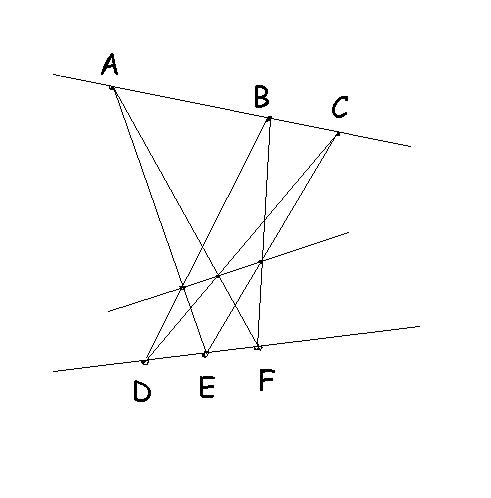
Invariant is something that does not change under a set of transformations. The picture on the right shows Pappus’s Invariant in geometry. The invariant tells that by following certain rules the three intersection points shown in the figure are always collinear no matter how people may draw the two lines and locate ABC and DEF in the lines respectively.

Invariant study is fundamental to any scientific research, especially when the research domain is as complex as World Wide Web. Invariants are supposed to be constant within the specified research scope. By well understanding the invariants we may effectively improve the knowledge over many complicated issues. Therefore, it is unsurprisingly for us to see the discussion of invariant study in the new Web Science Research Initiative.

In "A Framework for Web Science", the flag article of Web Science, Tim Berners-Lee and his colleagues have carefully studied several invariants on the Web. In particular, one invariant is outstanding among all the others. The one is URI (Uniform Resource Identifier). In the paper Berners-Lee et. al. had focused on discussing which invariant represents the binding of semantics with declared objects. There was no final best solution concluded in the paper, however, the one closest to the best was URI.

In varied programming languages we have widely used an invariant, which is declared name. In programming languages such as Java or C++, "each unique object (i.e. with distinct semantics) is declared with a distinct name in one program. By referencing a name, a program accesses the semantics behind the name." Hence declared name is taken to be invariant.

On the Web we are currently using another invariant. "Web researchers decide to use location binding to solve the problem, i.e. URIs and URLs. By default, identical URIs reference the same semantics. Identical URIs on web is the same as identical declared names in programs. However, the name of this URI is varied, i.e. name is no longer an invariant. In constrast, URI becomes a new invariant."

The authors, however, pointed out that indeed neither of the two was proper invariant on Semantic Web (or on the future Web). "The difference is, however, that the requirement of machine understanding," said by the authors. We actually have no ways to promise the consistency of the meaning to which a URI points. It is the same as we cannot enforce users to consistently bind the same name to any unique object on the Web.

Although with the problem, the authors did not provide a satisfactory answer to the problem in their paper. By contrast, they simply emphasized that "W3C suggests that do not transfer URI to another object. That is, whenever you create an object, giving it a unique URI. This requirement is thus the same as that whenever we create a new object in program, make sure we give it a unique name." In other words, please do not change the referred destination of any URI though anybody has the right to perform such a change. This passive resolution is not a satisfactory answer. Deprecated URI has gradually become a severe problem when more and more Web applications start to assume URI to be invariant on the Web. May we have an alternate, active answer to the question?


The figure above shows three basic components when we bind semantics with certain object. They are the declared name, the object itself, and a link connecting the two sides. So which one of them is truly invariant when they are presented on the Web?

As the paper has discussed, neither the declared name nor the link (i.e., uri) is true invariant. "Apple" may be fruit or a software company. We have no way to restrict a handpointing to a fixed destination.

The only exceptional one is the object itself. Although by nature an object can only be itself and it is automatically an invariant to itself, how can we present this invariant besides name and link? This is thus the problem.

We humans have so customized of binding semantics with declared names that we have almost forgotten some more intrinsic binding beneath the surface.

When we are binding the declared name "apple" with the object apple, we are actually making a semantic computation in our brain such as to determine whether it is a fruit with red or yellow or green skin and sweet to tart crisp whitish flesh. For people, a name is not just a name, but also a computational procedure in human brains. It is actually not the name that identifies an object, it is the procedure that identifies the object. The declared name is only a named shortcut referred to the particular procedure in brain. When we convert the procedure to machines, it is an epistemological process.


The picture above shows the new paradigm of semantic binding on the Web. The left side is changed to a particular epistemological procedure (which could be implemented in various ways such as the one we have suggested). Unlike names, these procedures are unique since they can unambiguously answer either yes or no for any identification request. Based on these epistemological procedures, Web links (such as URIs) are upgraded to be Web threads. The Web threads connect the same Web into a varied layer. Moreover, from the philosophical and economical aspects the construction of epistemological procedures and Web threads would be the basis for the production of mind asset.

In summary, epistemological procedure and Web thread are invariants on the Web. Through Imindi, we are going to demonstrate the world something extraordinary happening on the Web.

UPDATE: related reading about URI, "What do people have against URLs or URIs?" by Kingsley Idehen.

Tuesday, May 06, 2008

World Wide Web is not just for browsing, it is for branding yourself!

I happen to read across a blog post titled "Branding Yourself with A Blog". I sincerely recommend this post to everybody. Blogging is not just for fun, it is a way to brand oneself. Take myself as an example, through my blogging at Thinking Space, Semantic Focus, Internet Evolution, and several other places, I have branded myself to be an active thinker and researcher on the most frontier Web technologies.

There is another interesting reading recently. Jeff Jarvis in his post "more writers than readers" tells that now there are more online writers than regular daily newspaper readers. Although this claim is less shocking than saying that online writers are outnumber online readers [I am sorry for the previous miss-reading of Jeff's post. I have revised my statement respectively. The main idea I want to express, however, is still in Jeff's post, I believe.], the phenomenon still shows a silent migration of where the value of the Web is. More Web users start to recognize that the Web is a place not only for reading, but also for publishing, and eventually for branding and prompting themselves. Hence people are willing to write more onto the Web, not for attracting many readers, but for engaging potentially only few person who indeed appreciate the presented brand.

Combing both the post I just cited, we may draw an interesting insight: World Wide Web is not just for browsing, it is for branding yourself! One more step towards the center of this thought---World Wide Web is where to build latent personality that we could hardly do before the age of the Web.

World Wide Web is a network of pages, World Wide Web is a collection of data, World Wide Web is a pool of services. But most intrinsically, World Wide Web is a web of people. This specification is not just about the fact that World Wide Web connects people. More critically, World Wide Web itself is a web of literally specified latent personalities of the people who have participated to the Web. This recognition supported by the content of the two cited posts matches perfectly to the view of Web evolution I authored.

Monday, December 03, 2007

Collectivism on the Web

Collectivism emphasizes on human interdependence and the importance of collective. As probably the greatest collective project of mankind in history, World Wide Web engages enormous practices of collectivism. In this article, we take a brief look at several typical examples of these engagements.

Collective Intelligence

Collective intelligence is the most well-known engagement of collectivism on World Wide Web. In particular, Web 2.0 advocates have declared "harnessing collective intelligence" to be the touchstone of the Web 2.0 revolution. By definition, collective intelligence is a form of intelligence that emerges from the collaboration and competition of many individuals. If someone feels a little bit puzzled of this definition, here is an alternative explanation that is imprecise but much easier to be understood. Informally, collective intelligence on the Web is the collections of user generated "intelligence".

A keen reader may immediately find an interesting comparison: are there any differences between user generated "intelligence" and user generated "content" (or user generated "data")? On Web 2.0, we have almost mentioned users generation content (UGC) as many times as collective intelligence. In many people's mind, UGC almost equals to the collective intelligence. But the actual meanings between "intelligence" and "content" or "data" are very much different. The intent of "intelligence" is much richer than "content/data". Tim O'Reilly also had briefly mentioned this distinction in one of his earlier post about harnessing collective intelligence.

Content/data is a type of intelligence but at the low end. Jean Piaget, a Swiss philosopher and pioneer of the constructivist epistemology, had a compact description about intelligence: "Intelligence is what you use when you don't know what to do." Content/data provides shallow and unrefined information for people to use. Content/data is often too crude to be efficiently used. Keeping the user generation intelligence at the level of content/data is not enough. This is a problem.

I foresee that the degree of complexity (as well as the degree of efficient usage) of the collective intelligence on the Web is going to evolve with the Web. For example, by tagging content with formal labels that are defined by ontologies, the user generated content/data would evolve to be the user generated knowledge. This is exactly what the vision of Semantic Web wants to bring to us. Moreover, by augmenting formally labeled content with external logic routines, the user generated knowledge would evolve to be the user generated wisdom. By encoding the mechanism of proactiveness into machine computation, the user generated wisdom might evolve to be the user generated creativity. By engaging user generated content/data, knowledge, wisdom, creativity together, we might eventually get the user generated personality, through which the human evolution reaches a new stage of being artificially immortal. Is this path a long way? Yes, there is a long way to go. Is this path an impossible dream? No, it is not. The practice of collective intelligence is converting our society into a virtual world simultaneously from the level of individuals and the level of collective groups.

Collective Behavior

Collective intelligence is not the only practice of collectivism on the Web. Another key practice of collectivism on the Web is the implementation of collective behavior.

Collective behavior is very much difference from collective intelligence. All types of collective intelligences are static and thus they can be easily presented in an explicit way. In comparison, collective behaviors are dynamic and it is difficult to present them in an explicit way. As the result, collective behaviors are much harder to be used than collective intelligences on the Web though in fact at the same time the amount of collective behaviors is much greater than the amount of collective intelligences. The reason of this amount difference is indeed trivial. Every piece of collective intelligence on the Web must be related to at least one human behavior (i.e. the one action that post this piece of information online). The majority of the time, any piece of collective intelligence must be associated with many human behaviors such as reading and writing. With such a large pool of collective behaviors, it is surprising to see that so few actions have been made so far to manage and utilize this large pool.

Fortunately, Web researchers have started to pay their attention to the collective behaviors. The recent proposal of the implicit web is a typical example. The implicit web is a network that defragments every piece of implicitness on the explicit web. The majority of the implicitness on the Web actually belongs to the collective behaviors.

Collective Responsibility

The collective intelligence is a popular concept. The discussion of collective behavior is also not rare. But the rest of practices of collectivism on the Web I am going to discuss are indeed uncommonly. Many readers may not even hear of them before. But all these practices are unexceptionally important and valuable for the evolution of World Wide Web. The first one I introduce is the collective responsibility.

Collective responsibility is a concept, or doctrine, according to which individuals are to be held responsible for other people's actions by tolerating, ignoring, or harboring them, without actively collaborating in these actions. This concept is particularly important to the study of Internet security.

On the age of Web 2.0 and afterwards, security is no longer a solo issue with the deeper and wider implementation of collectivism. As a result, being innocent may no longer be simply taken as an individual issue. We must start to consider collective responsibility, i.e., some people may have to be punished not due to their own guilty but because they have not actively prohibited the guilty happened regularly in their participated societies. This issue is going to be very much debatable and exciting.

Collective Identity

A collective identity refers to individuals' sense of belonging to a group.

Identity is a tough issue on the Web. Normally, a web user may have varied identities on different sites. These varied identities, however, cause serious problems when people try to organize their information of interest across the boundaries of web sites. To address this problem, web researchers have issued the project OpenID that allows users to use a single ID over the entire Web.

But OpenID, even if it would be a standard over the Web, is not the end of the Web identity issue. Similar to that individual persons have their particular roles in real life, individual identities on the Web must gain their particular social roles in virtual life. The identification of these roles is particularly important when we would start to manipulate human generated information on the Web, i.e. collective intelligence, collective behaviors, etc. Only until humans or machines may identify the social roles of the information producers or owners, these humans or machines may be able to properly manipulate the information. The research of collective identity will focus on the identification of social roles of individual identities.

The collective identities are identities of identities. The study of this issue is another exciting and unexplored field that may cause much attention in the future.

Collective Consciousness

Collective consciousness refers to the shared beliefs and moral attitudes which operate as a unifying force within society. In the other words, the collective consciousness is about machine morality because human consciousness on the Web is handled by machines. The machine morality is not a sci-fi term; this issue is indeed real. Machine morality is the reflection of human morality onto the virtual world.

The implementation of collective consciousness is very much related to all the previously mentioned collective factors. Human consciousnesses are materialized on the Web as static intelligence and dynamic behaviors. Moreover, the collective identities assign social roles for the materialized consciousnesses. The integrity of these materialized consciousnesses is closely related to the level of collective responsibility that is maintained at the meantime. The combination of all these issues compose the intent of the machine morality.

Collective Effervescence

Collective effervescence is a perceived energy formed by a gathering of people as might be experienced at a sporting event, a carnival, a rave, or a riot. This energy can cause people to act differently than in their everyday life.

Collective effervescence is the emotion web site owners want to bring. Collective effervescence represents one word---hype! Collective effervescence is the ultimate goal of implementing collectivism on the Web. At the same time, how much an implementation of collectivism successfully brings collective effervescence into a web site is the fundamental standard that we can measure the quality of the implementations of collectivism. This concept encloses the entire set of collective factors and upgrades the evaluation of collectivism into the computational realm.

Summary

We have discussed several examples of how we may engage practices of collectivism onto the Web. Certainly there could be many other possible practices that are beyond this article. But one thing is certain. Collectivism is a crucial phenomenon on the evolving Web. The study of collectivism on the Web is going to be a critical issue of the Web Science.

Tuesday, October 09, 2007

Web Evolution

(last updated, June 10th, 2008)

Many people agree on Web evolution, but few take it seriously. As a term, "Web evolution" is commonly used. But few people have thoughtfully studied its principles, i.e. why and how the Web evolves. Even after the initiative of Web Science, Web evolution, supposed to be a major branch of Web Science, is still lack of considerable attention. For example, Wikipedia, the most popular online encyclopedia, does not have an entry of Web evolution till now (last checked June 10th, 2008). We need to change this situation.

A Brief History

One of the early attempts of formalizing the concept of evolution on the Web was done by Tim Berners-Lee, the father of World Wide Web. In 1998, he explained the importance of evolvability of Web technology. In short, we need to preserve spaces for Web technologies so that they can be continuously upgraded to compromise new requests. According to Tim, "evolvability" is one of the two fundamental goals of all W3C technologies (the other goal is "Interoperability"). Berners-Lee also emphasized that the key evolutionary issues at the meantime should be language evolution and data evolution. Within the context of his discussion, the term "evolvable" was actually closer to the meaning of "extensible" than the meaning of "evolutionary".

A more recent discussion about Web evolution was at the panel "Meaning on the Web: Evolution or Intelligent Design?" at Edinburgh, Unite Kingdom during the WWW-2006 conference. This panel invited five well-known web researchers, Ron Brachman, Dan Connolly, Rohit Khare, Frank Smadja, and Frank van Harmelen. In the description of this panel, it was written as follows.

"should meaning on the Web be evolutionary, driven organically through the bottom-up human assignment of tags? Or does it need to be carefully crafted and managed by a higher authority, using structured representations with defined semantics?"

The evolution of meaning specifications on the Web is a central issue of Web evolution; and this issue is particularly critical to the vision of Semantic Web. But this panel still did not touch the very core of Web evolution, i.e. what the essential driving force of web evolution is and how this force really drives the Web forward.

Very recently at WWW 2008, we finally have a workshop organized by the WSRI that focused solely on the study of Web evolution. Nevertheless is it a big step forward, most of the accepted papers in the workshop still focuses on describing the various phenomena of Web technology evolution rather than digging the fundamental reasons that drive the progress of Web evolution and how these reasons may drive the Web forward in the future.

Formal Study of Web Evolution

To the best of my knowledge, the article "Evolution of World Wide Web, a historical view and analogical study" is the first attempt to explain the essence of Web evolution on the ground of a theoretical study. The first draft of Part 1 was posted at January 12, 2007, and the first draft of Part 2 was posted at April 27, 2007. The Part 3 is still in progress. The Part 1 describes an analogical comparison between the growth of World Wide Web and the growth of humans. The Part 2 makes a scientific abstraction of the analogy discussed in Part 1 and concludes a view of Web evolution by two postulates and seven corollaries. Furthermore, in Part 2 we have also applied the newly abstracted Web-evolution theory to predict the path towards the next-generation Web (or Web 3.0 in someone's mind).

We have taken a great deal of effort to write and revise the articles. But it is simply too broad and sophisticated project to make it perfect in short time. Hence at the same time, I have authored a compact series about Web evolution in ten installments here at Thinking Space (the whole list of the post is attached at the end of this post). This series is more updated than the original article.

Brief Summary of the Web Evolution Theory

If World Wide Web does evolve, we believe that the progress of Web evolution must obey the general law of Transformation of Quantity into Quality, which is a general law of any evolutionary process in the world. In particular to the case of Web evolution, the general law is shown as a spiral advancement that consists of unstopping quantitative accumulation of Web resources and successive qualitative stage transitions. On the Web, whenever the quantity of Web resources reaches a certain level so that the amount becomes too many to be efficiently operated by the Web resource operating mechanism at the meantime, the Web will demand an upgrade of Web resource operating mechanism (a qualitative transition) to ensure the continuity of Web evolution. After the qualitative transition is done, the Web then start a new round of quantitative accumulation of Web resources at a higher level. The transition from Web 1.0 to Web 2.0 is a typical example of this theory.

Although the general law of Transformation of Quantity into Quality explains the path of Web evolution, it does not explain the reasons beneath the unstopping quantitative accumulation of Web resources. In other words, why does such a unstopping quantitative accumulation of Web resources happen and never stop? The answer to this question is related to the human aspect of World Wide Web. To the end, World Wide Web is a project produced by humans, contributed by humans, and serving humans.

The fundamental power of unstopping human contribution to the Web is laid on a nature of mankind---the desire of being known when alive and still being remembered after death. Human is a social creature. The invention of World Wide Web helps satisfy the deep concern of humanity itself. This fulfillment is the fundamental momentum that drives the resource accumulation on the Web.

This theory of Web evolution is not flawless. Many arguments might be debatable and amendable. The main purpose of this work is to bring the world a fresh new vision of Web evolution. In fact, Web evolution is not just about the Web, it is indeed about all humans and our society.

A View of Web Evolution

1. In the Beginning …
2. Three Evolutionary Elements
3. Two Postulates
4. Web Evolution and Human Growth
5. Evolutionary Stage
6. Qualities of Evolutionary Stages
7. Trigger of Transition
8. Beginning of a Stage Transition
9. Essence of Web Evolution
10. Completion of a Stage Transition

Saturday, September 15, 2007

Quality and Quantity

Quality and quantity are two fundamental definitions in Marx' philosophy. Marx believed, however, that every being could be uniquely decided by its quality. Thus, quality is the basic character or nature of something. When the quality of a thing is changed, this thing is no longer itself. Quality is the first division of Being.

Quantity is a variable amount of a thing, where the amount does not affect the quality (the basic nature) of what the thing is. A quantitative change may or may not cause the alteration of quality. The range of quantitative change that keeps a thing remaining being itself shows how stable this thing exists in its context. Quantity is the second division of Being.

Beyond Quality and Quantity, there is Measure, the unity of quality and quantity. Measure is the qualitative quantum, to which a determinate being or a quality is attached. A being can be completely decided by the measure of how many quantity with typical quality. Measure is the third division of Being.

On the basis of previous understanding, we may computationally measure any existence in quantity by carefully defining the presentation of their quality though some time these definitions are hard to be made. I believe, however, that this is a (if not the) philosophical foundation of any computational science. Furthermore, my view of web evolution is also on the basis of this philosophical belief. In particular, the quality measures of web evolution stages are defined so that web evolution progress becomes a computationally decidable process.

More exploration on this field should be a major topic of Web Science. More discussion of quality and quantity in Marxism can be found at here.

This post is part of the collection of terminology, which explains several heavily repeated terms in Thinking Space.

Sunday, September 02, 2007

Qualities of Evolutionary Stages, A View of Web Evolution, series No. 6

(Revised May. 25, 2008)

Quality is a characteristic property that defines the apparent individual nature of something. The last corollary tells that the Web evolution stages can be measured by quality. Now we are going to resolve what the particular qualities are.

Corollary 3: the quality measurement of characteristic variables of Web evolution can be defined analogously to the quality measurement of the respective characteristic variables of human growth.

This corollary is obtained from the Corollary 1 and Corollary 2. Since every evolutionary stage of the Web can be well mapped to a particular stage of human growth, we can certainly define the measurement methods for Web evolution in an analogous way of defining the measurement methods for human growth. The two varied evolutionary procedures, however, share a mapping of their quality evaluation methodology.

Three Basic Types of Web Resources

Based on the discussion of three basic evolutionary elements of WWW, Web resources have three basic types---the descriptive type (static content, data resources), the functional type (dynamic behavior, service resources), and the interconnective type (interconnective link, link resources). The three resource types are mutually independent to each other. A data resource can exist without being used by any service and connected by any link; a service resource can exist without having any data and being connected by any link; a link resource can exist without being used to connect any other resources. Because of this fact, we need to have varied quality and quantity measurement for each of the individual type of Web resources.

Based on the Corollary 3, we can map the three types of web resources (descriptive, functional, and interconnective) to three characteristic variables that measure the growth of human---personality, capability, and interpersonal relationship. To simplify our presentation, we substitute "interpersonal relationship" by "friendship" in the future discussion. In particular, personality of human is descriptive type and hence it maps to data resource on the web; capability of human is functional type and hence it maps to service resource on the web; and friendship of human is interconnective type and hence it maps to link resource on the web. We will justify these mappings in more details shortly later. By these mappings, we can analogically define the quality and quantity measurements of Web evolution on the basis of the quality and quantity measurements of human growth.

Two Fundamental Views about Quality Measurements

There are two fundamental views when measuring human growth---the individual point of view and the community point of view. By the individual point of view, a person grows up by improving the qualities of personality, capability, and friendship himself. By the community point of view, however, a person's growth is about the person's incrementally taking (and producing) varied resources from (and for) a community. Within a particular stage of one's growth, a person takes (and produces) certain quality of resources from (and for) community by quantity. Within a transitional period of one's growth (i.e. one grows up from a lower stage to an upper stage, e.g., growing up from newborn to pre-school), however, the person suddenly gains the ability to take (and produce) resources of a higher quality from (and for) community. By the Corollary 1, Web evolution can be measured in the same way.

Quality and Quantity Measurements of Human Growth

Measurements of Personality

From the individual point of view, personality is the complex of all the attributes that characterizes a unique individual. For example, a person's personality is a complex of his emotion, knowledge, customs, etc.

From the community point of view, however, every personal attribute is a descriptive resource that belongs to a community. For example, my emotion and knowledge are resources of the community I participate. They are the resources that are consumable by the other community members (certainly, however, including myself). By this community view, there is a clear mapping between human personality and Web data resource.

By the community point of view, the personality of a person is a unique, personalized subset of descriptive community resources. In terms of humans' growth, this definition describes a measurement of quantity and quality about personality.

The quantity of a personality is measured by the amount of descriptive community resources the personality possesses. For example, from the individual point of view John learns more knowledge. This is, however, equivalent to say that John possesses greater quantity of shared knowledge resources from a community. From the individual point of view Peter thinks of a new theory. This is equivalent to say that Peter has produced a new knowledge resource for community. Moreover, Peter automatically possesses the new resource by having produced it himself.

The quality of a personality is measured by the highest quality of one's possessed descriptive resources. The quality of a descriptive resource is then measured by the degree of productiveness the resource supports when it is used. More productive descriptive resources are with higher quality. For example, between patience and impatience the former one is a higher quality personality resource and the latter one is a lower quality personality resource. Impatience is generally less helpful for producing more valuable community resources. On the contrary, patience is a high quality resource that is preferred by community for more resource production. In similar, impatience is a personality resource we have with us when we were born. But patience is a personality resource we obtain when we grow up.

Measurements of Capability

From the individual point of view, capability is the ability to execute a specified course of action. For example, Alice can knit; knitting is a capability of Alice.

From the community point of view, every personal ability is a functional resource of a community. A functional resource is a resource that may consume the other community resources and produce. For example, Alice owns the functional resource of knitting, which consumes community resources such as Alice's labor and patience, and eventually produces product such as sweater. By this community view, there is a clear mapping between human capability and Web service resource.

By the community view, the capability of a person is a unique, personalized subset of functional community resources. In terms of humans' growth, this definition presents a measurement of quantity and quality about capability.

The quantity of a capability is measured by the amount of functional community resources the capability possesses. For example, from the individual point of view Alice learns more capabilities. This is equivalent to say that Alice possesses greater quantity of functional resources from a community.

The quality of a capability is measured by the highest quality of its possessed functional resources. The quality of a functional resource is then measured by how much initiative the functional resource is when consuming community resources (of any type). The functional resources with greater initiative have higher quality. For example, Alice can clean room by being asked to do it. This passive house-cleaning capability is with low quality. By contrast, Mary actively clean room without being asked. This active house-cleaning capability is with high quality. Again, we see that the active capabilities are not born-with but requiring people to grow up to certain age to obtain.

Measurements of Friendship

From the individual point of view, friendship is the connections of a person to the other persons in a society.

From the community point of view, every connection among persons is an interpersonal resource. Hence we also see a clear mapping between human friendship and Web link resources.

By the community view, the friendship of a person is a unique, personalized subset of interpersonal community resources. In terms of humans' growth, this definition presents a measurement of quantity and quality about friendships.

The quantity of a friendship is measured by the number of interpersonal community resources the friendship possesses. For example, from the individual point of view Peter makes more friends. This is equivalent to say that Peter possesses more interpersonal resources from community.

The quality of a friendship is measured by the highest quality of its possessed interpersonal community resources. The quality of a interpersonal resource is measured by how vulnerable its connection is. The less vulnerable connections have higher quality. For example, the friendships between pre-school kids are generally with less quality than the friendships between college students. The friendships between pre-school kids are built upon loose foundation, such as they are living in the same neighborhood and have attended the same school. But the friendships between college students are built upon much stronger foundation such as common interest and beliefs (e.g., the common interest of classic music and the common belief of pursuing democracy). In comparison, the friendships of the former type are more vulnerable to the change of external environment than the ones of the latter type.

Quality Measurements of Web Evolution

By carefully define the quality measurements of human growth, by the Corollary 3 we can analogically define the quality measurements of Web evolution.

(1) The quality of a data resource is measured by the degree of productiveness the data resource has when it is used by the public. For example, the Web-1.0-quality data resources are raw data without labels; the Web-2.0-quality data resources are human-tagged data. Hence Web-2.0 data resources have higher quality than Web-1.0 data resources have because they are more useful for production.

(2) The quality of a service resource is measured by the degree of initiativity this service resource has when consuming Web resources (which could include itself). For example, the Web-1.0-quality service resources are passive (or reactive) and non-portable; the Web-2.0-quality service resources are active and portable. Hence Web-2.0 service resources have higher quality than Web-1.0 service resources have because they are more initiative to do their work.

(3) The quality of a link resource is measured by the degree of vulnerability the link resource has. For example, the Web-1.0-quality link resources are hardcoded and each of them links between only two nodes; the Web-2.0-quality link resources are labeled and each of them simultaneously connects many nodes. Hence Web-2.0 link resources have higher quality because it is much more difficult to totally delete them from the Web (they are less vulnerable).

Final Address

The Corollary 3 is actually a general methodology for studying the progress of Web evolution. A difficult of Web evolution research with respect to others such as natural evolution is that the Web is too new to have long history for us to study. This is why the analogical methodology become particularly useful and helpful. Without a fair reference, the research of Web evolution might simply be trapped into fortune-telling. However, from Corollary 1 to Corollary 3 we declared a scientific methodology that can lead the research of Web evolution into a formal track. This is a standard scientific way to study events that will happen but not happen yet.

The next: Trigger of Transition

Thursday, August 30, 2007

Some Truth about the Semantic Web

I have a new post at the Semantic Focus blog. Also I appreciate James Simmons for his help of editing my original submission. This article discusses issues on the philosophical level and probably it is more related to the new realm of Web Science. So it should be easily readable for all persons, even if they are not familiar to the idea of semantic web.

In this new post, I discussed several debatable issues about semantic web. Particularly, these are the main viewpoints in the post.

1) A semantic web must simultaneously be a proactive web, while the traditional Web is a reactive web.

2) Web 2.0 is a low-degree active web, an initial step towards the Semantic Web.

3) In a semantic web, each web node by default has a unique interpretation about the existing web. In contrast, in the traditional Web every web node by default shares a common interpretation about the existing web.

4) The motivation of seeking increased communication will help construct greater scale ontological agreements. The motivation of seeking profits of invention, however, will help construct brand new ontological agreements to replace old ones. This is a secret in modern democratic society; and this is the secret to construct a practical semantic world from bottom-up.

For more details, readers can watch the full post at here.

Sunday, August 26, 2007

Evolutionary Stage, A View of Web Evolution, series No. 5

A central issue of Web evolution research is to identify the evolutionary stages. If the Web evolves in stages as we declare, we should be able to check these stages in an objective way. This is what science is all about. Based on the Postulate 1, we actually already have the answer to our question.

Corollary 2: the evolutionary stage of a macroscopic Web existence can be identified by the quality of its contained Web resources.

A Web resources is a self-contained piece of productive information on the Web. By self-contained a Web resource can be transmitted from one place to another on the Web alone without information loss. By productive a Web resource can be used to produce and manufacture. For example, a Web document is often a Web resource, and so is an independent Web service or a Web link. By contrast, a single word such as "Ding" is often not a Web resource because its meaning is generally undecidable without a local context, i.e., a single word often cannot be transmitted alone on the Web without information loss. Informally, we may say that a Web resource is a piece of intentionally produced resource on the Web that can be unambiguously reused and further manufactured.

By having understood what a Web resource is, a macroscopic Web existence is an existence on the Web that contains a non-empty set of Web resources. For instance, a macroscopic Web existence could be a Web page, a Web site, a particular subset of WWW, or even the entire World Wide Web itself.

People often unconsciously use stage-style terms to describe macroscopic Web existences. For example, this is a 1.0 page, or that is a 2.0 Web site, or there may be a semantic web. Are these statements having scientific adjustment?

Based on the Law of Transformation of Quantity into Quality (foundation of the Postulate 1), the progress of every macroscopic evolutionary element can be measured by certain quality that is checkable. By applying this fact to the practice of Web evolution, we may also be able to measure the evolutionary stage of a macroscopic Web existence by certain quality. Moreover, the quality of a macroscopic Web existence must be evaluated by the qualities of its contained Web resources since it is a collection of Web resources. Hence we have the Corollary 2.

The Corollary 2 only tells that there exist quality to measure the progress of Web evolution. But what are these qualities and how do they measure? It is up to the next corollary to answer these questions.

The next: Qualities of Evolutionary Stages