Showing posts with label religion. Show all posts

Monday, January 24, 2011

A land flowing with milk and honey

A Chinese said to me that how much blessed America is for being a land flowing with milk and honey, and how unlucky China is by not being such a land. I was stunned and asked, "How could a place not being a land flowing with milk and honey but have raised more than a billion people?"

In Bible, it is said that the holy land WAS a land flowing with milk and honey when God promised it to Abraham, Issac, Jacob, and Moses. It is no longer now. But the people in the land is still blessed. A Muslim friend of mine once told me how much blessed he felt being a Muslim since God give the Muslim world most of the oil fields in the world. And to Israel, my Muslim friend said, "God left them nothing." (They have no oil, basically it's the meaning.) "Well," I smiled, "surely you are blessed. But God gave Israel people nothing else but HIMSELF."

What is truly a land flowing with milk and honey? It is not about how rich, productive, or geographically superior the land is. It is about how the people who live in the land are. If the people are honest, industrious, and kind to each other, the land flows milk and honey despite of its natural geography. On the contrary, a land by nature flowing milk and honey could become a desert.

Monday, November 10, 2008

World Wide Web spreads like religions

I have previously claimed that according to its eternal goal the World Wide Web is a religion-like existence. Most recently, however, Michael Doebeli and Iaroslav Ispolatov at the University of Vancouver had a paper called "A Model for the Evolutionary Diversification of Religions". In the paper, the authors described the spread of religions in the way of the spread of viruses. After reading the paper, I would rather say that the spread of World Wide Web is closer to the spread of viruses. Or if the authors assessment is proper, World Wide Web spreads like religions.

The following is quoted from the paper.

"Religions are sets of ideas, statements and prescriptions of whose validity and applicability individual humans can become convinced. Thus, individual minds are the hosts of religious memes, which can exert considerable influence on the behaviour of their hosts."

In fact, we can apply nearly the identical statements on the construction of Web content and its impact to the content creators. The information on the Web is sets of ideas, statements and prescriptions of whose validity and applicability individual humans can become convinced. Thus, individual minds are the hosts of these Web memes, which can exert considerable influence on the behaviour of their hosts.

When we spread user-generated content over the Web, we spread the belief about the soundness of the information. A typical example is Wikipedia. Though we know that many Wikipedia authors are not professional and they have bare obligation of the correctness of their input, we often cite the Wikipedia entries as if they are the absolute truth. Unconsciously, we have applied the religion-like confidence onto the Web. When the Web spreads, it grows in the same momentum as a new religion grows. Moreover, the generated Web reacts to the people who create it as if it is a religion.

The relation between the Web and religion is an interest topic on Web Science and especially Web evolution that is worth of many future explorations.

Wednesday, September 03, 2008

Quantum universe, mind, and idealism

After posting "Programming the Universe", I received several questions about my thoughts of the topic. One request is particularly interesting, which is from François Dongier at Belgium. He asked, "does Seth explicitly talk about such reconciliation in the book? How does he (or do you) see the connection between a quantum universe and idealism?" In fact, Seth did not mention the issue in his book (the book is more mechanics-focused). By just following Seth's statement, however, we may achieve several interesting derivations that probably even beyond Seth's first-place expectation. So here are a few of my thoughts on replying François' request (extended from the original reply posted at Twine.com).

One of the most amazing facts of quantum is the phenomenon of particle-wave duality. Physicists, however, have shown that the particle-wave duality is indeed a general fact. The phenomenon is not only about tiny elemental particles but also for much larger physical bodies such as humans. The reason that it is generally hard to observe the wave-side of our physical world is because the world contains too many mutually interacted particles. These particles mutually become detectors to each other. Hence, based on Heisenberg's uncertainty principle we may only observe the objects in their physical body shape. That is, the particle effect predominates the wave effect.

To human, however, there is one other thing that is puzzling besides whether we are particles or waves. It is mind or human thought. A longtime debate is whether mind is a type of matter. The materialists insist that everything including human mind is matter. The extreme materialists even exclaim that mind is nothing but function of human brain. In essence, Materialism believes that mind cannot exist without matter. Hence matter is at the first place and the most fundamental of the world while mind is a secondary existence.

On the other hand, idealists argues that matter does not make any sense when there is no mind of perception. A matter is matter only when there is some detector, i.e., mind. Without mind to detect, matter might not even exist. Hence, Idealism believes that mind is the first place existence while matter is a secondary fact.

By all of the previous statements, we may think of another possible solution to the debate: whether it is possible that indeed both of matter and mind are equally fundamental and they are coexisting to each other just like particle and wave. Without matter there is no mind and vice versa. Neither of the two could be in our world when the counter party does not exist. To any object, mass/energy and mind/information are about the same thing just in two varied interpretations.

However, I must say that the previous statement also leads to another hard philosophical problem---does God exist? Note that if matter and mind are coexisting buddies, mind exists before humans appear in this world. Moreover, mind should exist as early as at the first second of Big Bang. When there is no human (and nearly nothing at all) at the beginning, to whom does mind belong? Can we thus tell that there must be God?

Sunday, October 07, 2007

What is Web 2.0? | The Path towards Next Generation, Series No.1

(Revised October 19, 2007)

towards next generationThis new series is the follow-up of A View of Web Evolution. In the previous series, we studied a theory of web evolution. In this new series, we apply the web-evolution theory to predict the next generation web. Since this new generation web follows Web 2.0, I adopt the name "Web 3.0" for it. So this series may also be called The Path towards Web 3.0.

To know a path, the first thing we need to discover is its starting point. The starting point toward the next generation web is the current web, which is well known as Web 2.0. So in this first installment we begin with the question: what is Web 2.0?

Various Expressions of Web 2.0

There have been dozens of expressions about what Web 2.0 is. I picked five representative ones that complement to each other. By analyzing these five expressions, I am going to conclude a new definition of Web 2.0 from which our path towards the next generation starts.

Expression from Tim O'Reilly

Tim O'Reilly, one of the co-inventors of the term "Web 2.0," had a substantial explanation of Web 2.0. I summarized the 5-page-long explanation into one compact definition.

Web 2.0 is a platform web that enriches user experiences by harnessing collective intelligence, encouraging explicitly declaration of ownership over data, and prompting the conversion from software products to services.

This definition seems complicated. It is, however, not sophisticated. Let's unfold its meaning one clause by another.

1. A platform web is a web of platform. Components in a platform web are portable. Users can freely plug and unplug these portable web components into arbitrary web spaces.
2. Since users can freely plug and unplug their favorite web components into their own web spaces, a platform web enriches user experiences on the Web.

Enriching user experiences is actually a general long-term goal of web evolution. But the typical methods used to enrich user experiences are, however, varied to different evolutionary stages. At the current stage, three typical methods are applied to enable this web of platform. In particular, they are collective intelligence, explicit ownership over web resources, and SaaS (Software as a Service). These methods are the identifiers of Web 2.0.

3. Originally, World Wide Web allows everybody contributes and everybody enjoys contributions from everybody else. A web of platform upgrades this philosophy by making every contribution be not only enjoyable but also freely portable to everybody else. Through this augmentation, the web intelligence becomes collective.
4. When web components are freely portable, the clarification of their ownership becomes a crucial issue. A web of platform requires an explicit mechanism of declaring ownerships over web resources so that they would not be mixed up during the deployment.
5. In particular, traditional software products are not suitable for a web of platform because they are generally not portable. The conversion from software products to services prompts the growth of a platform web.

Expression from Joining Dots

Joining Dots, a research consultancy company at UK, published its vision of Web 2.0. People at Joining Dots had not tried to define Web 2.0 in general but expressed Web 2.0 in their own way.

Web 2.0 is the joining dot of digital natives, internet economics, and the Read/Write Web.

This compact expression contains three clauses.

Web 2.0 connects people; and the connected people are digitalized and become native to the Web. This observation is illuminating. Real humans become part of the Web 2.0. In comparison, real humans were foreigners (not native) to the Web before Web 2.0. Humans visit Web 1.0; but humans live on Web 2.0.

Web 2.0 represents special economical opportunities. The theory of Long Tail is a commercial mutant of collective intelligence. With the participation of "native web people", the execution of Long Tail becomes not only practical but also profitable.

Web 2.0 is a Read/Write Web. Blogs and wikis (primarily read and write) prompt the transformation of web users from foreigners to natives on the Web. This presentation of Read/Write Web is the precise description of Web-2.0 front end. Comparatively, the presentation of platform web in Tim O'Reilly's expression is the description of Web-2.0 back end.

Expression from Andy Budd
Andy Budd, an internationally renowned user experience designer and web standards expert, has his understanding of Web 2.0.

"Web 2.0 isn't a thing... It's a state of mind."

Sound even more weird this time. What Andy emphasizes is that Web 2.0 is a change of thought. The essence of WWW never changes; what does change regularly how we indeed understand about the Web. Before Web 2.0, we commonly think of the Web as a document delivery system. On Web 2.0, we start to watch the Web as an application platform. This updated view gives the Web a new life.

Although it is short, Andy's expression helps us to understand better about web evolution. Web evolution does not change the essence of WWW, i.e. an interlinked system that prompts human communication. But with continuously upgraded views, WWW may mean differently to us within different time periods. Looking for a revolutionary but pragmatic view is the key to investigate the unknown future of World Wide Web. This discovery is a principle when we foresee Web 3.0.

Expression from Nicholas Carr

Nicholas Carr, an acclaimed business writer and speaker whose work centers on strategy, innovation, and technology, had his fabulous vision that "Web 2.0 is amoral."

"From the start, the World Wide Web has been a vessel of quasi-religious longing." Nicholas said. He also quoted from Kevin Kelly's marvelous article We Are the Web that "because of the ease of creation and dissemination, online culture is the culture." At the end, Nicholas conclude that Web 2.0 is "what it is, not what we wish it would be."

These expressions are enlightening. As "a vessel of quasi-religious longing," the Web is a religionary existence. The growth of WWW is thus beyond the judgment of right or wrong, mortal or immortal, profitable or nonprofitable, and favorite or unfavorite to individuals. Based on Nicholas's expressions, the emergence and growth of Web 2.0 is due to objective principles that reflect amoral willingness of the general public. The emergence of this Web 2.0 is not due to that we wish there was a Web 2.0. Web 2.0 emerged only because it was the time for it to emerge. Web evolution is independent to humans' will.

Expression from Dion Hinchcliffe

Dion Hinchcliffe, a well-known evangelist of Web 2.0, SOA, and Enterprise 2.0, had another outstanding explanation on how we got Web 2.0. His expression supplements to Nicholas's expressions.

"Web 2.0 is what happened while we were waiting for the Semantic Web."

In real, no one had expected Web 2.0 before this Web 2.0 suddenly boomed out. What did people originally expect? The answer was Semantic Web. The plot of Semantic Web was drawn several years before the name "Web 2.0" was coined. Many web evangelists had looked for a web that machines could understand. Barely few people had thought of a web in which humans were digitalized. Most of the web evangelists back to the pre-2.0 age and even a few top-tier web professionals at present think of connecting humans on the Web to be a fake question. Hadn't we already connected humans in the original World Wide Web? they asked. They have mistaken "the connect to the Web" and "the connection on the Web."

Dion's observation is revealing. We didn't expect the emergence of Web 2.0 at all from the beginning. The emergence of blogging was a minor improvement on online communication; the spread of web services was a standard advance on leveraging web applications; the rise of tagging was a little bit more than a semantic sugar; and the invention of AJAX was nothing but another one out of one hundred new technologies that had invented. Few people had seen how all these little things might constitute a grand new version of World Wide Web.

When few people were aware, the transition to Web 2.0 had already started. Web 2.0 simply came to the world as an uninvited guest. But this unexpected guest received one of the most magnificent welcome parties ever. This is the astonishing story of Web 2.0.

My Expression of Web 2.0

Web 2.0 tells that the World Wide Web has evolved to its second major stage in its history of evolution. Web 2.0 is a new amoral view of World Wide Web that digitalizes humans participation through collective intelligence, explicit ownership over web resources, and portable web services. At the front-end, Web 2.0 is a Read/Write Web. At the back-end, Web 2.0 is a web of platform.

This expression summarizes the five Web-2.0 expressions we just reviewed besides my addition of explanations. In the following I explain its clauses one-by-one.

Web 2.0 is a major stage in web evolution. This claim is directly based on the view of web evolution. I do not view "2.0" as a pure marketing term. By contrast, it is a precise declaration that the World Wide Web is coming to its second major stage in history.

Web 2.0 is a new view of World World Web instead of a new World Wide Web. We had not built a new Web. We are still on the only Web. But we do have a new vision to the Web. This clause is an alternative to Andy Budd's expression.

Web 2.0 is an amoral new view. Web 2.0 is not a human-designed plan. This view of Web 2.0 exists independent to individual prejudice. Web 2.0 would be in this current form disregarding the human efforts on either prompting or blocking it. Humans may either accelerate or decelerate its progress. But there is no way to stop or deviate this progress. This clause is a reassessment of expressions from Nicholas Carr and Dion Hinchcliffe.

Humans participate onto Web 2.0 as digitalized natives. Humans at Web 2.0 are connected within the Web instead of to the Web. The transformation of humans from foreigners to natives to the Web is a primal symptom. This clause is based on the expression from Joining Dots.

The immigration process (humans from foreigners to natives to the Web) is only at its beginning on Web 2.0. At Web 2.0, digitalization of humans is still far away from its potential ultimate form. The transformation is at its unnoticed start. Few people have really recognized its revolutionary value. The further web evolution will gradually show how this transformation impacts the world. This clause is a composition of the view of web evolution and the expression from Joining Dots.

This engagement of human participation on Web 2.0 is achieved by prompting collective intelligence, explicit ownership over web resources, and portable web services. Tim O'Reilly's expression explains which characters of humans are digitalized and how they are digitalized on Web 2.0. At the individual level, Web 2.0 digitalizes ownership (i.e. self, the fundamental of individual) and service (i.e. action, the fundamental of being alive). Mashup is an improvement on actions, which we will specifically discuss in later installments. At the community level, Web 2.0 digitalizes aggregation of individual contributions, which is collective intelligence. These three typical achievements constitutes the foundation of a digital society. A social network aggregated with digitalized living selves is the essence of Web 2.0.

Web 2.0 have two basic presentations respectively for professional web developers and ordinary web users. To developers, the back-end of Web 2.0 is a web of platform. This presentation tells how developers can contribute to Web 2.0 and manipulate Web-2.0 resources. Typical technology-side advances such as mashup and SaaS are upon this presentation.

To ordinary users, the front-end of Web 2.0 is a Read/Write Web. This presentation tells how ordinary users play with Web 2.0 and business people venture into Web 2.0. Typical non-technology-side advances such as social network and Long Tail are upon this presentation.

Summary

Web 2.0 is more than a commercial slogan "to signify that the web was roaring back after the dot com bust!" Although the initiative of this term might be with this sole purpose, it actually ended on a grand picture far beyond a commercial trick. From the various expressions of Web 2.0, we have seen that Web 2.0 is a major stage upgrade in the history of web evolution. After a long time accumulation, the dot-com bubble ultimately triggered the Web 2.0 off; the web evangelists Tim O'Reilly and others happened to be the first ones who caught and named this big moment.

In this first installment, I present a new expression of Web 2.0 by integrating several previous expressions together with my own viewpoints of web evolution. With this new expression, Web 2.0 is a revolutionary new vision of World Wide Web. From this Web 2.0 age, World Wide Web becomes not only a great human conducted project, but also a digital society of real people. Web 2.0 is the starting point of the path towards the fascinating next generation web.

Tuesday, May 08, 2007

Web Search, is Google the ultimate monster?

(Revised at Sept. 29, 2007)

If investing on web technologies is buying jewelry, web search technology is the most brilliant diamond on top of these jewelries. A recent post about Top 17 Search Innovations Outside Of Google at Read/WriteWeb attracted hundreds of click and dozens of comments again. Google or Post-Google, this question attracts eyeballs.

New companies may beat Google, but not by the Google way. At present, this claim represents not only innovation of search technologies, but also revolution of basic web search strategies. As I discussed in an earlier post, unlikely we can build another, more advanced "semantic Google" to beat the current Google. To defeat Google in real, the basic strategy of web search must experience a revolutionary change.

The current web search strategy can be summarized as the oracle-based web search. When web users search information, they look for oracles from the "Gods of the Web." These "Gods" are search engines, which are assumed knowing about the Web way more than us as normal persons know. Among these "Gods" the greatest one is Google. In the current WWW, Google is the "God." We beg for the oracles from it to access expected web resources. If there are no answers from Google, by convention we just believe that there are no answers to our question on the Web. This scenario typically shows how much we have trusted and relied on this "God." Although nearly all of us know that Google often makes mistakes and even Google can only search a comparatively small portion of all web resources, we indeed have barely better choices. To many companies, competing a better Google rank is a premier task. Isn't it a pity to make the life miserable because of some non-existing "God?"

This is not the first time in history we humans have this experience. In almost all the ancient countries, our ancestors had worshiped various non-existing Gods and begged for vague oracles from them. During the period of these dark days, formal education was not prevailed. Knowledge was primarily holden in the hand of few priests who were "servants" to the various Gods. These priests produced vague oracles using the names of these non-exiting Gods to control the mind of people. If even priests could not answer a question, normal people at the meantime had to believe that there were no answers to the question. Asking priests was the primary way to access knowledge of the unknown world. This scenario is exactly the reflection to the current stage of web search.

How did our ancestors get out of this darkness? The answer is one word --- education! The prevalence of formal education liberated humans out of the control of vague oracles. When knowledge education was prevailed, people found new ways to look for the unknown. Rather than to be new priests who generally know everything, the new knowledge education system educated normal persons to be specialists of various domains. Therefore, people no longer needed to look for vague oracles from priests. In contrast, they looked for much more clear and precise advices from particular domain specialists. They no longer laid the hopes on the shoulder of the man-made Gods. They started learning to help each other by sharing individual knowledge. This was the great Renaissance. Such a formal education and social system became the basis of our modern society.

The evolution of web search will follow a similar path. Sooner or later, the "Gods of the Web" will gradually step down from the stage. Though the algorithms about centralized web search are improving, the speed of knowledge accumulation is much faster than the improvement of the algorithms. This was the essential reason why in old days the priests could no longer pretended to be Gods. The set of knowledge was simply become too much to be holden by small groups. Educating everyone became the sole solution, and it did work.

What is an educated web? The educated web is the Semantic Web. To build this educated web, we need to prevail the cognition of eduction. On the Web, it means the cognition that we need to educate machines. The progress of constructing semantic web is not to build a system. No, we do not build a system; but we educate individuals and the network of these individuals automatically is an educated web.

The specialist-based search (i.e. a combination of vertical search and collaborative search) will gradually replace the oracle-based search. Engaged with more and more user-generated tags, the web is moving towards this direction. What is still lacking now is advocates of web education of machines. But we are certainly on the right track.

Final Address

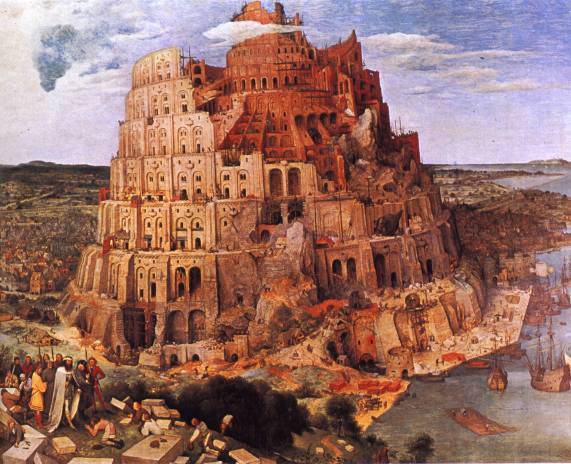
Don't try to build another Tower of Babel. Our ancestors had tried once, and the attempt was failed. If the physical tower failed, could we succeed in building a mental Tower of Babel? I doubt it strongly. Constructing the Semantic Web is not to build a Tower of Babel. It is to simulate our modern human society. It is impossible to achieve "Semantic Google." But Semantic Web will still be available. At the day, however, there are no noble seats reserved for an oracle-announcer Google.

For readers who like to know more about this vision of web evolution, the Part 2 of the web evolution article is an old but coherent version of the view. A newer version is in this blog, the series of "A View of Web Evolution." (Follow the tag web evolution and you can get it.) Any comments are far more than welcomed.


Trackback:

Saravanan's post: Beat Google!

Sunday, March 25, 2007

The religionary side of World Wide Web

(Revised at Sept. 29, 2007)
World Wide Web is a religion. But please don't be panic if you are either an atheist or a fundamentalist. World Wide Web is not a "standard" religion. It is a religion-like Atheism. World Wide Web directly addresses the fundamental of all religions --- the seeking to eternity.

Every religion is an attempt to answer one essential question: what does eternity mean to us? The difference among various religions including Atheism is basically the different answers to this question. To Christians the answer is Jesus Christ; to Muslims the answer is Allah; to Jewish people the answer is Jehovah in the Jewish Bible; to Buddhists the answer is transmigration of the soul; to atheists the answer is that there is no eternity, one's life terminates immediately after death without any form of successors. To WWW users the implicit answer is that we can keep ourselves mentally eternal on the Web.

Almost everyone, no matter whether they believe in Gods or which God they believe, agrees on the existence of immortality. There is, however, difference between physical immortality, spiritual immortality, and artificial immortality. Many religions believe in spiritual immortality; our soul can last forever after the death of body. Some religions even seek to the chance of physical immortality; let body live forever. In contrast, both atheists and theists accept certain form of artificial immortality, i.e., transferring one's consciousness (except self-awareness) into an alternative media that can be assumed staying forever. The fundamental difference between artificial immortality and spiritual immortality is that the latter one also includes the resurrection of humans' ultimate identity --- ones' self-awareness.

Humans have experienced artificial immortality in many forms. Writing books, composing musics, producing artifacts, building constructions, and worshiping antecessors are several typical forms to achieve artificial immortality. We regard ourselves being artificially immortal when our consciousness is kept in history and remembered by our posterity through our publications and artifacts. Based these inherited work, later generations can restore part of the precious consciousness of their ancestors. By this sense, these ancestors reach certain level of immortality though they cannot reclaim the ownership over these consciousness (i.e. the restore of self-awareness).

World Wide Web is a revolutionary new way to achieve artificial immortality. In history, artificial immortality was a reachable but expensive goal. Only the greatest work of mankind could be kept; let it alone the requirements of surviving from wars and natural disasters. But the invention of WWW gives normal persons a cheap and convenient way to keep their consciousness in history for long time. This is the first time ever normal people have a chance be remembered by not requiring great thoughts. Anyone can materializes their consciousness on web even if the thoughts are silly. This is poor man's revolution.

By this sense of artificial immortality WWW is like a religion. Religions addict people into them by the promise of providing immortal future. In similar, WWW addicts web users into it by the promise of providing artificial immortality on the Web. This satisfaction of intrinsic nature of mankind is an essential reason (or probably the most essential reason) why World Wide Web engages such a great success in history. Faith and intrinsic desire are the ones that can never be evaluated by money and time.

This faith to artificial immortality is the fundamental driving force to web evolution. In one of my previous posts, I presented that web evolution is a history of incrementally cloning the consciousness of individual web users. The goal of web evolution is to improve this cloning procedure to its deeper level. Ultimately, we may be able to mentally resurrect any web user by the preserved consciousness. If this time could ever come, no one will die with respect to the others. Pitifully, however, everyone of us could still not live longer than our one life, with respect to ourselves.