Showing posts with label paper review. Show all posts

Saturday, October 04, 2008

Revisiting Web 3.0, When Web Sites Become Web Services

Today I happened to revisit a popular post written by Alex Iskold at March 2007. In the post, Alex claimed that Web 3.0 might be realized when the major Web sites have transformed themselves into Web services. After more than one year and a half, it is interesting to check how well this claim is realized in the real life.

From one aspect, the prediction is becoming true. During this past one and a half year, many Web sites have started to reform themselves into Web services. One typical example is Yahoo. Yahoo was the representative of the traditional Web portal philosophy. By the most recent Y!OS proposal and the release of SearchMonkey and BOSS, however, Yahoo has rapidly transformed much of its original site into Web services. If even Yahoo has made this change, it is convincible to tell that the transformation is close to its successful ending.

In the original post, Alex has worried about the legal issue of Web scraping that may be a result of this transformation. The real world practices show that this worry is probably unnecessary. By transforming a site into services, the site owners actually often gain more (instead of less) control over the site content. Through service design the site owners may more actively prevent external users from illegally copying the information that is not free for sharing.

On the other hand, the Web is still at its 2.0 stage though all the predicted changes are happening. Even after the major sites have already transformed themselves into Web services, Web 3.0 is still an unknown future.

We must have missed something. By just transforming sites into services, the original Web sites actually have not provided anything significantly new to the users. Therefore, how could the Web be entering a new age without a new revolution? This is why the transformation, despite of its inevitability, is not enough to trigger the transition into Web 3.0.

We are still waiting.

Tuesday, July 08, 2008

Invariants on the Web

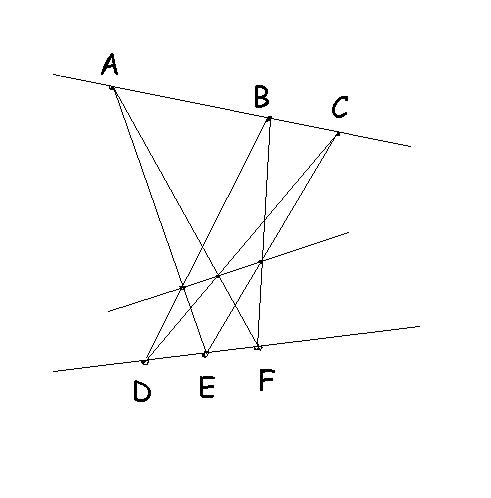
Invariant is something that does not change under a set of transformations. The picture on the right shows Pappus’s Invariant in geometry. The invariant tells that by following certain rules the three intersection points shown in the figure are always collinear no matter how people may draw the two lines and locate ABC and DEF in the lines respectively.

Invariant study is fundamental to any scientific research, especially when the research domain is as complex as World Wide Web. Invariants are supposed to be constant within the specified research scope. By well understanding the invariants we may effectively improve the knowledge over many complicated issues. Therefore, it is unsurprisingly for us to see the discussion of invariant study in the new Web Science Research Initiative.

In "A Framework for Web Science", the flag article of Web Science, Tim Berners-Lee and his colleagues have carefully studied several invariants on the Web. In particular, one invariant is outstanding among all the others. The one is URI (Uniform Resource Identifier). In the paper Berners-Lee et. al. had focused on discussing which invariant represents the binding of semantics with declared objects. There was no final best solution concluded in the paper, however, the one closest to the best was URI.

In varied programming languages we have widely used an invariant, which is declared name. In programming languages such as Java or C++, "each unique object (i.e. with distinct semantics) is declared with a distinct name in one program. By referencing a name, a program accesses the semantics behind the name." Hence declared name is taken to be invariant.

On the Web we are currently using another invariant. "Web researchers decide to use location binding to solve the problem, i.e. URIs and URLs. By default, identical URIs reference the same semantics. Identical URIs on web is the same as identical declared names in programs. However, the name of this URI is varied, i.e. name is no longer an invariant. In constrast, URI becomes a new invariant."

The authors, however, pointed out that indeed neither of the two was proper invariant on Semantic Web (or on the future Web). "The difference is, however, that the requirement of machine understanding," said by the authors. We actually have no ways to promise the consistency of the meaning to which a URI points. It is the same as we cannot enforce users to consistently bind the same name to any unique object on the Web.

Although with the problem, the authors did not provide a satisfactory answer to the problem in their paper. By contrast, they simply emphasized that "W3C suggests that do not transfer URI to another object. That is, whenever you create an object, giving it a unique URI. This requirement is thus the same as that whenever we create a new object in program, make sure we give it a unique name." In other words, please do not change the referred destination of any URI though anybody has the right to perform such a change. This passive resolution is not a satisfactory answer. Deprecated URI has gradually become a severe problem when more and more Web applications start to assume URI to be invariant on the Web. May we have an alternate, active answer to the question?


The figure above shows three basic components when we bind semantics with certain object. They are the declared name, the object itself, and a link connecting the two sides. So which one of them is truly invariant when they are presented on the Web?

As the paper has discussed, neither the declared name nor the link (i.e., uri) is true invariant. "Apple" may be fruit or a software company. We have no way to restrict a handpointing to a fixed destination.

The only exceptional one is the object itself. Although by nature an object can only be itself and it is automatically an invariant to itself, how can we present this invariant besides name and link? This is thus the problem.

We humans have so customized of binding semantics with declared names that we have almost forgotten some more intrinsic binding beneath the surface.

When we are binding the declared name "apple" with the object apple, we are actually making a semantic computation in our brain such as to determine whether it is a fruit with red or yellow or green skin and sweet to tart crisp whitish flesh. For people, a name is not just a name, but also a computational procedure in human brains. It is actually not the name that identifies an object, it is the procedure that identifies the object. The declared name is only a named shortcut referred to the particular procedure in brain. When we convert the procedure to machines, it is an epistemological process.


The picture above shows the new paradigm of semantic binding on the Web. The left side is changed to a particular epistemological procedure (which could be implemented in various ways such as the one we have suggested). Unlike names, these procedures are unique since they can unambiguously answer either yes or no for any identification request. Based on these epistemological procedures, Web links (such as URIs) are upgraded to be Web threads. The Web threads connect the same Web into a varied layer. Moreover, from the philosophical and economical aspects the construction of epistemological procedures and Web threads would be the basis for the production of mind asset.

In summary, epistemological procedure and Web thread are invariants on the Web. Through Imindi, we are going to demonstrate the world something extraordinary happening on the Web.

UPDATE: related reading about URI, "What do people have against URLs or URIs?" by Kingsley Idehen.

Friday, September 07, 2007

A Blend of Future --- some thoughts after the "10 Future Web Trends"

At the Read/WriteWeb, Richard MacManus told about his thought of the top ten future web trends. Despite of this well-written post, the author misses something at the end. Certainly there is only ONE future web instead of TEN future webs. As a long-time reader of Read/WriteWeb, I am more interested in MacManus' view about how these ten trends could be mixed well into one big design. Before waiting for MacManus' response, here is my ONE blend with MacManus' TEN condiments.

This blend is adhere to my consistent vision of web evolution. In this vision, the entire web is considered to be a group of virtual children, who has unique identities of themselves but may or may not do actions or has social with other virtual children. At the same time, human web users are addressed as parents of these virtual children. Not surprisingly (or surprisingly to some people), this vision well blend MacManus' TEN into ONE. In this post, I will not follow the same sequence as MacManus did, though I still keep the original sequential numbers for reference.

The evolution of World Wide Web is similar to the growth of a society of children. Parents need to take the responsibility of raising a new generation. As its return, this growing-up new generation can bring more and more surprises to the parents.

2. Artificial Intelligence --- living spirit of children

A living world needs living spirit. Artificial intelligence, as the name suggests, is a simulation of living spirit. Unlike the current web which is an idle world, the future web will be a living world. By being a living web, web nodes can act by themselves based on pre-specified (or even gradually learned) semantics. The realization of this dream (which is indeed the same dream of semantic web) requires the achievements on artificial intelligence. This is a certain direction to the web future.

1. Semantic Web --- real society (playground) of children
3. Virtual Worlds --- visible societies (playgrounds) of children
9. International Web --- society of parents


Living children needs a playground to act. In particular, such a playground is also a container of a society of these children. Physically, Semantic Web is such a playground. Mentally, the Semantic Web represents a living society of machines. With the augmentation of machine-processable semantics, artificial intelligence becomes useful and producible on the web. Otherwise, (artificial) living creatures without playground are incapable of acting. This is why Semantic Web is another certain trend.

Humans are also visual creatures. Humans are often LESS interested in what they could NOT see. Visualizing playgrounds of machines thus becomes an essential issue. The success of Second Life has shown the profit of this achievement. But Second Life is just the beginning of this trend.

If Semantic Web represents the real society of machines and virtual worlds represent visible societies of machines, shouldn't these two technologies be welded together? (More thoughts about this topic could be found here.)

The real world is and will still be dominated by humans. (I am not assuming any Sci-Fi pictures that robots are going to replace real human beings.) So International Web is another trend of future. Though physically the Web will become a world of active machine agents, it is still a world of machine agents that are controlled by humans. Children's world is a reflection of their parents' world. On its reverse, however, a children's world may also affect the constitution of their parents' world. The study of how a virtual world might affect the real human world will become more and more interesting and substantial with the evolution of World Wide Web.

4. Mobile --- natural communication between parents and children
5. Attention Economy --- commercial link between parents and children


When there are a virtual world and a real world, we need connections between the two worlds. In order to facilitate the life in virtual worlds, we need to strengthen the connections between the two worlds. By applying our metaphor, these connections are natural communication between parents (human web users) and children (machine agents). Mobile technologies are essential for humans to contact their virtual children effectively at anywhere and anytime.

One difference between raising human children and machine children is commercial motivations. As we know, child-education is fairly expensive. Due to inborn nature, humans can educate their own children disregarding the cost. This attitude is, however, generally inapplicable to the education of machine agents. This is indeed an essential obstacle on realizing semantic web. The emergence of attention economy is one of the initial steps to break this barrier. When humans can satisfy the balance between contributing to machine-processable semantics and gathering respective benefits, this attention economy technology enables a commercial link between parents (human web users) and children (machine agents). This trend is another important direction to the future web.

6. Web Sites as Web Services --- adding active capabilities to children
8. Rich Internet Apps --- gathering richer resources for children
7. Online Video / Internet TV --- an example of raising children with special capability
10. Personalization --- raising unique child


These last four predictions on MacManus' list are valuable evolutionary trends about future web nodes. Certainly we can tell more than these four trends in this category. Due to the limit of slots, however, these four selections are critical ones.

Both Web Sites as Web Services (WSaWS) and Rich Internet Apps (RIA) focus on enhancing the execution capabilities on future web nodes. The purpose of WSaWS is turning descriptive web nodes to be executing web nodes. It is similar to raising newborn babies (inactive) to be young boys/girls (active or proactive). In addition to the execution capabilities, we need more executable resources to demonstrate these capabilities. The purpose of RIA is thus gathering more resources for individual web nodes to execute. With the merging of online and offline applications, we are trying our best to exploit all possible resources for machines to execute.

Online Video/Internet TV belongs to another sub-category of web-node evolution. Besides enhancing general execution capabilities, we expect to produce special-purpose future web nodes. A typical example is the construction of video-displaying nodes. This type of nodes becomes especially interesting because of the huge traditional entertainment business realm. But still this realm is only ONE of many profitable business realms. The merging of WSaWS into traditional business realms is an important trend of future web.

Finally, the trend of personalization allows web evolution touching to the heart of individual web users. Not only companies, but also individuals are preferring to build their personalized brands on the web. If companies are trying to selling what they have, individuals are more about trying to buying what they want. Both are typical brands in different senses. This trend of personalization will eventually lead to highly variety of future web nodes. When children grow up, don't their individual personalities become diversity? The future web will definitely be more beautiful and exciting than the current one due to this trend.

Summary

As several comments at Read/WriteWeb pointed out, these 10 trends by their names are only about the web in near future (such as 2 to 5 years) rather than for a long-term period (such as more than 10 years). But if we can watch deeper at their sharing core and blend them together as a united web, there is a greater uniform picture of web evolution. Though the names of particular technologies would be varied from time to time, the general direction of web evolution is clear and certain. This general trend of web evolution is indeed the most crucial one that we must understand, no matter we are businesspersons or research people.

For other predictions about 10 particular trends of the future web, Stephen Downes, who had predicted that Semantic Web would fail, again posted his varied version. It is fun to read the differences. Does anybody have other suggestions?

Sunday, August 26, 2007

The Internet is Dead and Boring?

At August 24, Mark Cuban made another attending grabbing headline at his blog---"The Internet is Dead and Boring." In the post, Cuban explained a viewpoint that "every generation has its defining breakthrough." Nevertheless I agree with this viewpoint, his evidence to support this viewpoint, which is the Internet, is awkward. Cuban claimed that the Internet was at present stopping evolving. The cycle of Internet evolution has come to its end. I am, however, quite doubt of this claim.

According to Wikipedia, the Internet is a worldwide, publicly accessible network of interconnected computer networks that transmit data by packet switching using the standard Internet Protocol (IP). If Cuban's assessment is only about the very low level machine protocols, probably it is boring since many of them have been standards and unlikely to be changed in the future. But just a little bit above these every bottom-level protocols, there are many new problems occurred during the web evolution. For example, how should we design better machine protocols to share semantics over the Internet? This type of demands regularly emerges above the surface when World Wide Web, the most important product due to the invention of Internet, evolves. In fact, we can predict that the upgrade of fundamental internet technologies will not stop before the end of WWW evolution.

bandwidthIn the post, Cuban emphasized the limitation of bandwidth on the Internet. Nevertheless this is a serious problem, it actually is a sign that we need creative innovations on Internet instead of being a signal that the Internet is dead and boring.

The size of bandwidth is always has its physical limit, but humans' demanding of greater bandwidth never ends. This basic contradiction on the Internet is actually a driving force leading new innovations on higher-performance data transmission over the Internet. Besides paving more optical lines underground, we can also invent new protocols and new internet communication models to solve the bandwidth problem. As a metaphor, the bandwidth problem on the Internet is similar to the limit of time in our real life. As we know, we only have 24 hours a day and this bandwidth can never be increased. But does it mean that we cannot have better communication among people due to this limit? Certainly not! We can have better scheduling and communication methods so that the time usage could be optimized. For many centuries, people still have ways to invent new ideas of using time. If innovations on using real-world time never ends, why should we be pessimistic about the dead of Internet due to the limit of bandwidth?

In conclusion, the Internet might be dead and boring some day, but it is definitely not at present. The living progress of web evolution seeks for new innovations on basic internet functions. The demand of better consuming of bandwidth also requires new innovations on the Internet. The future of Internet is exciting. Let's all look forward to the new innovations of the Internet!

Monday, June 25, 2007

Article Review: Embracing "Web 3.0"

Ora Lassila From time to time, I wrote short reviews about some interesting articles. To be honest, being a critic is much easier than being a creative writer. All these orginal authors are tremendous. They addressed excellent insights on these articles. My purpose is only to share my understanding after reading their work, and try to broadcast these brilliant work to more people.

James Hendler Not long ago, two leading scientists of web research, Ora Lassila and James Hendler, published an article titled Embracing "Web 3.0" at IEEE Internet Computing. This is a great article addressed the understanding of the buzzword "Web 3.0" and even the web beyond it from top Semantic Web scientists. This article begins with the addressing of a popular New York Times article by John Markoff, which claimed Web 3.0 to be the Semantic Web. Many Semantic Web researchers, including these two authors and me, do not like this naming. But all of us agree, as addressed in this article, that "we enthusiastically embrace the technologies it is bringing to the field."

Brief Summary

This article contains three parts. At the first part, the authors briefly introduced some background of Semantic Web probably to the readers that are lack of knowledge about the Semantic Web. At the second part, the authors presented their understanding of what "Web 3.0" might look like. In particular, the authors have addressed the adoption of RDF and SPARQL in the industry domain. At the third part, the authors addressed their dream beyond Web 3.0. As a matter of fact, the descriptions seem going back to the original dream of Semantic Web, which have been discussed repeatedly among Semantic Web researchers for years. In the authors' mind, the so-called "Web 3.0" is nothing but a short period of infant Semantic Web.

Comment and Thought

In this article, the authors presented that Semantic Web "supports ... a view of information processing that emphasizes information rather than processing." Despite of agreeing with what the authors wanted to emphasize, this sentence itself is dangerous. This sentence delivers a hint that Semantic Web is primarily a stationary web (since it is more about information) but not an active web (since it is less about processing information). This latent message becomes very dangerous because without the ability of processing, what on earth can we expect the production of semantics? Information is produced for processing. But without the focusing of processing, the momentum of producing information loses. In fact, this is the problem I repeatedly blogged. This is why the realization of Semantic Web becomes so slow, and it is still quite overlooked by many people. Unless we start to refocus the attentions onto the processing side, Semantic Web would not be realized in near future.

A lesson we have learned from the previous "AI hype" is that "you can't sell a stand-alone 'AI-application'," addressed by the authors. I totally agree with this point. Unfortunately, however, it seems that many people still do not learn from it. This lesson basically tells us that semantic Google is impossible to be built. No company by itself can build a super-program, even if it might be very well paralleled and distributed, that semantically processing all knowledge on the web. In order to realize the real, pragmatic semantic search, collaboration of almost every web user on the web is a demanding. That is, the solution could only be a search network that is operated by every one, but NOT operated only by one big node. This is thus the vision of the semantic search web.

"Web 2.0 is most a social revolution in the use of Web technologies," addressed by the authors. Nevertheless Web 2.0 is a social revolution, it is far beyond a social revolution. Web 2.0 is also a major landmark on web revolution. Unlike many other Semantic Web dedicators, I am kind of like the term "Web 2.0." From the view of web evolution, this term very well reveals a fact that our web is evolving and it is now at its second major stage of its evolution. The hype of Web 2.0 changes not only our real human society, but more importantly it also changes our virtual human society, i.e., the World Wide Web itself. The quality of web resources has been significantly upgraded. Semantic Web researchers must not only focus on Floksonimies and Microformats. Thought these two things are unquestionably important, other things such as the implementation of community collaboration might be at least as important as, if not more important than, the mentioned two technologies.

Web 3.0 is more than RDF and SPARQL. In short, the trend of web evolution is the web being more and more alive. Machines (or machine agents) on the web will start to think of things by themselves based on their learned semantics. No single machine could think all the knowledge. But only if individual ones are thinking of their limited knowledge, the collaboration of all of them can handle close to the entire set of web knowledge. Similarly, no individual humans know much of knowledge. But the whole set of human knowledge becomes so huge and it is so great because we are not just individuals. In contrast, we are collaborated people and our society has been evolved to well cooperate individual knowledge. This is what Web 3.0 and the ones beyond it would deliver to us.

Sunday, May 06, 2007

Evolution of Web Links, another direction of thoughts

Danny Ayers had his most recent column at IEEE Internet Computing: Evolving the Link. In this article, Ayers summarized his vision of how web links evolve with the progress of World Wide Web. Agreeing with his vision, I, however, have some supplementary thoughts about the evolution of web links.

Before presenting my supplementary thoughts, I would like to briefly review what Danny presented about web link evolution. In general, Danny's vision followed a strict technical line. At the beginning, web link were anonymous connections that linked one web page to another. Using his example, "< href="http://creativecommons.org/licences/by/2.0/">cc by 2.0< /a>" produces an anonymous connection from the page that contains this specification to a particular web location: "http://creativecommons.org/licences/by/2.0/". Though each destination has its distinctive meaning, web links themselves mean nothing else except that the referenced web resources are ABOUT the local text. The meaning of ABOUT is, however, simply too rich to be properly distinguished.

To solve the problem, the "rel" attribute is designed so that it describes de relationship from the current document to the destination resource. For example, "< href="http://creativecommons.org/licences/by/2.0/" rel="license">cc by 2.0< /a>" shows the meaning of the link to be "license." Again, this solution still has its problem because the meaning of content inside the rel attribute is often not machine-processable.

In this column article, Danny presented that a potential solution to this last problem is to treat links as data. Thus, we map not only data but also links to proper RDF descriptions. With these mappings, machines can automatically interpret the meanings of not only resource nodes on the web, but also the links among these resource nodes. This vision of web links thus concluded the article.

Nevertheless I agree with Danny's vision, I feel something else also important to the evolution of web links but missed in discussion at this article. Besides semantic meanings, vulnerability is another essential aspect of web links. Traditionally handcrafted, anonymous web links are often vulnerable to individual prejudice. For example, I have produced a normal web link from this post to Danny's blog, which shows a relation of this post to Danny. Meanwhile, I can also subjectively remove this link (but not the content) so that there becomes no immediate link from this post to Danny, though indeed there should be such a link since the content is not changed. This simple example shows a basic problem about traditional links---they are vulnerable to individual prejudice.

Though to solve this vulnerability problem is not the intentional driving force of web link evolution, an important side effect of this evolution is the gradual invulnerability of web links. With the emergence of Web 2.0, more and more indirect web links are created based on common tags. For example, I have tagged this post with a keyword "Danny Ayers," while at the same time, Danny's blog is also tagged by the keyword "Danny Ayers." Therefore, even if I have removed a normal href-style direct web link in my post to Danny's blog, there is still an immediate link between this post to Danny's blog because we have shared a common tag. Due to the objectiveness of tagging, this type of web links becomes less vulnerable to individual prejudice than the previous purely handcrafted web links.

When the web evolve forward to the ideal semantic web, we can predict the creation of more and more objective links between web resources. These links are going to more and more based on common meanings (objectiveness) rather than individual preferences (subjectiveness). As Danny presented in his column, when links are shared as open data annotated by formal taxonomies, the existence of these links becomes less and less vulnerable to individual prejudice. It is the content itself that would decided the links.

This evolutionary aspect of web links is important to not only web links, but also the WWW in general. It means that the web is going to be weaved not only in more and more details, but also more and more objectively. Based on this conclusion, we can make several interesting predictions about the future web.


  1. Tags and annotations are going to be premier resources on web search. Due to their objectiveness (less vulnerable), the network composed by tags and annotations is going to be more stable than the network composed by handcrafted links. This fact may significantly help improve the efficiency of web search.

  2. The weight of tags and annotations are going to be more and more critical on ranking research results. The balance between these weights (the side of objectiveness) and link popularities (the side of subjectiveness) will be an essential issue on new web search ranking algorithms. Does it mean the dusk of the PageRank algorithm and thus the declining of Google? We are not sure yet. But at least this is not a positive news to Google.

  3. Tags and annotations are going to weave the web into close-related communities with distinct topics. As a result, vertical search engines may replace horizontal search engines becoming the basis of web search. At present, vertical search is relied on horizontal search and then provide more details on particular domains. In the future, horizontal search will be based on vertical search and then provide more details on cross-domain communication. This role switch on web search may significantly affect the structure of web industry, especially the web search businesses.


I have more discussions on web evolution in general in my article of Evolution of World Wide Web. The most recent post is the Part 2, Web Evolution Theory and The Next Stage. In this part, we studied several web evolution laws and composed them together to be a basis for predicting the evolutionary future of World Wide Web. Though these are only our viewpoints, we hope it brings some fresh air into the study of web evolution.

Monday, February 12, 2007

article review: The Death of Computing


Neil McBride recently wrote an interesting article titled "The Death of Computing." In the article, Neil foresaw the decline of Computer Science, due to the decreasing interest about Computer Science from the student side.

By reading this article, it brings me a memory back to the early 90th, when the hype of Computer Science barely started. I was a colleage student majoring on Mechanical Engineering at the time. In 1990, I thought Computer Science was interesting but it was not a real branch of "science" to work on. It seemed to me that Computer Science was nothing but a tool for varied scientists, engineers, or even normal people. Everybody might need to know something about computer and basic programming. But only very few people were really needed to develop these softwares.

This type of thoughts were soon overthrown by the hype of Computer Science, especially the hype of World Wide Web at the rest of 90th. Computer Science became a word that was vogue, modern, and high technical. Even myself, I have changed my major from Mechanical Engineering to Computer Science. I must say that CS is really an exciting field. Comparing to the traditional research fields such as ME, CS grows much faster and it is full of chances for young researchers to explore.

But now, what has happened? Why suddenly CS has been foreseen to its death. I believe a problem of current Computer Science education is that it mixed SCIENCE with TECHNOLOGY too much. For many students, it seems that CS education equals to the programming education, which is completely wrong. This article addressed this important problem, though the author was too pessimistic to the consequence of this problem.

Back to my understanding of CS on the early 90th, CS was about programming languages and theories for a period of time. It was because at the time programming languages were not mature enough for other research to move forward. Essentially, programming languages are the basis of computer science research because we need programs to verify theories. But it is incorrect to limit CS being programming only. To its end, Computer Science is about how to simulate human thoughts using machines. This is a field that probably has no ends. Programming for Computer Scientists likes the lab experiments for chemists and physicists. Even if physicists or chemists do not know how the experimental devices are built, they can still be great researchers on their fields because building these devices are indeed not the main interest of the research, though these devices are necessary tools to reach the main interest.

I believe the research of Computer Science is repeating the same orbit that had been walked by the other traditional branches of science. During the early stages of physics and chemistry, many researchers had focused their work on developing lab equipments to facilitate the research (and even until now, few researchers still work on this type of study). For students, learning to using these experimental equipments is also an important part of their study, but it is not the goal. The real goal of physics and chemistry is to discover natural laws rather than to build more experimental devices. And this is why their research is named to be "science."

I think Computer Science education should start to address this problem and let students understand the real meaning of Computer "Science." Pure training of programmers is not a proper goal of Computer Science education. In my mind, the training of programmers may need to be handed to individual departments. To the end, the programmers always work for specific domains of work and it is best that they are the experts on both programming and domain knowledge. Unless they work for the domain of Computer Science, it is less valued to train many Computer Science programmers to handle cases on varied domains.

Monday, February 05, 2007

Article review: We are the Web

I just read a remarkable article written by Kevin Kelly---"We are the web." Kevin is a well-known writer, editor, publisher, and possibly the most important to this context, he is a famous participant and observer of "cyberculture". When I am writing my article about web evolution, I am so glad and feel amazing to watch several of the thoughts been forseen by these great thinkers such as Kevin.

But looking back now, after 10 years of living online, what surprises me about the genesis of the Web is how much was missing from Vannevar Bush's vision, Nelson's docuverse, and my own expectations. We all missed the big story. The revolution launched by Netscape's IPO was only marginally about hypertext and human knowledge. At its heart was a new kind of participation that has since developed into an emerging culture based on sharing. And the ways of participating unleashed by hyperlinks are creating a new type of thinking - part human and part machine - found nowhere else on the planet or in history.


Web begins from its newborn stage. After more than 10 years, it finally comes to the pre-school stage. The lack of creative thinking of machines is thus understandable. In essence, are there many people who care about what newborns think? Even after they become pre-school kids, we still often neglect what they think because their thinking can barely bring any value to the world. Therefore, we have no driving force to implement mechanism to enable machines think.

But this phenomenon is going to change on the next-generation web. We start listening to what elementary-school children think because in this new stage of human life, children do have the capability of producing valuable results based on thinking. Hence it is valuable for us to enable machines think when web evolves to this new stage too. Web evolution is directing to this goal. Kevin will see what he expects becoming reality in the near future (though it must be progressive).


No Web phenomenon is more confounding than blogging. Everything media experts knew about audiences - and they knew a lot - confirmed the focus group belief that audiences would never get off their butts and start making their own entertainment. Everyone knew writing and reading were dead; music was too much trouble to make when you could sit back and listen; video production was simply out of reach of amateurs. Blogs and other participant media would never happen, or if they happened they would not draw an audience, or if they drew an audience they would not matter. What a shock, then, to witness the near-instantaneous rise of 50-million blogs, with a new one appearing every two seconds. There - another new blog! One more person doing what AOL and ABC - and almost everyone else - expected only AOL and ABC to be doing. These user-created channels make no sense economically. Where are the time, energy, and resources coming from?


One fundamental and unique character of human beings is the expection of being immortal. This is the reason why religion only exists among humans but not any other animals. This character, however, is the basic driving force of blogging. Though certainly everyone will pass away eventually, it is still very attractive if we known that we can keep the virtual-self (i.e. our thoughts, beliefs and personal history) forever on the web. "I am not ash in history but a living person that has contributed to the world!" This is an internal voice on almost every one of human beings. Blogging is the current way of allowing normal people to be immortal. But I am confident that it is just a beginning. Virtual clones of us are going to be produced on web and people are going to be enchanted by this type of new technologies.


There is only one time in the history of each planet when its inhabitants first wire up its innumerable parts to make one large Machine. Later that Machine may run faster, but there is only one time when it is born.

You and I are alive at this moment.


Yes, I deeply appreciate for my living in this great time. Now it is another great time period on human history as the time periods about the first and second industrial revolution. We are within a new industrial revolution. There are so many new inventions now, just like what had happened before. Similarly, there are (and will be) many great names both on people and companies in this period. Some of them have already appeared and some others are not yet. Surely we should be glad that we are now living in this greatest time, and may have chances to witness some greatest legends in the history.

Monday, January 15, 2007

Paper Review: two Websense columns by Danny Ayers

Recently, Danny Ayers published two successive Websense columns on Internet Computing: "The Shortest Path to the Future Web" and "From Here to There." In these two columns, Danny presented his views of the current web moving towards the Semantic Web. This is a brief summary of the two articles based on my reading.

In his first column, Danny discussed a path to the future web, which, by his words, may or may not be the shortest one, however. Semantic Web technologies offer a logical model that are full of potentials. This is what Danny want to deliver to readers.

This first column starts with a summary of the traditional web. Danny emphasized two points: simplicity of the web and communication model. The majority of web users do not have much knowledge of web technologies. Simplicity is surely a key of success. Moreover, the strength of WWW lies on its communication model. Most of the time, WWW is exciting because it links everybody. By this sense, the evolution of WWW very much depends on the advancement of its communication model.

Then Danny discussed the ways of revising the web. I am particularly interested in his comparison between incremental and leaping progresses. In fact, Web 2.0 shows the combination of these two types of development. With several years of incremental progesses on its key techniques (such as tagging and blogging), the web jumps to a new level (becoming Web 2.0). The aggregation of many minor increments can eventually lead to a fundamental leap. Is the same process happening right now on the realization of Semantic Web? The current Web 2.0 hype can bring Semantic Web researchers many hints. I believe this is what Danny want to express.

In his second column article, Danny quoted an interesting proverb by George E.P. Box: "All models are wrong. Some are useful." This is a very interesting observation, though I am still not very sure how it is applied in the article.

Semantic Web is thought to be the web of data. I have seen this representation in many places. But I am a little bit afraid whether we have pushed this argument too far. Semantic Web adds machine-processible semantics for web data. But is this process of semantic annotation objectively or subjectively? The statement (web of data) likely emphasizes more on the objective side than the subjective side. As a result, the role of humans on deciding the meanings of data becomes unclear. Will it be a big problem later?

Are we on a transitional web now? If yes, are we within the transition from Web 1.0 to Web 2.0, or within the transition from Web 2.0 to Semantic Web? I think these are interesting questions. Microformats have been mentioned by more and more researchers and developers. Will micorformats be a standard presentation in future web? Or is it itself also a "transitional term"? We may still need time to answer these questions.

Sunday, October 15, 2006

Paper Review: Creating a Science of the Web

Science Magazine, 11 August 2006: Vol. 313. no. 5788, pp. 769 - 771
Creating a Science of the Web Tim Berners-Lee, Wendy Hall, James Hendler, Nigel Shadbolt, Daniel J. Weitzner

Understanding and fostering the growth of the World Wide Web, both in engineering and societal terms, will require the development of a new interdisciplinary field.
This is a remarkable observation. Web research is starting to be beyond the traditional scope of Computer Science, which, by Berners-Lee and his colleagues, "is concerned with the construction of new languages and algorithms in order to produce novel desired computer behaviors." Behaviors on the Web are not only about computer behaviors, but also about human behaviors. On the Web, we are not using computers to simulate human behaviors. Instead, we are expecting computer behaving to cooperate with humans. This is a portion of Web Science that is beyond Computer Science.

Comparing to physics and biology, Web Science is to analyze Web behaviors and try to "find microscopic laws that, extrapolated to the macroscopic realm, would generate the behavior observed." This perspective is again different from traditional Computer Science. There are no natural laws in Computer Science research. We may adopt (or adapt) natural rules for Computer Science research to follow or simulate in contrast to discover natural laws in Computer Science research. There is, however, a semi-natural existence in Web Science research, which is the World Wide Web itself. Although the Web is an artificial creature, it has grown to be a nearly natural existence because no single human (or even entire human beings) may shut it down. Therefore, Web Science is indeed unique and it is a hybrid branch of nature science and social science.

Reference resources: