Showing posts with label Kevin Kelly. Show all posts

Monday, July 25, 2011

Technology and Morality

In a recent interview with Christianity Today Kevin Kelly shared his thoughts on how God may think of the man-made technologies. Nicholas Carr, one of my favorite technology author and blogger, then shared his arguments against Kelly's viewpoints in two very interesting posts (1, 2). All of these discussions are worth of reading twice.

"Is technology a moral force?" Nick Carr asked this question in his second post. Kelly insisted that the progress of technology achievement makes our society better. Therefore, technology certainly is a moral force if we accept that we live happier and happier because of the technological achievements. By contrast, Carr believe that technology does nothing about goodness or badness. I incline to Nick's viewpoint on this topic though I agree more to Kevin's general worldview.

Technology contributes nothing to improve or to decrease the overall morality of the society. Technology is not a moral force that we may use to lift the happiness of people overall.

The central point in Kelly's argument is that the advance of technology provides people more options of living. Therefore, Kelly followed, by owning more options of living people are able to live better and be happier since they may then live in their preferred way and do their preferred things with the loosened constraints.

I do not agree to this point. For example, my parents do not feel happier with all the new technologies. Many times they talk about the good old days. Though the life seemed harder with little support from technology, they felt happier internally in their heart.

Technology brings nothing about "love", if it is what Kelly truly wanted to address. If Kelly's point is valid, won't we have to agree that rich people must be generally happier than poor people since rich people generally live with the more advanced technology? In fact, we do not have this conclusion over the history. Rich people do not have more love than poor people have. The enjoyment of the advanced technology does not lift the morality of the respective classes of people. Technology does provide more options of living. But the more options of living does not make people live in a higher moral life.

By reading the interview, I felt most astonished by the following claims by Kelly.

"We are here to surprise God. God could make everything, but instead he says, "I bestow upon you the gift of free will so that you can participate in making this world. I could make everything, but I am going to give you some spark of my genius. Surprise me with something truly good and beautiful." So we invent things, and God says, "Oh my gosh, that was so cool! I could have thought of that, but they thought of that instead."

We are not going to surprise God in any sense. As a matter of fact, I do not believe that God really cares any about our technological achievements. According to the Bible, anything must be realized immediately when God says so. Then which technology of us may surprise God. HE is beyond any technology! Will we be surprised by the greatest ever technology invented by ants (if ants may invent)? Let it alone that the greatest ever technology of mankind must have not been yet invented if there is a one.

Morality is the living standard God puts in our mind. The achievement of our technology is not going to improve it. Neither will it deprive morality. But God may still be happy of the technological improvement we make. It is not because through it we lift the morality of the society. It may only due to that by doing so we show that we want to help the others. This willing to help the others is a demonstration of love. And that is all what God really cares.

Sunday, February 01, 2009

Do not exaggerate the importance of machines

There is a trend, which began several centuries ago since the First Industrial Revolution and it is still a fashion until today. We often tend to exaggerate the importance of machines, and think of this exaggeration to be scientific prediction, though history has repeatedly disapproved the imaginations.

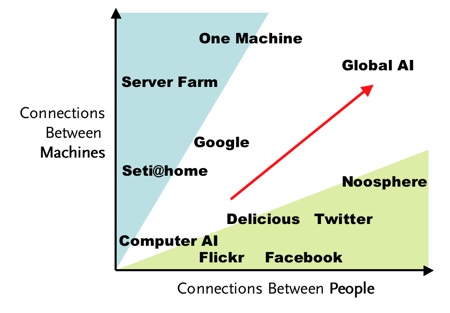
Kevin Kelly, one of my most respected living thinkers, has a recent post titled Two Strands of Connectionism. In the post, Kevin claimed the co-existence of human connections and machine connections on the Web. Kevin thus suggested the future Web to be a balanced network in the middle of the two strands of connectionism. Nevertheless the vision is illuminating, Kevin exaggerated the importance of machines and, inevitably, overlooked the true value of human mind.

Kevin is right on observing the two strands of connectionism. What I do not agree to Kevin is, however, to equalize the importance of the two strands. The danger of this equalization is that it easily misleads people to believe that the Web intelligence is a fair mixture between the collective human intelligence and the collective machine intelligence. In fact, there is only human intelligence on the Web. The so-called machine intelligence is nothing but a steady, lack of self-creative, and embodied portion of the human intelligence. Any exaggeration of the machine intelligence would only lead us to some unrealizable plots that waste our resources and time.

We should be clear that the strand of machine connection is a way of distributing the strand of human connection instead of being another independent set of connections. By this vision, we may grasp the true spirit of World Wide Web evolution, which is essentially an evolutionary reorganization of human intelligence in contrast to constructing certain independent machine intelligence that is beyond humans. The greatness of the Semantic Web is not about building up machine intelligence. By contrast, it is to be able to connect various pieces of human intelligence in the mind of different individual human beings that we can never realize in any other environment except of the Semantic Web. Whether or not understand this distinction could be fundamental and crucial to the success of any Semantic Web business institute.

Tuesday, September 23, 2008

Technology

By Kevin Kelly,

Technology is a type of thinking. ... However what technology ultimately offers is far greater that some more bad and some more good. In the sum it offers increased possibilities and choices. And this is why we gravitate to it so.

Technology is a type of thinking. So may Thinking Space be renamed as "Technology Space"? Sounds not bad, isn't it?

In fact, technology is a type of productive thinking. An essence of technology is to produce. Good or bad, technology produces. More production eventually leads to more choices and then more possibilities, which is thus the beauty.

Monday, February 05, 2007

Article review: We are the Web

I just read a remarkable article written by Kevin Kelly---"We are the web." Kevin is a well-known writer, editor, publisher, and possibly the most important to this context, he is a famous participant and observer of "cyberculture". When I am writing my article about web evolution, I am so glad and feel amazing to watch several of the thoughts been forseen by these great thinkers such as Kevin.

But looking back now, after 10 years of living online, what surprises me about the genesis of the Web is how much was missing from Vannevar Bush's vision, Nelson's docuverse, and my own expectations. We all missed the big story. The revolution launched by Netscape's IPO was only marginally about hypertext and human knowledge. At its heart was a new kind of participation that has since developed into an emerging culture based on sharing. And the ways of participating unleashed by hyperlinks are creating a new type of thinking - part human and part machine - found nowhere else on the planet or in history.


Web begins from its newborn stage. After more than 10 years, it finally comes to the pre-school stage. The lack of creative thinking of machines is thus understandable. In essence, are there many people who care about what newborns think? Even after they become pre-school kids, we still often neglect what they think because their thinking can barely bring any value to the world. Therefore, we have no driving force to implement mechanism to enable machines think.

But this phenomenon is going to change on the next-generation web. We start listening to what elementary-school children think because in this new stage of human life, children do have the capability of producing valuable results based on thinking. Hence it is valuable for us to enable machines think when web evolves to this new stage too. Web evolution is directing to this goal. Kevin will see what he expects becoming reality in the near future (though it must be progressive).


No Web phenomenon is more confounding than blogging. Everything media experts knew about audiences - and they knew a lot - confirmed the focus group belief that audiences would never get off their butts and start making their own entertainment. Everyone knew writing and reading were dead; music was too much trouble to make when you could sit back and listen; video production was simply out of reach of amateurs. Blogs and other participant media would never happen, or if they happened they would not draw an audience, or if they drew an audience they would not matter. What a shock, then, to witness the near-instantaneous rise of 50-million blogs, with a new one appearing every two seconds. There - another new blog! One more person doing what AOL and ABC - and almost everyone else - expected only AOL and ABC to be doing. These user-created channels make no sense economically. Where are the time, energy, and resources coming from?


One fundamental and unique character of human beings is the expection of being immortal. This is the reason why religion only exists among humans but not any other animals. This character, however, is the basic driving force of blogging. Though certainly everyone will pass away eventually, it is still very attractive if we known that we can keep the virtual-self (i.e. our thoughts, beliefs and personal history) forever on the web. "I am not ash in history but a living person that has contributed to the world!" This is an internal voice on almost every one of human beings. Blogging is the current way of allowing normal people to be immortal. But I am confident that it is just a beginning. Virtual clones of us are going to be produced on web and people are going to be enchanted by this type of new technologies.


There is only one time in the history of each planet when its inhabitants first wire up its innumerable parts to make one large Machine. Later that Machine may run faster, but there is only one time when it is born.

You and I are alive at this moment.


Yes, I deeply appreciate for my living in this great time. Now it is another great time period on human history as the time periods about the first and second industrial revolution. We are within a new industrial revolution. There are so many new inventions now, just like what had happened before. Similarly, there are (and will be) many great names both on people and companies in this period. Some of them have already appeared and some others are not yet. Surely we should be glad that we are now living in this greatest time, and may have chances to witness some greatest legends in the history.