Showing posts with label philosophy. Show all posts

Monday, July 25, 2011

Technology and Morality

In a recent interview with Christianity Today Kevin Kelly shared his thoughts on how God may think of the man-made technologies. Nicholas Carr, one of my favorite technology author and blogger, then shared his arguments against Kelly's viewpoints in two very interesting posts (1, 2). All of these discussions are worth of reading twice.

"Is technology a moral force?" Nick Carr asked this question in his second post. Kelly insisted that the progress of technology achievement makes our society better. Therefore, technology certainly is a moral force if we accept that we live happier and happier because of the technological achievements. By contrast, Carr believe that technology does nothing about goodness or badness. I incline to Nick's viewpoint on this topic though I agree more to Kevin's general worldview.

Technology contributes nothing to improve or to decrease the overall morality of the society. Technology is not a moral force that we may use to lift the happiness of people overall.

The central point in Kelly's argument is that the advance of technology provides people more options of living. Therefore, Kelly followed, by owning more options of living people are able to live better and be happier since they may then live in their preferred way and do their preferred things with the loosened constraints.

I do not agree to this point. For example, my parents do not feel happier with all the new technologies. Many times they talk about the good old days. Though the life seemed harder with little support from technology, they felt happier internally in their heart.

Technology brings nothing about "love", if it is what Kelly truly wanted to address. If Kelly's point is valid, won't we have to agree that rich people must be generally happier than poor people since rich people generally live with the more advanced technology? In fact, we do not have this conclusion over the history. Rich people do not have more love than poor people have. The enjoyment of the advanced technology does not lift the morality of the respective classes of people. Technology does provide more options of living. But the more options of living does not make people live in a higher moral life.

By reading the interview, I felt most astonished by the following claims by Kelly.

"We are here to surprise God. God could make everything, but instead he says, "I bestow upon you the gift of free will so that you can participate in making this world. I could make everything, but I am going to give you some spark of my genius. Surprise me with something truly good and beautiful." So we invent things, and God says, "Oh my gosh, that was so cool! I could have thought of that, but they thought of that instead."

We are not going to surprise God in any sense. As a matter of fact, I do not believe that God really cares any about our technological achievements. According to the Bible, anything must be realized immediately when God says so. Then which technology of us may surprise God. HE is beyond any technology! Will we be surprised by the greatest ever technology invented by ants (if ants may invent)? Let it alone that the greatest ever technology of mankind must have not been yet invented if there is a one.

Morality is the living standard God puts in our mind. The achievement of our technology is not going to improve it. Neither will it deprive morality. But God may still be happy of the technological improvement we make. It is not because through it we lift the morality of the society. It may only due to that by doing so we show that we want to help the others. This willing to help the others is a demonstration of love. And that is all what God really cares.

Friday, February 04, 2011

Turing Test and Web Evolution

Machines may have will, but it is not free will.

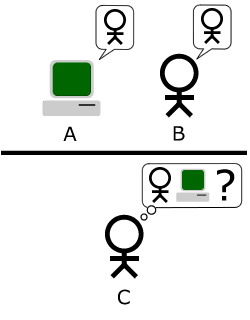
In 1950, Alan Turing challenged if machines could ever deceive a human judge from being identified non-human by answering questions indistinct to the real human responses. This proposed experiment is now well-known as the Turing Test, an essential concept in the philosophy of artificial intelligence. Now computer scientists generally agree that the Turing Test in a single standalone computer is likely unfeasible. With the rise of World Wide Web, however, people quickly revise the question by asking whether the collectivity of all computers in the world may eventually pass the Turing Test. May a network of computers do the trick? Or, a little bit more dramatically, may one day WWW evolve to be the Skynet?

To pass the Turing Test machines need to prove they may answer questions by free will, a unique character of the living creatures especially humans. In definition, free will is the putative ability of making choices discarding constraints. Constraints generally exist in any situation. The trick of free will is that independent to any other agent's prediction the agent may determine whether or not his decision is bound to any of the constraints. Free will means the ability of breaking rules with no limit and warning. Then a question follows: may we be able to assign this ability to the machines (discarding whether we will if we can)?

Here is my thought to the answer. If we continue building the computers based on the current computer architecture and programming them using the current type of the programming languages, there is no hope of inventing machine free will no matter of the standalone intelligence or the collective intelligence. The reason? The computer architecture and the programming languages themselves have already settled a set of rigid logic constraints. The machines built upon the architecture and programmed by the languages will not work correctly unless obeying these constraints. Please be aware that working incorrectly due to the technology problem is not a free will. Therefore, no true free will can be realized. In theory, we can always develop a set of questions that can cause trouble by the rigid set of logic to distinguish a machine from the real humans.

Now let's retreat half a step. May the machines have will despite it is not free? I believe, however, that the Web evolution is approaching this goal.

Recently in Wired Magazine, there is an article titled "Algorithms Take Control of Wall Street". In it the authors shared how the robots hired by the Wall Street traders instead of the traders themselves are controlling the stock prices. This scenario is a classic example on how the machines start having will, which is programmed by their human masters. In the article the authors also mentioned how some tragical events had happened due to the machines' will, which, the authors argued, was not really humans' expectation or intention. I think the authors may have underestimated the greedy nature of human beings. Behind the numerous rules there sits a word called "greed". Any single rule must be fair. The overall is, however, the consolidation of the greed. So it was not that the machines suddenly fell into greediness by their free will, the tragedies were nothing but the revealing of the overall greed in Wall Street. "There be no beasts." (quoted from Lois Lowry's Gathering Blue)

With the evolution the Web starts embodying the wills of not only the Wall Street traders but also many of us as the regular Web users. For example, the Google robots silently execute your will every time you press the search button. The Web starts being filled with the embodied wills and the machines claimed the ownership. That machines have will is already a fact.

With will, the machines now can do something fantastic. Also with will, the machines someday may do something horrible than we could imagine. The Wall Street tragedies mentioned by the Wired Magazine article are warnings. There is no any single rule that is particularly evil. It is the overall of all the rules/wills (established by the humans but) executed by the machines that causes the problem. If overall all of us are with good, positive intention, the embodiment of our wills overall will only lead our society and our world to becoming better and better. On the contrary, the tragedies will be inevitable. A little bit "harmless" greed by each of us can be accumulated by the machines that claim the embodied wills to become a great evil overall. Which future and which type of the Web we want it to be? The decision is in the hand of everyone of us. Now!

To the end, let's remember it. Machines may have will, but it is not free will. The future is in the hands of the free-thinking people, who are you and me. Let everyone of us uses the Web with good intention and thus the Web will be good to us. Otherwise, the tragedies will not just happen in the Wall Street.

Sunday, January 30, 2011

Misunderstanding is indeed creating

A distinction between humans and computers are that the former ones may misunderstand while the latter ones must either understand or do not understand.

If one asks what the mother of creation is, I choose misunderstanding. Any creation is an intentional or unintentional misunderstanding to a given fact. If we always think of facts as they are already known, no creation could ever be made. A creation happens only when a person misses the correct sense of a fact, either by his own intention or simply by accident. That is, he actually "misunderstands" the fact in the sense of "correct" logic.

Misunderstanding is a very powerful capability of human beings. By misunderstanding we break the flow of the regular logic derivation to encounter what must not been seen. Misunderstanding is not the single source for creating. But it is a distinctive source that tells the difference between humans and machines. Based on the current computer architecture, computers cannot misunderstand because it must always obey the correct logic derivation or otherwise it crashes. May quantum computer break this barrier for the machines?

Monday, January 10, 2011

Apple and a Mutant of Web it Creates

Holding an Apple product such as an iPhone or an iPad has been a fashion, let it alone the usefulness of the devices themselves. I am not a fashion speaker. However, what has driven me very excited about Apple is a mutant of the Web Apple creates. Intentionally or subconsciously Apple makes us a web backed by a different thinking. Due to the company's great success in business the thinking has already invaded into the mind of many of us though few might have noticed it. In this post I share my viewpoint about this Apple-created mutant and its relation to the eastern style of thinking we discussed in the last post.

The Web invented by Sir Tim Berners-Lee was conducted by a classic western style of thinking. The Web was composed of many nodes where each node represents a molecular object. Then there are hyperlinks connecting these nodes arbitrarily. In general every node of the Web has a name (typically a page title) while the hyperlinks are anonymous. This distinction is both essential and crucial. With name a thing declares its tangible intent and identity. Without a name, on the contrary, the intent of a thing is intangible. Therefore, by this design the Web is a world of objects/data and their categorization---the typical western style thinking. The initial Yahoo search was based exactly on this thinking in order to disclose the complete hierarchical structure of the Web, and in the first few years of the Web age the attempt succeeded more or less.

The fallen of Yahoo search and the rise of Google search was a remarkable event in the history of Web evolution. Besides all the other meanings, it tells that the Web had evolved by itself and broken the initial foundation upon the western style of thinking. Google's success showed that it was links instead of categories of the pages that mattered more when sorting the Web. The ones without name were more essential than the ones with name when we explored the topological structure of the Web. If only we think of this discovery once more, isn't the message itself shocking enough?

Then there was Apple.

Unlike Google who sorts and organizes the Web, Apple simply wants to use the Web. Unfortunately, like many other Web-based companies in the beginning Apple might have found that the Web was not very friendly for being consumed. Information on the Web is highly tangled and the traditional thinking of knowledge categorization is too slow to untangle the mess. Unlike an academic research institute, a company cannot wait since money never sleeps! So Steve thought of a solution.

At old days the ancient Chinese had faced the same problem but about the real world. Unlike the more idealistic ancient Greek who were enthusiastic in exploring the world knowledge bottom-up from the foundation, the ancient Chinese were more materialistic (or more practice-oriented; and until now they still are indeed). The ancient Chinese chose a middle-out way to explore the world. Neglecting object categorization and even logic, the ancient Chinese chose the methods of practice be the solution. Once one might have grasped a method of practice, he could apply the method universally to solve the other similar problems in the world. This is a core of the ancient Chinese philosophy. Note that when the "similar" in Chinese's mind is quite different from the "similar" in a westerner's mind. The westerners normally assume "similarity" within a common domain/category while the easterners (especially the ancient Chinese) generally do not have this hypothesis. Due to the difference it is not uncommon for a Chinese character being assigned multiple varied meanings in different (could even be mutually excluded) domains, and it is not unusual to find a Chinese character but with the absolute opposite meaning by simply being assigned a varied context. This type of word interpretation is rare in the western languages such as English, which generally pursue the preciseness and uniqueness on term definition. By focusing on grasping and utilizing the methods of resolutions in contrast to understanding the essence of the causes of problems, the ancient Chinese advanced the civilization faster than the western competitors in the early ages of human society. Apple adopted a similar solution as the ancient Chinese did.

Apple conducted a web of methods. Apple created a space so that people could implement their methods of consuming the Web and publish them. In contrast to selling information, Apple sells information-consuming methods. After buying an App, the users can decide how to use the method and which resources to be consumed. Through the AppStore, Apple creates a mutant of the Web in which the Apps (methods) are the main threads where objects are context.

Apple's methodology brings the company tremendous success in business. Have Apple added more regulation to the Web? Hardly any. Unlike the Semantic Web project, Apple's approach does little help for the Web to become a better organized place. But like what ancient Chinese did, through this methodology Apple gives the layman users the greatest freedom of utilizing their knowledge. In the ancient Greek society, knowledge was only on the hand of the intellects because it was studied in such an academic way. Comparatively people without much knowledge could learn a method and then applied it in their own life through their own human creativity by nature in the ancient Chinese society. It was an important reason that ancient China grew faster than the civilization in the western society. Now Apple cloned the similar methodology in its business.

Summary

Without the western style of thinking, we would not have invented World Wide Web. It was the objects and the links that constructed the skeleton and made the Web live. After the Web became alive, however, it is a much more complicated creature than a hierarchical category. Like the real world from which it is imaged, very quickly the virtual world is tangled. It is hopeless to untangle the mess from bottom-up or from top-down within short time of period. In order to facilitate the usage of the Web at this stage we need to borrow ideas from the eastern philosophies. At last, however, we still need the methodology in the western philosophy to finally solve the mess and invent the real science of the Web. It is like that eventually the long-lasting fundamental study in the western society made fruits from which we had the modern science and engineering. By contrast, the ancient Chinese civilization stopped growing eventually due to its lack of the fundamental study of the nature. It was the human history; and it will be the Web history.

Sunday, September 13, 2009

Gravitation, the Web, and Wikipedia

Gravitation

Gravitation is a natural phenomenon by which objects with mass attract one another. It is one of the most fundamental restrictions applied to every object in the universe. A universe without gravitation would diverge in random. According to the General Theory of Relativity, gravitation along with space and time together define the geometry of the universe. Philosophically, space allows the universe to contain things, time allows the things in the universe to grow and evolve, and gravitation makes the universe be a reasonable system (the fundamental rules can be established since gravity forces mass converging).

World Wide Web

World Wide Web is a man-made universe in which data is mass. Every object in the real universe is composed by mass. Every object in the Web is composed by data. In similar, the Web as universe also has space, time, and gravitation together defining its fundamental geometry so that the Web can contain things, the things contained in the Web can evolve, and all things in the Web constitute a reasonable system.

Space in the Web is the unlimited expanse in which everything in data is located, which is similar to that space in the real universe is the unlimited expanse in which everything in mass is located. The entire volume of the space in the Web equals the overall capacity of the memory and hard disk in the Web computers. The size of the space in the Web constantly expands when we continuously add more machines into Internet.

Time in the Web is inherited from our real universe. Through this dimension, and this dimension only, the man-made virtual universe is connected to the real universe. I feel astonished by this discovery myself. Basically it tells that the Web could be totally lost (inaccessible) if time would stop. The derivation is, however, reasonable since it always takes a few time (though it could be very short period) for us to access the information stored in the Web through computation. When time stops, this type of computation the Web relies cannot be performed. Hence probably we might conclude the Web indeed resides in the dimension of Time.

Gravitation in the Web is certainly not due to the gravity in the real universe. As we have discussed, the decisive function of gravitation is to bring things toward each other. In the real world, the gravity plays the role of pulling mass together. In the web, semantics plays the role of pulling data together. Gravitation in the Web thus is semantics. Without semantics, data in the Web will fundamentally diverge. With semantics, however, data in the Web converges essentially. Semantics is also the fundamental force that makes the Web be reasonable.

Wikipedia

The rise and popularization of Wikipedia is a phenomenon. But why Wikipedia? Certainly there are many reasons. Here I would like to take a look at the phenomenon in the way of Web Science using the gravitation in the Web we just discussed.

Unquestionably, Web 2.0 has reshaped the Web to become a social platform. A representative character of Web 2.0 is the prevalence of user generated content (UGC) due to all kinds of the online social activities. The variety of UGCs makes the Web more and more exciting. But there is a problem.

In order to make the UGC production be faster and more efficiently, most of the UGC is not self-explained as if the Web pages produced in the pre-2.0 age. By contrast, UGC heavily relies on the external references to settle the common ground of mutual communication. For example:

Party A: The UGC in site A is laid out ugly.
Party B: We use UGC to provide geographical information.


Did the two parties talk about the same UGC? (Actually they did not. The first party talked about User Generated Content, while the second party talked about Universal Geographic Code.)

Such a problem was generally not a problem in the pre-2.0 Web, when there were very few demands on mutual online communication between the Web content publishers and the Web readers. The majority of the webmasters thus had enough time and be professional enough to make the Web content be self-contained. That is, the key terms were always unambiguously defined to avoid potential misunderstanding.

The rise of Web 2.0 broke the scheme. Suddenly the demand of producing UGC becomes tremendous. Most of the UGC producers are either non-professional in the domain of content they are going to produce or they do not have time or patience to settle the unambiguous ground for the messages. In order to maintain such a new scheme, however, the Web demands a commonly shared place of semantic grounding for people to reference. This is thus some intrinsic reason behind the rise of Wikipedia; Wikipedia happened to match the demand on time.

By using the model of Web gravitation we can summarize all the discussion of Wikipedia till now in a fairly concise but illuminating way. The Wikipedia phenomenon tells that in the age of Web 2.0 the gravity in the Web has started the process of data solidification. After the Big Bang gravity started to pull mass together and solidify it to produce the stars and planets. In the Web, the process is similar. The various domain-specific Web sites are the planets while the sites that engage the formalization of semantics like Wikipedia are the stars around which the planets circulate. Despite all the sites are built by humans, it is actually the gravitation in the Web (semantics) that intuitively guides the construction of all these sites. Data in closely related semantics moves to each other and new sites emerge.

The excitement of Web evolution just starts.


Special thanks to Eric Goldman for sharing me his work on the Wikipedia study. The initial thought of the post was made during the email discussion with him in discussing the future of Wikipedia. Eric's latest article, "Wikipedia’s Labor Squeeze and its Consequences," is an excellent work and I recommend it to anybody who is interested in the research of Wikipedia as well as the research of the fate of social media.

Tuesday, March 31, 2009

Mind, Gene, Spirit

According to Wired, scientists have started to study how brains are expressed in genes. In the other words, which portion of human genes decides the growth of brain in contrast to controlling the growth of the other part of our bodies such as hand and foot?

Is this project interesting? Certainly. Based on the assumption that most of the human behaviors are controlled and determined by brains, the project, if ever it would succeed, might reveal us the answer of a question in long history---where thinking comes. But, is the assumption as sound as it appears being?

This blog intends to share creative product of human mind. In fact, the name of the blog is about thinking---an unique mind behavior. Philosophically, however, I always believe that mind is not only a product of mass computation but also (and more crucially) a product of spirit inspiration.

I do not lean to the viewpoint that Newton thought of the Universal Law of Gravitation under the apple tree was primarily due to some weird, unusual, but fascinating chemical reaction occasionally occurred in his brain at the moment. If it were the case, why in nowadays we witness much less great discoveries, innovations, and philosophies than a few centuries ago, while we are in an age that not only significantly outnumbers our ancestors, but also is much more knowledgeable in general than our ancestors. If genius thought is primarily due to unusual mass computation in brains and we agree to that the whole set of knowledge unknown is infinite, we certainly should already have many Newton-like scientists in these centuries. In reality obviously we have few. But the number is incomparable to the number if it truly follows a normal random theory, which it should be only if our thinking really is decided by the objective mass-based brain computation.

I believe the existence of spirit and God. The project may lead to great results. But it cannot answer the question we wish to be answered.

Wednesday, February 04, 2009

Evolution, a topic uneasy

February 12th of this year is the 200th birthday of Charles Darwin, one of the greatest biologists and philosophers in history. Darwin left us one of the most magnificent (and debated) treasure of human mind --- the theory of biological evolution.

It is ironic. I do not believe the biological evolution from one species to another. I believe God creation. At the same time, however, I concord on the theory of natural selection that the form (but not the DNA) of the species must evolve with the change of the environment (or the other external reasons). But such an evolution could not cause the emergence of any new species.

My proposed model of World Wide Web evolution is a reflection of this viewpoint of evolution. By default the Web evolution model exclaims the existence of the creators on the Web (such as the Web researchers) who take the responsibility to invent new types of Web resources whenever there is an accumulated qualitative transition. The innovated new types of Web resources could emerge only by creation instead of by evolution. After the creators have invented a new type of Web resources, the Web automatically evolves through the quantitative accumulation of the Web resources and demands the next invention when the amount of accumulation reaches threshold. Therefore, a main issue of Web evolution is to study the subtle and sophisticated relations between the creation and the evolution on the Web. Darwin, on the other hand, disclaimed the existence of creation in his theory.

An issue that is asynchronous to Darwin's model of evolution is the Second Law of Thermodynamics, which claims that any isolated system cannot move towards a higher degree of order without the interruption of the external forces. The Darwinian scholars explains it by saying that the biological system we witness is an open instead of isolated system. The problem is, however, that even an open system may not automatically reach a higher degree of order unless there is an intentional external force added upon the system. A room may keep neat because there is someone clean it up intentionally; water may flow from low to higher place because there is a pump intentionally pull it up; and so on. Mathematically and statistically, we know that without intentional design the entire accumulated external forces to a system generally still makes the system move to a state of greater entropy (i.e., lower degree of order). Then there is the question, who does maintain the "intention"? The Darwinian biological evolution could occur only if existing a great "intentional" (and also natural and automatic) external force that itself has to last at least hundreds of centuries and maintains unchanged. I have to say that the faith (instead of the so-called "scientific evidence") needed to believe this Darwinian evolution is absolutely no less than the faith to believe in God creation.

But, Darwin's theory of evolution is still, indeed, a great contribution to mankind.

From one side, it totally discloses the sinful nature of human beings. Without God, our human society is exactly what Darwin observed---a society of natural selection. Only the stronger deserves of surviving while the weaker should, would, and need to be eliminated. By this theory, many truly "unnatural" behaviors such as race termination become "scientific" and "natural" because these people say that it is due to natural selection. Because of this theory, to help the weak strangers becomes a virtue instead of a responsibility of human being. Because of this theory, we are self-excused from many of our evil behaviors since they are nothing but some natural inheritance from our animal ancestors. It is unsurprising that Darwin's theory is so much welcomed. A theory that excuses our sin by costing us nothing cannot be unpopular.

On the other hand, Darwin's theory is a true summary of our present real world. We are in a Darwinian world and many of the rules in this world obeys Darwin's theory. Hence, Darwin's theory is scientific, I agree.

Wednesday, September 03, 2008

Quantum universe, mind, and idealism

After posting "Programming the Universe", I received several questions about my thoughts of the topic. One request is particularly interesting, which is from François Dongier at Belgium. He asked, "does Seth explicitly talk about such reconciliation in the book? How does he (or do you) see the connection between a quantum universe and idealism?" In fact, Seth did not mention the issue in his book (the book is more mechanics-focused). By just following Seth's statement, however, we may achieve several interesting derivations that probably even beyond Seth's first-place expectation. So here are a few of my thoughts on replying François' request (extended from the original reply posted at Twine.com).

One of the most amazing facts of quantum is the phenomenon of particle-wave duality. Physicists, however, have shown that the particle-wave duality is indeed a general fact. The phenomenon is not only about tiny elemental particles but also for much larger physical bodies such as humans. The reason that it is generally hard to observe the wave-side of our physical world is because the world contains too many mutually interacted particles. These particles mutually become detectors to each other. Hence, based on Heisenberg's uncertainty principle we may only observe the objects in their physical body shape. That is, the particle effect predominates the wave effect.

To human, however, there is one other thing that is puzzling besides whether we are particles or waves. It is mind or human thought. A longtime debate is whether mind is a type of matter. The materialists insist that everything including human mind is matter. The extreme materialists even exclaim that mind is nothing but function of human brain. In essence, Materialism believes that mind cannot exist without matter. Hence matter is at the first place and the most fundamental of the world while mind is a secondary existence.

On the other hand, idealists argues that matter does not make any sense when there is no mind of perception. A matter is matter only when there is some detector, i.e., mind. Without mind to detect, matter might not even exist. Hence, Idealism believes that mind is the first place existence while matter is a secondary fact.

By all of the previous statements, we may think of another possible solution to the debate: whether it is possible that indeed both of matter and mind are equally fundamental and they are coexisting to each other just like particle and wave. Without matter there is no mind and vice versa. Neither of the two could be in our world when the counter party does not exist. To any object, mass/energy and mind/information are about the same thing just in two varied interpretations.

However, I must say that the previous statement also leads to another hard philosophical problem---does God exist? Note that if matter and mind are coexisting buddies, mind exists before humans appear in this world. Moreover, mind should exist as early as at the first second of Big Bang. When there is no human (and nearly nothing at all) at the beginning, to whom does mind belong? Can we thus tell that there must be God?

Thursday, July 24, 2008

Magic or Power of Mind

TED (Technology, Entertainment, Design) is an invitation-only event where the world's leading thinkers and doers gather to find inspiration. A recent show posted at TED brings me great interest. It is by Keith Barry, who is known as a "mind magician". After watching the show, I would like to ask a question---does the power of mind ever exist or are they just magic tricks?


I have no answer at this point. But here are two good references after you have watched this fascinating show. One is from MindHacks and the other is from Wired.

What do you think?

Tuesday, May 20, 2008

The Harmonious Age?

(you may also read the post in Chinese, translated by myself)

The Harmonious Age is an interesting philosophical view written by Adam Lindemann. Adam is a liquid thinker whose thoughts are compelling while at the same time he is also a clear-mind businessman who is very practical in action. It is hard to find the two great characters within one person simultaneously.

I am particularly blogging this thought here because the derivation of this thought fits well to my philosophical view of Web evolution. In the later posts, I will explain the similarity in more details and especially on explaining how Adam's thought means in a broader picture of the new industrial revolution we are experiencing at present. But in this post, I just want to first introduce what he think that "we are moving through the transitional period between the Industrial Capitalistic Age and a new age that might be described as the Harmonious Age."

One more word before proceeding. It is interesting to notice the similarity between the Harmonious Age used by Lindemann and the Harmonious Society slogan named by the current Chinese President Hu Jintao and Premier Wen Jiabao, though I am quite certain that there is no necessary link between the two. The theory of Harmonious Society has been the foundation of the so-called Hu-Wen New Administration that leads to the current economical boom in China. With this successful comparison, could we expect Harmonious Age be another great theory to lead us to a new Web age?

The following is written by Lindemann. My interpretation will be posted in later posts. Please keep on watching if you are also interested in it. Trust me, it could be more interesting than you thought.


Before the 1800s there was a feudal society where wealth was stored in land and real estate.

After the 1800s and the industrial revolution wealth began to be created on a massive industrial scale. In this industrial capitalistic society, wealth was stored in a financial system that created many different types of money.

Real money such as cash, stocks and shares and bonds. It was the mind of man that harnessed the awesome laws of nature as well as its energy and resources to fuel this industrial capitalistic society.

However, mankind is reaching a limit to its ability to harness the natural physical resources of the earth such as oil, gas and other fossil fuels and hence growth is becoming unsustainable. The fundamental problem is that man based his survival at odds with an not in harmony with the natural renewable balance of nature. The mind of man did not truly understand the symphony of live on earth - it tried and succeeded somewhat in being clever and failed to be wise. This was a time of division in knowledge and hearts and minds. It was a time of artificial abundance for some and fear and scarcity for others. It was a time of nation states and world wars.

The 21st century will be an age where man achieves wisdom and learns to work in harmony with the natural physical and spiritual laws of the universe such that we live in balance and harmony with the earth and each other. It will be a time of the fusion of knowledge, hearts and minds. It will be a time where the illusion of scarcity will become replaced by the reality of abundance. It will be a time of peace and sustainable life for humanity on earth.

The key to understanding this shift is to realise that its all a mindset. Money=Energy and Energy = states of matter. The feudal society can be seen a solid. The industrial capitalistic society can be seen as liquid and the new age of the 21st century and beyond can be seen as gas.

Saturday, September 15, 2007

Quality and Quantity

Quality and quantity are two fundamental definitions in Marx' philosophy. Marx believed, however, that every being could be uniquely decided by its quality. Thus, quality is the basic character or nature of something. When the quality of a thing is changed, this thing is no longer itself. Quality is the first division of Being.

Quantity is a variable amount of a thing, where the amount does not affect the quality (the basic nature) of what the thing is. A quantitative change may or may not cause the alteration of quality. The range of quantitative change that keeps a thing remaining being itself shows how stable this thing exists in its context. Quantity is the second division of Being.

Beyond Quality and Quantity, there is Measure, the unity of quality and quantity. Measure is the qualitative quantum, to which a determinate being or a quality is attached. A being can be completely decided by the measure of how many quantity with typical quality. Measure is the third division of Being.

On the basis of previous understanding, we may computationally measure any existence in quantity by carefully defining the presentation of their quality though some time these definitions are hard to be made. I believe, however, that this is a (if not the) philosophical foundation of any computational science. Furthermore, my view of web evolution is also on the basis of this philosophical belief. In particular, the quality measures of web evolution stages are defined so that web evolution progress becomes a computationally decidable process.

More exploration on this field should be a major topic of Web Science. More discussion of quality and quantity in Marxism can be found at here.

This post is part of the collection of terminology, which explains several heavily repeated terms in Thinking Space.