Showing posts with label Imindi. Show all posts

Tuesday, January 11, 2011

Data, Mind, A Web of ?

The advance of technology should always make us smarter.

Data and a web of data

When it is related to computing, data is information in a form suitable for use with a computer.

Data owns many merits. Data is honest, objective, and long-lasting. Data is convenient to be connected, shared, copied, manipulated, consumed, transported, bought, and sold. And in general data is inexpensive to be created and stored.

But data is also with some weaknesses. Data does not think. Data cannot interpret itself. Data could be confusing. Data is easy to be abused. And after all data does not produce. Data is consumable goods like grains or coal in contrast to tools such as lathe or electric generator. Data is for the Wall Street traders and retail salesmen to trade in contrast to for the manufacturers to produce.

What is going to be if the Web truly becomes a web of data, or more precisely a web of linked data? It will be a paradise for salesmen and Wall Street traders. The Web becomes a super supermarket. Wonderful! Bravo! Done. A new age of mankind arrives ...

But wait! Is there anything wrong? Imagine a society where the salesmen and traders dominate everything but the producers and manufacturers are second-class, may the society be sustainable? Oh, maybe it is the United States now.

Mind and a web of mind

Mind is the aspect of intellect and consciousness experienced as combinations of thought, perception, memory, emotion, will, and imagination, including all unconscious cognitive processes. This definition is too long. In a short version, a mind is how a human interprets the world, and his result interpretation. In the sense of computing, mind is the methods/procedures for manufacturing data, and the manufactured output.

Mind also has a few merits. Mind is creative, genuine, active, and exciting. Mind flows by itself. Mind produces. A mind never stops interact with the other minds. Mind grows. Mind is alive.

Despite of all the merits, mind has terrible weaknesses too. Mind is subjective. Mind could be selfish or with unspeakable bad intention. Mind could be deceived. It is more difficult to share or connect minds because they could own their own identity that claim to be uncompromisable.

A web of mind is like a world of factories. Everybody debates, competes, and even fights each other. Such a world is like a mess such as a troubled third-world country you can imagine.

Contrast

But there is a very interesting discovery if we compare the two very different Webs more carefully. In the world of the data web, humans are outsiders, observers, or at most the communicators to the world. Or let's speak the fact in another way, humans are not part of the world though they do business with the world. On the contrary, in the world of the mind web, humans are part of the world because it is THEIR mind and it is THEM who fight each other on such web in contrast to through such web. We are becoming part of the Web.

Such a distinction is crucial since the goal of our Web development must not be teaching computers to think and make them smarter and smarter. By contrast, the right and indeed ever-lasting goal for any of the human creation must be to make us, human beings, be smarter and smarter over time. We should be using computers to help humans think and create value instead of the opposite. When we are part of the Web, we become smarter when the Web gets smarter. When we are outside of the Web, we tend to be more stupid when the Web gets smarter. Only if we can correct our intention of Web development to the right track, the eventual enthusiasm of the general public will be invoked into this, possibly great ever, achievement of all mankind.

We need data and we need mind. The future of World Wide Web demands the both, simultaneously and being balanced.

In the last year, I witnessed the final death (corrected by the founder, it was in hibernation instead of being given up) of an early-born baby that donated itself to the mind Web. It is sad but the hopes remains. Myself have learned many lessons for this attempt, and I am certain the founders must have learned more. However, I am fully confident that it is still the correct path forward. The next footstep after Netscape, Yahoo, Google, Apple, and Facebook will be on this path. Human and human mind being the driving force in (instead of "to") the Web is the next great invention about the Web.

Monday, June 01, 2009

A great discussion about Imindi

Thanks to François Dongier, who gave a fairly insightful discussion of the pros and cons of Imindi in the current stage. I think that it is definitely worth of being shared to more readers. Here is the link.

In particular, I quote the conclusion section of the article in the following.

"Lost in the ocean of distracting facts and contingent news, thoughts are rare and indeed very precious. There is an important sense in which they are what really matters to us, as an essential aspect of our human nature. They are also important in a more "practical" sense, playing a central role in the economy, as the major source of all the inventions that lead to new products. There are now new web applications like Imindi, Primal Fusion and, maybe to a lesser extent, Twine, that really focus on thoughts and try to isolate them from the stream to make them more visible and reinforce their efficiency. My view is that such applications will have a great impact on how the web evolves.

I personally find extremely attractive the fact that this project is very ambitious. It's got the nice A.I. feel that you also find in projects like Wolfram|Alpha and Twine. It's not just an ordinary web app: it wants to be disruptive and revolutionize the way we communicate and think together. Maybe it will fail, if the problem of efficient thought-modeling and thought-merging turns out to be too complex for the current technology. But it certainly looks worth giving it a try."


UPDATE: here is rancois`s thoughts on Imindi. A graph itself is better than 1000 words.

Monday, May 25, 2009

Imindi private beta, a door towards the next generation Web

Web 2.0 is passing and a new generation of the Web is emerging. While many of us are curious on the next generation, Imindi finally released its private beta eight months after the TC50 2008 in which it was one of the 50 finalists over more than 1000 applicants. The new beta shows us a few clues of the upcoming future.

Imindi is a service to enable regular Web users to construct their own embodied mind sets and also to connect the individually constructed mind sets together so that a normal Web user can directly explore the tremendous power of the collective human mind.

In person, I have closely involved with Adam Lindemann on the Imindi service design. To readers who are interested in Web technology and artificial intelligence, Imindi can be seen to be another take of what Wolfram Alfa does. While Wolfram Alfa aims to construct a centrally controlled knowledge base to leverage intelligent question answering, Imindi is to gradually produce a decentralized mind network in which answers and questions are seamlessly integrated. Unlike the traditional take that Google and Wolfram Alfa represents, Imindi believes that there is no distinction between questions and answers. Both question and answer are nothing but a type of mind. Hence we may be able to apply mind to look for mind in contrast to employ questions to look for answers through an integrated mind network (called mindex by Imindi). This is one of the several major contributions that Imindi brings to the world.

Another contribution of Imindi is to construct mind asset. Mind asset is a concept that I coined with Adam Lindemann when studying Imindi. In additional to land and capital, we need to figure out a way of monetizing human mind to eventually resolve the conflict between the materialized capitalist world and the new metaphysical virtual world represented by the Web. Step by step, Imindi is trying to implement this scheme by creating the world a new adoption of monetization. If Imindi may grow steadily, users will gradually witness the details of our implementation, and it will foster a truly novel business model beyond Web 2.0.

In short, as Erick Schonfeld has shared today, there is still long way for Imindi to go beyond the present beta. The point is, however, that the potential of the service is truly unimaginable. What Adam and Imindi lack only right now is the investment that can maintain and prompt the progress of implementation. If Imindi is luckily given a chance, it could eventually be the door (in contrast to "a" door) towards the next generation Web.

Readers who are interested in learning more of Imindi could also read my previous discussion of the Imindi service in the last September after the TC50 conference. Certainly, do not forget to apply to be a beta tester!

Saturday, February 21, 2009

Imindi looks for more fund

Imindi, an innovative Web 3.0 startup that dedicates to constructing mind networks to augment human thinking and collaboration, is now looking for more fund oppotunities. As one of the last year's TechCrunch50 finalists, Imindi discloses a new category of Web services that is beyond Web 2.0.

Unlike the other Semantic Web startups, Imindi approaches a new take of Semantic Web. Instead of teaching computers smarter because of human beings, Imindi implements a new mechanism to teach humans smarter because of computers. This vision creatively invents a method towards the Semantic Web but in a Web-2.0 way. As the result, Imindi indeed invents a new category of Web services that might be representative in Web 3.0, i.e., a Web that not only connects users (the sense of Web 2.0) but also actively teaches the interconnected users. More analysis of this new service can be found here.

Due to the present financial crisis, however, the founders have self funded this revolutionary product for far longer than they are able. Hence now they are actively seeking visionary investors to help. Anyone who is interested in lending a hand or want to learn more of this innovative service may contact the founders directly at adlin@imindi.com.

Tuesday, September 16, 2008

Improve Human Intelligence: the opposite to Artificial Intelligence

My newest post at Internet Evolution has been online. Essentially, it is a rethinking of artificial intelligence, a debating topic for decades.

Thinking Space readers may have seen that I have blogged about Imindi, a new startup company, heavily in these few weeks. I am particularly interested in this company because it represents so many great new thoughts that I can hardly see from any other Web companies at this moment. Imindi service is built on a brand new vision of World Wide Web and its potential extension is broad. At this new post, I mainly focuses on one philosophy behind the Imindi service, i.e., to improve human beings because of computers instead of to improve computers because of human beings.

Be interested, you may watch the original article at here. Or do not have much time, watch the imindi graphs below then. ;-)

Sunday, September 14, 2008

Lessons for start-up companies, learned from TC50

These are the lessons I summarized by attending the TC50 conference. At the meantime, Adam Lindemann, CEO of Imindi, has written a well Imindi graph of his experience.

To save time, in this post I only publish my thoughts in Imindi graphs. By clicking "Summary by Yihong" you may watch my thoughts. Moreover, by clicking "Summary by Adam" and then "The Event," readers may see all the thoughts written by Adam Lindemann in his post without the need of browsing away from my site. The mind graph has automatically connected my thoughts to Adam's existing thoughts.

I have spent about 15 minutes to publish my thoughts using Imindi graphs. If I had written a normal blog post that had organized all the thoughts into article, it would have taken me at least an hour and the main points would not have been so clear as it is now. By the way, have I mentioned the connection of my thoughts to Adam's thoughts?

The Imindi private beta will open in two weeks!

I just received a message from Adam Lindemann, the CEO and a co-founder of Imindi, that the Imindi private beta will start letting people in within two weeks. So if you have sent request to try this service, please be patient for a while.

Imindi has received over 2500 requests after its not-good opening speech at the TC50 stage. I think this number of requests itself tells something. After such a negative evaluation from the judges, many regular Web users like you and me still trust in this brilliant innovation.

What may I tell Imindi at this moment? She is the newborn ugly duckling. Many people are just laughing at how ugly looking she is. But the ones with truly insightful eyes know that she is not a duck, but a swan, among the most beautiful and elegant!

By the way, you may register to be a beta tester through the Imindi Web site.


Wednesday, September 10, 2008

imindi (2): what indeed is imindi?

Now let's forget the nonsense made by Mark Cuban but focus ourselves onto the main issue---why is imindi brilliant? Is imindi an unrealistic dream, or is it a service that have no financial future in near term, or is it something else?

I, probably more than anybody else in this world (even including possibly the two co-founders themselves at some sense), might be able to answer these questions. Unlike the two co-founders who in some sense have been over-occupied by their intuition, I may interpret the power and reality of the service from a much more objective viewpoint. So let me start to explain my view over this fantastic revolution.

(1) imindi is about embodying thinking.

Many people get afraid of this statement. "Get into your head", it looks like a dangerous term. Indeed, however, it is not frightening at all. For people still doubt of it, please watch the following question:

are you afraid of blogging?

Blogging, one of the most popular Web services ever, is indeed about embodying human thinking---turning authors' thoughts into blog posts. If people are not afraid of blogging, why should they be afraid of authoring a few thoughts using imindi?

If it is said "Imindi wants to get into your head," isn't blogging already getting into your head at a very profound level? What on earth can another service dig into people's mind deeper than blogging?

(2) imindi is similar to mini-blogging.

However, imindi is not a traditional style blogging. If we have to compare, the imindi service is closer to mini-blogging. imindi is a compact new way of authoring thoughts.

In this busy and extremely information overloading age, Twitter has demonstrated the power of mini-blogging by saving people time and triggering active thinking because users have to encode their thoughts within 140 characters. While quite a few skeptics questioned (some still are questioning) whether it could be successful, the popularity of Twitter until now shows the success of mini-blogging.

In similar, imindi restricts any thought unit to be specified into no more than FIVE words. Unlike Twitter, however, imindi allows users to describe a thought into a graph containing multiple thought units in contrast to a sentence of statement or question. With some simple graphical display of thoughts, imindi has at least identical power of knowledge expression as what mini-blogging can express.

(3) imindi saves time and help recording thoughts.

Does imindi cost investing more time as Mark Cuban accused? Not at all.

Suppose one has a thought in mind and wants to share it. Option 1 is to write a blog post about it, and Option 2 is to scratch a brief outline of the thoughts. Which option would cost less time?

For ones with just a little bit experience of writing, they may conclude almost immediately that Option 1 must cost more time than Option 2. It is indeed fairly sophisticated and time-consuming to convert a few main points to be a fluent article; every writer knows it.

Moreover, unexperienced writers often lose their points when writing articles because the processing of producing articles from a few thoughts is just non-trivial. Blogging is a hard work. Good blogging requires professional training of writing. Even with all of that, blogging is still a time-consuming job.

On the other hand, poor skill of writing does not equal to poor thoughts. Many people have great thoughts but they cannot deliver the thoughts since they cannot write well. At the same time, it would be much easier for them to just list a few main points of their thought since it does not require the technique of writing sentences and paragraphs.

Writing a list of main points of a thought is, however, exactly what imindi is asking. So, at least to those hundreds of millions of bloggers all over the world, imindi must cost them less time to express thoughts than writing blog posts.

Moreover, for billions of people who are not blogging, isn't it very much likey that a decent percentage of these people might join the force of thought contribution since imindi has now freed them from the requirement of high skill writing?

Are we excited now? Indeed, we are just warmed up. Some revolution is about to start.

(4) imindi automatically connects similar embodied thoughts.

This is the first revolution imindi brings to the world.

There is a breathtaking beauty in imindi's implementation of connecting embodied thoughts. It encourages the ambiguity of thought connection!

If you are not a true IT guy or if you are not a real geek, you may not feel how great the revolution is (though it is only one of the several revolutions imindi carries, and not even the greatest one). But if you allow me to quote a sentence written by Professor Seth Lloyd at MIT in his illuminating book "Programming the Universe", you will get it.

"... for computers, ambiguity is a bug. ... The ambiguity of human language is not a bug, it's a bonus!" (pg. 27)

Should I say more? On Semantic Web and artificial intelligence, computer scientists have struggled on solving the ambiguity of knowledge expression for many years. The reason is straight---teach computers to think while computers are bad at handling ambiguity. As the result, computer scientists have no other choices but to make ambiguity a bug and try to solve it in programming. Years after, many young generation computer geeks have nearly forgotten the origin of the problem by blindly following what they learned from textbook that ambiguity is a bug to solve.

But here is the critical point---for real thinking, ambiguity is a bonus but not a bug. Hence, the change is eventually asked by someone who is not a computer geek, such as a neuroscientist, Dr. Galen Kaufman, a co-founder of imindi. From his profession, Galen has intuitively insisted on constructing the mind index of imindi service (called mindex) in a different way (actually closer to real neuron connections in human brains) that normal computer scientists may not adopt. Without disclosing the technological details, the consequence is that mindex favors the mixture of semantics, i.e., the increase (but not decrease) of ambiguity of semantics in mindex. Be honest, both the professional developers of imindi and me have not gotten the point of design at the beginning. I finally got the point only after reading Prof. Lloyd's book. This is indeed the beauty of human thinking. And this is the first step that makes imindi service unique.

imindi actually empowers computers to improve human thinking in contrast to enhance computers to simulate human thinking. imindi is working on human intelligence but not artificial intelligence.

I believe all of the panelists, including the most geeky Kevin Rose, missed the point because the founders of imindi failed to tell them. Here is, however, a very unfortunate double curse of knowledge. What intuitive to imindi founders are novel to the geeky panelist such as Kevin, what intuitive to Kevin is unknown to the imindi founders. As the result, great innovation becomes a classic mess of miscommunication.

(5) imindi discloses and constructs a new layer of the Web.

In essence, such a layer essentially exists but implicitly. But imindi service turns it to be explicit. This is an attempt of disclosing the implicit web.

On the superficial level, imindi is constructing a web of human mind. In its real meaning, as suggested by the company name and visioned by the founders' vision, imindi is constructing a web of individuals, i.e., "i"s. That is, the company is "i-mind-i".

Be responsible to the interest of the founders, I would not disclose more details of this vision publicly in this post. I have participated much thinking of constructing the vision. I must say that it is another revolution. By discussing the details with the co-founders, I was really amazed that imindi turned many difficult problems to be much easier pieces to solve. I just cannot help expecting the future of imindi.

(6) Besides these aspects, imindi has several other great innovations that requires more human and financial resources to develop. After deeply shared with the imindi co-founders, I have to say that I am deeply impressed how far imindi can carry us. The most important thing is, however, none of them are wild dreams. From a professional computer scientist's point of view, all the innovations are realizable because of the unique vision and design of infrastructure created by the imindi co-founders.

By the way, after understanding these described innovation, does anybody still doubt of the business model of imindi?

imindi is a revolution. If the two innovators of imindi are killed on the stage of Silicon Valley by a few irresponsible dirty words, I would rather say that it is one of the most shameful events in the history of Web innovation.

imindi (1): it is a fortune Mark Cuban didn't get it

In two posts, I want to tell two things: (1) why we should not listen to Mark Cuban and (2) what Imindi is really about. If you are interested in only one of the topics, please choose it freely.

it is a fortune Mark Cuban didn't get it

What can I say? This morning, I have witnessed some worst time in the history of innovation. Under the stage of TC50, I watched the humiliation towards bright human mind, which I believe, however, should never happen, especially at Silicon Valley---the incubator of innovation. At the TechCrunch blog, it has already an objective coverage of the story. As reader, please make the judgment by yourself.

But I still want to say something. It is not only that I indeed know, support, and even cooperate with the two Imindi co-founders at certain level, but also a responsibility of a normal but tenderhearted person like many of you are and a person who really know the details to stand up speaking about the truth. On the stage, Mark Cuban just had shown his own arrogance, ignorance, and short sight as he used to be.

Mark, if the Internet was already "dead and boring" as you said, why did you come to attend a conference that focuses on launching services on this "dead and boring" Internet? Are you just coming to humiliate the true innovative souls so that you can demonstrate your ignorance? In fact, when you repeated that "The days of the Internet creating explosively exciting ideas are dead for the foreseeable future" in your own post, you had already kicked yourself out of the history of Web innovation, no matter how much contribution you did before the arrogant exclamation.

Hence the following are what I would like to say to the two Imindi co-founders.

Never give up! It is a blessing that Mark Cuban didn't get it. If ever Mark would truly have blessed you, you might not have been the innovators as you are now. There is a quote of an ancient wisdom of China---Tao Te Ching by Lao Tzu (about 500 BC), one of the greatest philosopher in Chinese history. The following is a quote from Verse 41, a very famous teaching that has inspired people all over the world for generations.

On hearing of the Way, the best of men
Will earnestly explore its length.
The mediocre person learns of it
And takes it up and sets it down.
But vulger people, when they hear the news,
Will laugh out loud, and if they did not laugh,
It would not be the Way.

And so there is a proverb:

"When going looks like coming back,
The clearest road is mighty dark.
"

Friday, July 25, 2008

The Revolution Behind Google Knol

Google has announced Knol to the public. When many discussion of Knol focuses on the potential head-to-head competition between Google and Wikipedia, I want to explain the action from a different angle. Hence the title of my analysis become---the revolution behind Google Knol.

First of all, Knol is about authorship. Any Web user can author a knol about what he/she is passionate on. The philosophy behind is that everyone is an expert of something and thus everybody is qualified to author something. Moreover, Google declared that Knol is (or will be) equipped with powerful community tools so that it would not be solely the original author(s) but also anybody who has the same passion to contribute to the knowledge composition. So far it seems that Knol is just another Wikipedia. But the following improvement not only distinguishes Knol from being the Wikipedia II, but also put Knol into a category of revolutionary products ever.

Google decides to provide the Knol authors with a revenue share through the AdSense program.

Readers may be confused on why this is a revolution. Isn't AdSense already a program for years and with millions, if not billions, subscribers? Certainly, it is. But this time, combining AdSense with Knol means different.

By its original design, AdSense is just an advertisement service to prompt Google's leading position in the online advertisement market. By joining the AdSense program, Webmasters may receive a few unexpected, extra money from hosting their original sites. Though this service is a great exploration about Web business models, it is a little bit flattery to call the service revolutionary in its initial thoughts.

By combining AdSense with Knol, some magic chemistry happens. The first time in history, explicitly abstract knowledge (despite of its shallowness) is immediately converted to be monetary asset. The rise of mind asset---this is what the revolution really is about.

In this modern age, children start to learn knowledge even before they go to school. Then they continuously develop their mind in various aspects during growing up. Eventually, however, only a small portion of their mind may bring them monetary payback, i.e., the so-called professional knowledge---the portion of mind related to their professional work or paid jobs. Most of the other mind is simply wasted. People may have spent much time and money to build up the unprofessional portion of mind (and these mind may be very much valuable to the other people). But until now very few people can really receive physical benefit (especially monetary benefit) from the unprofessional portion of mind. The announcement of Knol starts to change this situation.

Before Knol, people have already been able to freely embody their mind, either the professional portion or the unprofessional portion, online. From Wikipedia to squidoo, many sites have been profitable by asking for the free contribution of user generated content. On the other hand, the human volunteers at these sites receive nothing but a few questionable "fame" by embodying their mind online. Certainly, the value between the generation of mind and the embodiment of mind is imbalanced. Human mind has never been seriously treated as worthy personal asset that has its monetary value.

After coupling Knol with AdSense, Google admits (no matter it is intentionally or unconsciously) that any human mind is worth of certain amount of money. Moreover, Google evaluates the amount of equivalence between embodied mind and currency money through AdSense. In the other words, AdSense plays as a standard to measure how much money certain embodied mind is worth. Popular embodied mind (such as Britney Spears) may be evaluated by Google be more valuable than the others since they are searched and viewed more frequently. Despite people may argue whether such a measurement of the value of embodied mind is fair or it might be improved, this progress itself is revolutionary because it realizes a concept---mind is a type of circulating asset the same as capital!

Google has made a small step, but human world has made a great step. In a previous post, I have predicted the rise of mind asset in the progress of Web evolution. Knol is a concrete signal that this prediction is coming true. Through Knol and AdSense, we are still far away from measure the fair value of human mind, let it alone to produce high-quality mind asset so that it may worth more. But this is still an exciting beginning, when any mind (discarding its shallowness) is generally seen as an asset.

A few more thoughts I wonder

Competing to get the authorship of popular topics in Knol is a way to make extra income, especially for somebody who is knowledgeable. Unlike setting up a random personal site, embodying mind in Knol is guaranteed to be popular if the content is popular (watch the story of reaching Page 1 on Google in 24 hours). Make money by your own knowledge, this is a divine intuition.

Comparing to Knol, Microsoft's Live Search cashback is so clumsy a program. Though both companies try to get more user engagement by paying users, Google pay users to grant for their knowledge---a honorable and bright side of humanity, while Microsoft tries to amplify the greediness of users for paying less to obtain more---a dark side of humanity. "Don't be evil", I am glad to see that Google proves its informal corporate motto again.

Many current analysis focuses just on Knol and Wikipedia. In fact, however, the first sacrifice of Knol might be squidoo, a company whose motto is "Everyone’s an expert on something!". Wikipedia is still too popular and powerful to be shaken by this new initiative. But for little niche players such as squidoo, its time may come to the end. This action is another sign that niche-domain companies must try to either grow up faster or sell themselves quicker to the big brothers. Or otherwise they may not survive long even if once they are seemly to be successful.

At last, Adam Lindemann, Galen Kaufman, and I are thinking of producing a variety of mind asset for end users. Imindi, a company full of genuine products, is going to amaze the world. One of the key mission of Imindi is to help ordinary people build their mind asset. Google Knol has shown us a positive example of mind asset construction. We believe that during the Web evolution, any mind of ordinary people will eventually be some sort of general-purpose asset that can be shared, delivered, and transacted among people.

Sunday, July 13, 2008

The initial signal of Web 3.0

For more than a year, I have studied the laws of Web evolution. A few news in recent months have already made me think whether the transition towards the next generation Web (or Web 3.0) has started. Finally, a break news at the last weekend becomes the last straw.

This break news is about Jason Calacanis' official announcement of retirement from blogging. For readers who are not familiar to him, Jason is a symbolic person in the Web 2.0 age. He founded Weblogs Inc. and Mahalo.com. He has also joined Sequoia Capital and organized TechCrunch50 together with Michael Arrington. Although I do not agree to their argument that "DEMO needs to die," it does not decrease any of my respect to either Jason or Michael. They are visionary pioneers who always make big actions. With such a background, I would like to ask the objective meaning (in contrast to subjective thoughts) of Jason's retirement from blogging statement with respect to Web evolution.

To answer the question, there are a few other "coincidental" events we need to watch altogether. Here are they.

    a) the prevalence of the general idea of Data Portability

    b) the emergence of companies that start to "rethink" the Web such as Imindi and Genome

    c) more Web celebrities who start moving away from the traditional blogosphere such as Nova Spivack

I claim that there are intrinsic coherence beneath these seemly irrelevant news, i.e., the transition from Web 2.0 to Web 3.0 has started. This interpretation tells the unconsciousness side of Jason Calacanis' action of retirement. Maybe Jason himself has not been consciously known, his action is an initial signal of a stage transition in Web evolution.

Data portability intends to solve the central problem in the Web 2.0 infrastructure---managing the ever-increasing quantity of Web 2.0 resources. Too many duplications of online information (especially such as the duplicated personal identities in varied subscribed Web 2.0 sites) have gradually cause more and more troubles for both of the individual users and Web industrial companies. With the implementation of data portability, we may solve most of the data duplication issues and significant release the pressure of Web object identification.

If we project data portability onto Web industry, it is more than opening up platforms or publishing APIs. By contrast, it demands rethinking of the basic infrastructure of the Web. Data portability will remodel the Web from a gigantic platform (2.0 stage) to a uniform playground (3.0 stage). The process is similar to that asynchronous data processing remodeled the Web from a generic file system (1.0 stage) to a gigantic platform. Both Imindi and Genome are trying to develop a new form of products grounded upon the new thinking, which make them be different from the other Web 2.0 peers. However, I am certain that there must be more new rethinking in the stealth mode besides the two I know.

On the other hand, if we project data portability onto individual practices on the Web, we are going to see the transformation of Web spaces from blog (2.0 stage) to the next form (3.0 stage), which is similar to the transformation from homepages (1.0 stage) to blogs. Both Jason and Nova claimed that they would adopt another form of Web space besides blog to communicate with people. Jason said that it would be a new form mail list and Nova claimed it to be Twine. If we look at these two forms in details, Jason's solution focuses more on privacy, distraction from time wasting, and higher quality of communication. Nova's solution focuses more on uniform control over various identities. Both points are related to the problems Vlad discussed in his Genome proposal. What a coincidence!

Probably Jason is just tired of continuing to blog for too many readers and Nova is just trying to advertise the product of his company. But unconsciously their actions have illustrated one thing---we are entering a new transitional period from Web 2.0 to 3.0 now. Web 2.0 is about to be passed.

Friday, July 11, 2008

DEMO versus TechCrunch: credit, money, and passion


In 18 years, DEMO continuously proves itself to be a leader that helps entrepreneurs showcase their novel products as well as venture capitals meet up with new startups that are of great potential. At this fall, however, DEMO is going to face a real "head-to-head" competitor. After DEMOfall 2008 was announced from Sept. 7-9 at San Diego, TechCrunch50 declared to be hold from Sept. 8-10 at San Fransisco.

The main melody of the story is credit, money, and passion. In specific, it is DEMO's credit versus TechCrunch's money, plus passion from the attended companies.

The focused debate (apparently) between the two organizations is the $18,500 demonstrator fee required by DEMO for each selected company versus free attendance for every selected TechCrunch50 company. Michael Arrington, founder of TechCrunch, even shared with the media by saying that "Demo needs to die." Is TechCrunch an angel fighting to the evil old dragon DEMO? Certainly not. Both sides are equally businessmen/women.

Many people has been distracted by Arrington's comparison between "pay to play" and free to play. Even Chris Shipley herself defended palely by only repeating that "the fees may well establish those that pay it as serious about their products in the minds of the press and venture capitalists that attend." Fair argument, but less than strong and convincible enough.

In fact, Shipley should ask the question back directly and clearly---isn't the admission to DEMO worth more than $18,500?

Moreover, Shipley should add---any successful (or at least claimed to be successful) businessman/woman should have the ability to convert the DEMO admission ticket to at least $18,500 endorsement, it is a demonstration to both of their passion to the product and their business skill of marketing!

On the basis of the 18-year-success credit, DEMO and Shipley can exclaim the previous two points in loud voice. The credit of their conference is worth more than the money they ask. And the money they ask is not at all a debt but instead providing a chance for young entrepreneurs to show the world that they are not only passionate to the product but also ready to be real businesspersons.

On the other hand, by waiving such a fee, TechCrunch50 also waives a chance to help young entrepreneurs raise their ability of decidability, which is far more important and valuable for the young entrepreneurs in a long term than being waived an amount of $18,500. It is an ability to survive under pressure and an ability to extend a business by grasping a tiny oppotunity such as an admission ticket to DEMO.

For venture capitalists, if there are two young startups,
    1) both of them have good product with great potential,
    2) neither of them has money,
         and hence ...
    3) one decides to go for the free TechCrunch50,
    4) the other one decides to use the DEMO admission ticket to raise $18,500 endorsement and attend DEMO,
Question: which one would you pick to invest if you can invest only one of them?

The one that takes the pressure and has demonstrated its ability of converting a tiny chance to business success deserves being given a prior consideration.

Please allow me quoting myself to conclude the post. Free is a nice feature, but free is not always good and healthy for the growth. Some time, and many times, paid demonstrates more than free, especially when it is a time for demonstration!

Tuesday, July 08, 2008

Invariants on the Web

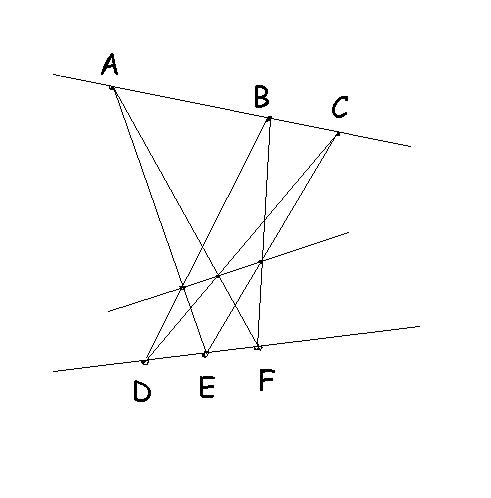
Invariant is something that does not change under a set of transformations. The picture on the right shows Pappus’s Invariant in geometry. The invariant tells that by following certain rules the three intersection points shown in the figure are always collinear no matter how people may draw the two lines and locate ABC and DEF in the lines respectively.

Invariant study is fundamental to any scientific research, especially when the research domain is as complex as World Wide Web. Invariants are supposed to be constant within the specified research scope. By well understanding the invariants we may effectively improve the knowledge over many complicated issues. Therefore, it is unsurprisingly for us to see the discussion of invariant study in the new Web Science Research Initiative.

In "A Framework for Web Science", the flag article of Web Science, Tim Berners-Lee and his colleagues have carefully studied several invariants on the Web. In particular, one invariant is outstanding among all the others. The one is URI (Uniform Resource Identifier). In the paper Berners-Lee et. al. had focused on discussing which invariant represents the binding of semantics with declared objects. There was no final best solution concluded in the paper, however, the one closest to the best was URI.

In varied programming languages we have widely used an invariant, which is declared name. In programming languages such as Java or C++, "each unique object (i.e. with distinct semantics) is declared with a distinct name in one program. By referencing a name, a program accesses the semantics behind the name." Hence declared name is taken to be invariant.

On the Web we are currently using another invariant. "Web researchers decide to use location binding to solve the problem, i.e. URIs and URLs. By default, identical URIs reference the same semantics. Identical URIs on web is the same as identical declared names in programs. However, the name of this URI is varied, i.e. name is no longer an invariant. In constrast, URI becomes a new invariant."

The authors, however, pointed out that indeed neither of the two was proper invariant on Semantic Web (or on the future Web). "The difference is, however, that the requirement of machine understanding," said by the authors. We actually have no ways to promise the consistency of the meaning to which a URI points. It is the same as we cannot enforce users to consistently bind the same name to any unique object on the Web.

Although with the problem, the authors did not provide a satisfactory answer to the problem in their paper. By contrast, they simply emphasized that "W3C suggests that do not transfer URI to another object. That is, whenever you create an object, giving it a unique URI. This requirement is thus the same as that whenever we create a new object in program, make sure we give it a unique name." In other words, please do not change the referred destination of any URI though anybody has the right to perform such a change. This passive resolution is not a satisfactory answer. Deprecated URI has gradually become a severe problem when more and more Web applications start to assume URI to be invariant on the Web. May we have an alternate, active answer to the question?


The figure above shows three basic components when we bind semantics with certain object. They are the declared name, the object itself, and a link connecting the two sides. So which one of them is truly invariant when they are presented on the Web?

As the paper has discussed, neither the declared name nor the link (i.e., uri) is true invariant. "Apple" may be fruit or a software company. We have no way to restrict a handpointing to a fixed destination.

The only exceptional one is the object itself. Although by nature an object can only be itself and it is automatically an invariant to itself, how can we present this invariant besides name and link? This is thus the problem.

We humans have so customized of binding semantics with declared names that we have almost forgotten some more intrinsic binding beneath the surface.

When we are binding the declared name "apple" with the object apple, we are actually making a semantic computation in our brain such as to determine whether it is a fruit with red or yellow or green skin and sweet to tart crisp whitish flesh. For people, a name is not just a name, but also a computational procedure in human brains. It is actually not the name that identifies an object, it is the procedure that identifies the object. The declared name is only a named shortcut referred to the particular procedure in brain. When we convert the procedure to machines, it is an epistemological process.


The picture above shows the new paradigm of semantic binding on the Web. The left side is changed to a particular epistemological procedure (which could be implemented in various ways such as the one we have suggested). Unlike names, these procedures are unique since they can unambiguously answer either yes or no for any identification request. Based on these epistemological procedures, Web links (such as URIs) are upgraded to be Web threads. The Web threads connect the same Web into a varied layer. Moreover, from the philosophical and economical aspects the construction of epistemological procedures and Web threads would be the basis for the production of mind asset.

In summary, epistemological procedure and Web thread are invariants on the Web. Through Imindi, we are going to demonstrate the world something extraordinary happening on the Web.

UPDATE: related reading about URI, "What do people have against URLs or URIs?" by Kingsley Idehen.