Thursday, July 10, 2008

Enough ants may bite an elephant to death

A traditional Chinese idiom says that enough ants may bite an elephant to death (Chinese: 蚁多咬死象). The idiom perfectly describes the strategy beneath Yahoo's newest Web search service---BOSS (Build your Own Search Service). Google is facing the most severe challenge ever in its history.

As we all know, until now Google is likely unbeatable by its dominating power on Web search. Neither Yahoo nor Microsoft, nor even Microhoo, may compete to Google head-to-head. Google is a huge elephant and nobody may even shake it.

Although even a leopard cannot fight an elephant, by raising a huge amount of ants they may bite the elephant to death. Yahoo thinks so, and I agree to it. Google can easily defeat any individual competitor, but Google cannot beat the united force of all competitors. It is the power of collectivity. Brilliant strategy, Yahoo!

On the other hand, however, this action is a double-edged sword. If the ants are so many numbered that they may bite an elephant to death, certainly they can kill a leopard without a question. Therefore, Yahoo search itself might be swapped out of the market even before the decaying of Google search.

A few people may be curious on why Yahoo search might be hurt. Isn't Yahoo that is the service provider of BOSS? If Amazon can make great deal of profit from its public Web service, how could Yahoo's public service eventually hurt itself? To answer this question, we must take a deep look at the difference between Yahoo' service product and Amazon's service product.

Amazon self-produces a large amount of data and makes itself be a huge data center. Amazon Web services allow users accessing and using Amazon's data for varied purposes, including business purposes. To the end, however, Amazon controls the source of data. Hence Amazon have the control over all of its service users.

Now let's turn to Yahoo. Surely Yahoo also produces data, but original data production is the secondary task in Yahoo. Primarily, Yahoo indexes the Web. In contrast to Amazon as a data-resource producer, Yahoo is primarily a link-resource producer. The problem of a link-resource producer is that it actually does not have the power of controlling the linked data. In short, Yahoo knows links, but Yahoo actually does not own the linked data. Because of this reason, any niche search engine may use Yahoo infrastructure to build up a self index of links in its niche domain during the steal mode. After the niche search engine comes to public, it can primarily works on its own index and just using Yahoo infrastructure to be a reference checker. The key point here is that links are normally not the end data users look for.

Does it mean that Yahoo has done a work only hurts others but not benefits itself? Not at all. The key point is that Yahoo must not try to charge the search flow through its opened infrastructure ever after, even if some search flow is for commercial purposes. Be not like Amazon Web services because they are totally different (thought they are similar on surface but completely varied in essence).

Yahoo should make itself be the biggest player over its own free and open search infrastructure in contrast to make itself be the leader of its not totally free and not totally open search infrastructure. Or in other words, Yahoo makes itself to be the largest ant instead of a leopard. If Yahoo can keep on its strategy in this way, Yahoo will have a chance to not only compete to Google, but also defeat Google at the end.

Keep on your great work! Jerry, your passion is truly respectful!


For readers who want to learn more details about BOSS, here are a few resources they can start for looking.

  • Read/WriteWeb: Search War: Yahoo! Opens Its Search Engine to Attack Google With An Army of Verticals
  • Yahoo! Search Blog: BOSS -- The Next Step in our Open Search Ecosystem
  • Between the Lines: Yahoo’s desperate search times call for open source
  • VentureBeat: Yahoo opens up its search platform to third parties, Me.dium takes the plunge
  • GigaOM: Yahoo, Now Offering Search as a Web Service
  • TechCrunch: Yahoo Radically Opens Web Search With BOSS
  • zooie’s blog (a BOSS team insider): Yahoo! Boss - An Insider View

Tuesday, July 08, 2008

Invariants on the Web

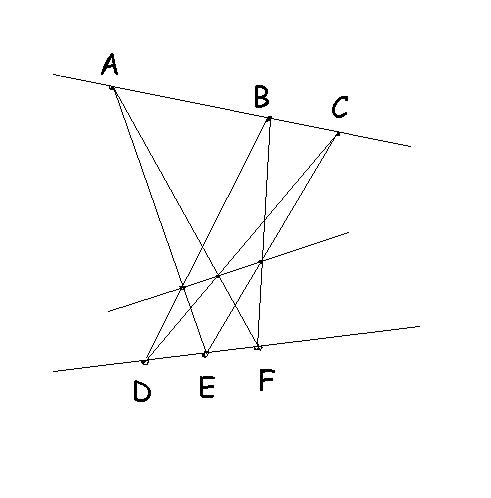
Invariant is something that does not change under a set of transformations. The picture on the right shows Pappus’s Invariant in geometry. The invariant tells that by following certain rules the three intersection points shown in the figure are always collinear no matter how people may draw the two lines and locate ABC and DEF in the lines respectively.

Invariant study is fundamental to any scientific research, especially when the research domain is as complex as World Wide Web. Invariants are supposed to be constant within the specified research scope. By well understanding the invariants we may effectively improve the knowledge over many complicated issues. Therefore, it is unsurprisingly for us to see the discussion of invariant study in the new Web Science Research Initiative.

In "A Framework for Web Science", the flag article of Web Science, Tim Berners-Lee and his colleagues have carefully studied several invariants on the Web. In particular, one invariant is outstanding among all the others. The one is URI (Uniform Resource Identifier). In the paper Berners-Lee et. al. had focused on discussing which invariant represents the binding of semantics with declared objects. There was no final best solution concluded in the paper, however, the one closest to the best was URI.

In varied programming languages we have widely used an invariant, which is declared name. In programming languages such as Java or C++, "each unique object (i.e. with distinct semantics) is declared with a distinct name in one program. By referencing a name, a program accesses the semantics behind the name." Hence declared name is taken to be invariant.

On the Web we are currently using another invariant. "Web researchers decide to use location binding to solve the problem, i.e. URIs and URLs. By default, identical URIs reference the same semantics. Identical URIs on web is the same as identical declared names in programs. However, the name of this URI is varied, i.e. name is no longer an invariant. In constrast, URI becomes a new invariant."

The authors, however, pointed out that indeed neither of the two was proper invariant on Semantic Web (or on the future Web). "The difference is, however, that the requirement of machine understanding," said by the authors. We actually have no ways to promise the consistency of the meaning to which a URI points. It is the same as we cannot enforce users to consistently bind the same name to any unique object on the Web.

Although with the problem, the authors did not provide a satisfactory answer to the problem in their paper. By contrast, they simply emphasized that "W3C suggests that do not transfer URI to another object. That is, whenever you create an object, giving it a unique URI. This requirement is thus the same as that whenever we create a new object in program, make sure we give it a unique name." In other words, please do not change the referred destination of any URI though anybody has the right to perform such a change. This passive resolution is not a satisfactory answer. Deprecated URI has gradually become a severe problem when more and more Web applications start to assume URI to be invariant on the Web. May we have an alternate, active answer to the question?


The figure above shows three basic components when we bind semantics with certain object. They are the declared name, the object itself, and a link connecting the two sides. So which one of them is truly invariant when they are presented on the Web?

As the paper has discussed, neither the declared name nor the link (i.e., uri) is true invariant. "Apple" may be fruit or a software company. We have no way to restrict a handpointing to a fixed destination.

The only exceptional one is the object itself. Although by nature an object can only be itself and it is automatically an invariant to itself, how can we present this invariant besides name and link? This is thus the problem.

We humans have so customized of binding semantics with declared names that we have almost forgotten some more intrinsic binding beneath the surface.

When we are binding the declared name "apple" with the object apple, we are actually making a semantic computation in our brain such as to determine whether it is a fruit with red or yellow or green skin and sweet to tart crisp whitish flesh. For people, a name is not just a name, but also a computational procedure in human brains. It is actually not the name that identifies an object, it is the procedure that identifies the object. The declared name is only a named shortcut referred to the particular procedure in brain. When we convert the procedure to machines, it is an epistemological process.


The picture above shows the new paradigm of semantic binding on the Web. The left side is changed to a particular epistemological procedure (which could be implemented in various ways such as the one we have suggested). Unlike names, these procedures are unique since they can unambiguously answer either yes or no for any identification request. Based on these epistemological procedures, Web links (such as URIs) are upgraded to be Web threads. The Web threads connect the same Web into a varied layer. Moreover, from the philosophical and economical aspects the construction of epistemological procedures and Web threads would be the basis for the production of mind asset.

In summary, epistemological procedure and Web thread are invariants on the Web. Through Imindi, we are going to demonstrate the world something extraordinary happening on the Web.

UPDATE: related reading about URI, "What do people have against URLs or URIs?" by Kingsley Idehen.

Wednesday, July 02, 2008

The Secret behind Powerset Acquisition

So it has been. Finally, Microsoft and PowerSet reached an agreement of acquisition. It is a deal about $100 Million in total. A question is, however, why does Microsoft acquire Powerset?

I have been at Redmond face-to-face talking with a few Microsoft Live Search top engineers two months before. None of them, however, seemed sympathetic to the coming of Semantic Web. At the same time, however, Microsoft people did emphasize that they expected to walk in a different way from Google because Google is too powerful in its research capability to compete. Does this newest acquisition mean Microsoft suddenly changed its mind and decided to compete Google by adopting Semantic Web? I don't think so. In order to discover the secret behind this acquisition, we may need to look at and think of the following coincidental events related to the acquisition.

1) PowerSet went live to the public only at May 12.

Paul Miller thought "$100million seems like a poor return for those Powerset investors" since the investors have "injected their $12.5million way back in 2006." I agree to Paul's argument based on the assumption that Powerset is a novel semantic search engine full of potential. A question is, however, whether the Powerset approach is indeed full of potential despite of its novelty.

The ones who know the best of the answer to the previous question should be the Powerset investors mentioned by Paul. Especially after Powerset has already been public, its long-term potential must have already been thoughtfully studied by the investors. We can be confident that all of these investors are bright and knowledgeable; and moreover, they are not philanthropists. If all of these analysis are sound, there is only one conclusion we can draw---the potential of Powerset is limited.

Until now, the application domain of Powerset is limited to Wikipedia. As other technology analysts also pointed out, the Wikipedia pages are consistent in their format and there are people dedicating to polishing the English writing of many pages. Powerset's self-limitation of its service only to such a special external site indicates the existence of severe technology difficulty in its approach and it is hard to conquer. I, myself, is a Semantic Web researcher (and particularly on semantic annotation). Thus I very much understand the problem encountered.

With all the concerns, unless Microsoft really thinks of taking Semantic Web as its long-term strategy (which, however, might not be a bad idea), this acquisition is questionable to Microsoft's short-term goal. Hence it becomes confusing---is Microsoft really thinking of going long or going short? Or, maybe, Microsoft plans to take both since it just has too much money.

The investors of Powerset are not foolish, and nor should we assume Mr. Ballmer of Microsoft be so. Then what did Mr. Ballmer think when he made the decision of acquisition?

2) This deal came after the break of Microsoft-Yahoo deal.

By looking for acquiring Yahoo, Microsoft was planning to hit Google in the front. After the attempt failed, Microsoft finally decided to attack Google from the back by acquiring Powerset. This is the real story behind the scene.

Microsoft is looking for the market of online advertisement, everybody knows it. The dominator of the market at present is Google. In order to compete Google, the fastest and also the most effective way for Microsoft is to buy the company in the second place of that market, which is Yahoo. But Yahoo defended insistently to Microsoft's acquisition. Should Mr. Ballmer then abandon the plan? No, or otherwise he must not be the Ballmer. Here thus comes the acquisition of Powerset.

3) Yahoo's SearchMonkey opened up for developers at May 15.

I have said that SearchMonkey is Yahoo's strategy to come back. Although I also predicted negative to the full success of this ambitious project (partial success is however believable), Microsoft has no patience to wait for the natural death of it.

The best way to accelerate the death of SearchMonkey is to defeat the plan directly. By acquiring Powerset, Microsoft may launch a competitive Semantic Web service for SearchMonkey. SearchMonkey itself is already too ambitious. By short of volunteered developers all over the world, the date of its failure thus could be counted. At that moment, Microsoft may go back to the table and buy Yahoo in a much cheaper value. The difference would certainly be greater than $100 million.

4) Google declines to bid for acquiring PowerSet.

In the whole story, Google's situation is quite subtle. From one hand, Google certainly does not expect Microsoft to acquire Yahoo. Hence Google would not be willing to see Microsoft acquiring Powerset.

On the other hand, however, Google does not believe in Semantic Web either. Competing price of Powerset with Microsoft is meaningless for Google. The reason is simple. Neither Microsoft nor Google is really interested in Semantic Web. Microsoft buys a Semantic Web company only to attack Google from the back. If Google attends the competition, Microsoft may just raise the bid and let Google win it. Then Microsoft can simply go for another Semantic Web company. Powerset is surely not the only one who does Semantic Web technology! Google has no chance to win this battle unless it buys all of the Semantic Web companies, which is totally nonsense for its lack of interest in Semantic Web.

I have to say that Microsoft's strategy is very brilliant. The strategy directly hits Google and Google has no effective way to fight back. Now the only pity sacrifice is Yahoo again. But probably it may beg Google to save it once more.

In summary, by acquiring Powerset Microsoft has done an excellent move towards the next acquisition of Yahoo and eventually be closer to beat Google. How would Google and Yahoo take this challenge? The story is to be continued ...

Monday, June 30, 2008

LinkedIn to Chinese market, oppotunity and challenge

My friend Jia Jiang, currently working for LinkedIn on its China marketing strategy, visited me recently. In his visit, we shared how LinkedIn might enter China---the largest growing market in the world. Linked into China, how many opportunities and challenges the company will face?

Social Network, the difference between Chinese and western culture

In western culture, social is part of the life. In Chinese culture, however, social is the life.

I have been at United States for more than 10 years. Before it, I was in China. For years I have observed the cultural difference between the two countries. Certainly in both countries social networking is a very important part of normal person's regular life. There is, however, some subtle but critical difference. United States encourages individual heroism. Social networking is thus auxiliary to this general goal. China, on the other hand, encourages collaboration but discourages individual heroism in general. In China social networking is thus the goal. When facing a problem, a typical American thought is to solve it by oneself or otherwise engage his social network under his direction to solve it. By contrast, a typical Chinese thought is to engage one's social network to solve it and make himself be a member of the collaborative team.

Philosophically, Chinese style social networking is based on the Doctrine of the Mean (Chinese: 中庸; pinyin: Zhōngyōng). Chinese people believe in that if one tree is higher above all the others, wind will destroy it first (Chinese: 木秀于林,风必摧之; pinyin: mù xiù yú lín,fēng bì cuī zhī). Hence the principle of surviving but also living well is to follow Doctrine of the Mean---be neither too outstanding nor too insignificant. This philosophy is the basis of Chinese social networking.

Such a subtle difference actually indicates some fundamental difference between Chinese social networking and western social networking. If a western social networking company wants to enter and make itself succeed in the Chinese market, it must not only understand the difference but also know how to adjust their particular marketing strategy and even technological user interface design respectively.

LinkedIn, strengths and weaknesses with respect to Chinese market

LinkedIn, as well as all the other western social networking companies, advocates individual-centric social networks. In particular, LinkedIn makes much effort on composing individual's professional profiles in order to strengthen formal business connections among its users.

The strengths of LinkedIn with respect to Chinese market are obvious. In general, western software companies have advanced technologies better than their Chinese competitors. As one of the early adopters of Web 2.0, LinkedIn has strong technology team as well as excellent management team who really understand Web 2.0 in principles and technical details. LinkedIn has successfully branded itself to be the leader of professional social networks. In its particular domain, LinkedIn profile is more effective than either Facebook profile or MySpace profile.

Lack of the elements of Chinese culture is an immediate weaknesses for not only LinkedIn but also all the other western social networking sites which plans to enter Chinese market. No western companies can succeed in China by simply translating their sites into Chinese, especially if they are the social networking sites. (Hence I don't expect the recently reported Facebook's initial plan of entering Chinese market would be a success.) My friend Gang Lu recently wrote at Read/WriteWeb a post about the Facebook clones in China. One reason that many of these Chinese clones of Facebook are expected to grow better than Facebook China is that every one of them has customized their sites with certain unique Chinese cultural elements that the official Facebook China does not have. If LinkedIn expects to enter China, the culture customization is the first crucial barrier it has to overcome.

Another specific problem of LinkedIn entering China is its requirements of filling in detailed career information in profiles. Certainly this requirement represents the value of LinkedIn services. Such a request, however, could be seen as a serious thread by the Chinese government. Many foreign observers are surprised that there are much fewer LinkedIn copycats than the Facebook copycats in China. Indeed, it is not surprising at all from a native Chinese's eye. The Chinese government would simply not tolerate any private company to collect sensitive employment records of all Chinese people, let it alone a foreign company. In tradition, (due to the so-call "national security") only the government or certain authorized public organizations may have the privilege of owning personal profiles with detailed career information (Chinese: 个人档案). This is why even Chinese people feel difficult to copy the business model of LinkedIn in China. This issue might be a killer for the future of LinkedIn in China.

Can LinkedIn succeed in China?

Despite of all the problems, LinkedIn still has its chance to succeed in Chinese market. The key of success is, however, a point I mentioned at the beginning---Doctrine of the Mean (中庸)! The following are several particular suggestions for LinkedIn to enter China.

1) Never ever claim itself to be the leader of professional social networks in Chinese market.

2) Narrow down its domains of professional social networks to only the insensitive realms. Explicitly prohibit the adding of career information from such as army, nuclear plants, police department, and various other sensitive, national security related government departments. Narrow the use of LinkedIn China to pure business, especially on the realms such as the Sino-American exporting business.

3) Change the individual-centric LinkedIn profiles to group-centric LinkedIn profiles. Intentionally decrease the significance of individuals in the LinkedIn network of China. By contrast, significantly increase the weight of groups in the LinkedIn network of China. Such a change may require a major re-design of LinkeIn China user interface.

4) Add the unique Chinese cultural elements to the LinkedIn China site.

I must say that some of my suggestions are indeed controversial. But they are critical for western companies to succeed in China, not only just about LinkedIn.

First of all, any attempt of monopolizing Chinese market on information management may not survive long, even if it would succeed once. Chinese government had tolerated foreign companies to monopolize the TV set market in China for many years, and it is now even tolerating the foreign monopoly of gold mines in China. But it would never tolerate foreign monopoly of information access or information management in China. Neither TV set nor gold mine is directly about people. But information management is directly about people. Loss of a few money would not be pleasant but it is tolerable. Loss of the control of people, however, would be a disaster in the present China, and thus it is absolutely intolerable. LinkedIn must abandon the unrealistic dream of being the leader of professional social networks in Chinese market.

By not being the general leader does not mean it would not be profitable. Due to the large population in China, LinkedIn China in vertical could be a great success. By narrowing its realm to several most profitable realms, LinkedIn may have more focused design of its Chinese user interface with unique cultural elements and improved the quality of its services that are then more focused.

Furthermore, by emphasizing the group-centric in contrast to individual-centric LinkedIn may help its Chinese subscribers release the pressure of disclosing information for a foreign company. Actually, it has been a general law of 中庸 in China since ancient time. Let LinkedIn China be in a chinese-style infrastructure of group guiding individuals in contrast to in the western-style infrastructure of individual composing groups. I guess the same philosophy may even be helpful for re-modeling many of the current Chinese social network sites too, if they want to get a break out of the highly competitive SNS market in China.

The last question: what is group-centric with respect to individual-centric in social networking? I may write another post dedicating to this topic later.

Saturday, June 28, 2008

Genome: rethinking of Social Networking

Social networking is a fascinating topic on Web 2.0. Despite of the various social network sites, there are still open questions about social networking in general. Vladislav Chernyshov, one of the co-founders of Genome along with Andrew Chernyh and Dmitry Gorpinchenko, discussed several of these issues in his blog.

In the post, Vlad argued five major problems in the current social networking practices: (1) the lack of sufficient privacy protection, (2) the overflowing of social message, (3) the low quality friendship maintenance, (4) the poor performance of advertisement filtering, and (5) the lack of identity management. Nevertheless are all the issues critical to the future of social networking, Vlad and his peers founded Genome to solve the problems. The company is at Novosibirsk, Russia. Invited by Vlad, I am a member of the advisory board.

The Genome service aims to solve the problem of identity management first. From the solution it will gradually cover the other four issues as well. The essential Genome service well integrates social networks, instance messagers, contact managers altogether and makes the integrated individual identity be accessible anytime from anywhere in the world. In person, I call the service a real Web-3.0 effort since it directly addresses the primary Web evolutionary issue at the level of Web 2.0---the contradiction between unstopping quantitative increase of Web 2.0 resources and the short of managing personal resources cross various Web-2.0 sites. Thus, Genome is not another Web 2.0 service. By contrast, it will be a real Web 3.0 service once it is fully developed.

In summary, Genome shows that we really need to start rethinking social networking to its next generation. The flood of social network sites has gradually made us more trouble than benefit. As Vlad pointed out, with more social networks, the quality of friendship decreases, the individual privacy leaks, the personal identity is under risk, and let it alone the distraction of increasing pokes and advertisement from all kinds of "friends". Genome will help solve all the problems. Just keep on watching.

Ahead The Road Ahead

It is now the time to say goodbye to a legendary person who has made our world be different. Bill Gates, founder of Microsoft, left his Redmond office (possibly forever) at Friday, June 27, 2008. I could not help myself picking up an old book written by him---The Road Ahead. What would be the road ahead of what Bill had already accomplished? I would like to ask this question.

Bill is a great visionary. Along with Paul Allen, he imagined a time when computers would be affordable to most of the people and software would do amazing things. From 1970s to early 1980s, such a dream "seemed very crazy." But Bill realized it through Microsoft. When we are now talking about how World Wide Web is bringing human society a great new transition, we must not forget that it is Bill Gates who has made computers be personal. Without the prevalence of PC, there would be no World Wide Web.

What was the road ahead? In his book, Bill told us that he had dreamed of the question "What if computing were nearly free?" Microsoft Windows was his answer. By providing users affordable and easy-to-manipulate operating system, the use of personal computers entered normal people's life. Also in the book, Bill asked the second question, which was his road ahead at the meantime, "What if communicating were almost free?" From the time to now, Microsoft was trying to make itself the leader of the so-called information highway. Unfortunately, however, after more than 10 years we have to say that Microsoft has not been so successful on this goal as it had succeeded in the previous one. An important reason of this failure is the imprecise vision of Internet. Primarily, Internet is an information net in contrast to an information highway system. Due to this confusion of Internet modeling, Microsoft missed the timing of Web 2.0. Google, instead, stole the oppotunity. Now, Gates and Ballmer have to confess that Web search would be the future of the company. This statement finally exclaims that Microsoft no longer seeks for the role of highway patrol but to look for the new role of librarian.

In Bill's two questions, he has particularly emphasized a word---"free". Unquestionably, free is a great feature especially when we would try to engage as many users as possible for a new product. After the product being popular, however, things start to change, especially when the product itself becomes the base of new production lines. The role of Web users is in a transition from mainly as consumer and viewer to be also as producer and publisher. The ones who consume a publisher-oriented Web are information consumers. The ones who consume a viewer-oriented Web are information producers. This important switch of roles appeals a new trend on the Web---"paid" instead of "free".

This switch of roles is actually easy to explain. When you are a consumer, you expect products be free. Once you become a producer, however, you expect your product not to be free. In fact, you expect to make profit out of your knowledge and your hard work. Hence when normal Web users start to realize that they are producers in addition to consumers of information on the Web, they will gradually accept the concept of "paid mind" (not free) on the Web. Web resources thus become mind asset.

Farewell, Bill. You have done excellent work and you will always be remembered as one of the greatest visionaries ever in human history. But there is still much road ahead of the road you have already walked. We will continue the journey and make our world be better and better.

Tuesday, June 24, 2008

Measurement of Mind Asset

Mind asset measurement is a novel and non-trivial issue. I have a few conversation of the topic with Michel Bauwens at P2P Foundation recently. It seems, however, that we only get more confused after the talk than at the beginning. Hence I feel the necessity of writing another essay dedicating to the topic. I believe that well understanding of this topic might be critical especially to new Web startup companies.

Asset Measurement in a Nutshell

In feudal society, value of land asset is measured by how much more land asset could be produced by possessing the land asset. In capitalist society, value of capital asset is measured by how much more capital asset could be produced by possessing the capital asset. Similarly, in harmonious society value of mind asset is measured by how much more mind asset could be produced by possessing the mind asset.

Value of Liability and Value of Asset

Before discussing measurement, we need to distinguish two types of personal belongings---liability and asset.

Liability is anything which only produces expense. Typical examples of liability are such as car, TV, computer, food, etc. Liability has its purchasing value when it is purchased. The real value of liability, however, only decreases with time after it is purchased.

Asset is any item which produces income. Typical examples of asset are such as rental real estates, stocks, bonds, etc. Asset also has its purchasing value when it is purchased. The real value of asset, however, may increase or decrease with time after it is purchased. The real value of asset is based on the real-time mutual consent of sellers and buyers.

The value of asset is primarily measured by its marketing value in contrast to that the value of liability is primarily measured by its purchasing value. For a liability such as a TV set or a car, more expensive means more valuable. For an asset such as a stock or a bond, more expensive per share does not necessarily mean more valuable at all.

For instance, at January 2004 the stock of Apple Inc. (AAPL) was about $11.28 per share in average while the stock of Yahoo Inc. (YHOO) was about $23.49 per share in average. After four and a half years, at June 2008 Apple stock is worth of $175.27 per share in average and Yahoo stock is worth of $21.99 per share in average. Were we able to be back to measure the value of stocks of the two companies in January 2004, which one would be more valuable? Certainly the answer must be Apple though its purchasing value at the meantime was less than the value of Yahoo stocks. This example shows that the real value of capital asset is about its ability of producing higher value capital asset in the future rather than its purchasing value at the meantime. This is a typical asset measurement in the form of capital.

Measurement of Land Asset

We have been familiar to capital asset value measurement since we are currently in the stage of capitalism. In consequence, however, we have forgotten how to measure the value of asset in the other types besides capital. For example, when we think of land, we immediately think of land as real estates---a particular form of capital. We have simply neglected that the value of land asset in feudal society was not measured by its capital value. On the contrary, capital in feudal society was measured by its land value since it was land but not capital that was the key asset of the feudal society. By going over the measurement of land asset in the past age of feudalism, we are going to understand the measurement of mind asset in the coming harmonious age.

The following is a few facts about key asset in society. Land was the key asset in feudal society. Capital is the key asset in capitalist society. Land was the primary input resources of traditional agriculture---the fundamental form of economy in feudal society. Capital is the primary input resources of modern industry---the fundamental form of economy in capitalist society. The class of people in a society is determined by the amount of key asset they own. Respectively, in feudal society the class of people was determined by the amount of land they owned, and in capitalist society the class of people is determined by the amount of capital they own. Due to this distinction, the measurement of land asset in feudal society is essentially different from the measurement of capital asset in capitalist society.

Let's take another example to show the difference of value measurement between land asset and capital asset. In the capitalist society a small penthouse at Manhattan is generally more valuable an asset than a several-acre-large plain land at rural Iowa. The reason is that we compare the two assets by their capital value. In other words, the two assets are only compared as two pieces of real estates---a typical form of capital asset. Now let's turn our clock back for two thousand years. In the ancient Rome Empire, would a small penthouse at Rome generally more valuable an asset than a several-acre-large plain land at Galilee, a far away rural province from Rome? The answer is no, while the reason is not that the land at rural Galilee would be more capital-productive than the penthouse at Rome. Instead, the reason is that a small penthouse at Rome is less land-productive than a several-acre-large plain land at Galilee discarding their capital value. The difference between land-productive and capital-productive is the key of the answer.

Land productivity is a central issue in feudal society. Large size of land and greater land productivity means that the landlords can raise more people under their leadership. By owning more people, the landlords may assemble a force to occupy more land. Hence it shows a fundamental economical cycle in feudal society---land to produce more land.

By contrast, capital ownership was not as essential as land ownership in feudal society. It was not straightforward to convert capital to land. Most of the time, money meant little simply because no land was on sale voluntarily even if someone had offered a large amount of money. On the contrary, it was always easy and straightforward to convert land to capital since nobody would worry of the lack of land buyers. Land, instead of capital, was the fundamental circulating asset in feudal society.

These discussions explain that value of land asset is measured by how much more land asset could be produced by possessing the land asset.

Measurement of Capital Asset

Measurement of capital asset is what we are familiar. Basically, we convert everything into its capital value and compare the amount of converted capital to each other.

What I want to emphasize is some fundamental revolution in human society that causes the change from land as key asset to capital as key asset. In a previous essay, I have discussed the impact of the invention of Watt steam engine. Due to this invention, the rate of capital production the first time in history was above the rate of land production. Industry replaced the agriculture becoming the foundation of modern economy. As the result, capital replaced land becoming the basic scale of asset measurement.

Because of this transformation, the wealth in society is measured by the capital ownership instead of the land ownership. By owning capital, people can buy anything that includes land. On the contrary, owning land does not necessarily mean owning capital because it is possible that nobody would be willing to buy it since land is not the essential input resources of industry. Therefore, land in capitalist society gets a new name---real estate. Land is only considered to be a special type of capital.

In summary, value of capital asset is measured by how much more capital asset could be produced by possessing the capital asset.

Measurement of Mind Asset

What we are facing now is the rise of information industry. Information industry is different from the traditional industry. Information industry takes mind as its primary input in comparing to that the traditional industry takes capital as its primary input. This change has been overlooked by many people until now because we have been used to think of mind also as a special type of capital---similar to simply take land as real estates. It is such a narrowed thought of mind that causes the difficulty of understanding the measurement of mind asset.

Mind essentially is different from capital, which is the same as that land essentially is different from capital. We may evaluate both land and mind in their capitalized value only if they are freely acquired with money or financial capital. When they are essentially more crucial in society than financial capital such as land in feudal society, however, they are not capital any more. By contrast, themselves become the scale of measurement about wealth in society.

Capital is not the natural scale of asset measurement and it will not be the scale of asset measurement forever. If the wealth of feudal society was measured by land but not capital, why can't the wealth of the new coming age be measured by mind instead of capital? We may apply financial capital (money) to measure wealth in any time period. But it does not necessary mean that financial capital is the ultimate scale of asset measurement. There is something money cannot buy, especially within certain particular time period.

Certainly, however, there are many technical issues we need to solve before mind indeed replaces capital to be the measurement scale of wealth. It also took many years for capital completely replacing land being the key asset of society, let it alone that such a replacement be eventually understood and adopted by the general public. (My grand-father-in-law still did not understand it until the middle of last century in China and thus he and his family paid a great deal on this misunderstanding in the rest of their life.)

In the history of capital, the invention of stocks was a landmark. Stock reveals that capital is liquid in contrast to that land is solid. We may look for a similar invention on mind presentation to prompt the adoption of mind asset. Obviously, however, the invention is not ready yet. We still need more patience for the coming new age of human society. (By the way, I will join Adam Lindemann at Imindi. We expect to not only produce novel mind product but also be end up with a few creative improvement on mind asset presentation as the Dutch East India Company did in 1606.)

Michel in his response also has addressed two specific questions of the value of mind asset: (1) the monetary value of mind asset, and (2) the mind asset protection from illegal copies. The following is my answer to the two specific ones.

I agree to the following argument made by Michel.

"There is no one to one relationship between the 100 million downloaded YouTube videos, and the income it can generate. The ratios are very low. This is what the crisis of value is about. Google may make a lot of money, but only a marginal number of websites makes money!! Most use value that is generated, even by high quality mind assets, does not generate a lot of monetary income."

But I have different thought on these facts.

The difference between my thought and Michel's thought is that Michel takes YouTube videos to be mind asset while to me they are more about mind liability than mind asset because (as Michel discovered) people can hardly use them to produce more mind asset. In other words, that until now it is still so difficult for mind product to be asset is because the general lack of production line of mind.

We have YouTube videos, and they are at the end of the current production line of mind. If they are not input resources of some other Web industrial companies, these videos can only be liability but not asset. Moreover, their purchasing value is also low because their producing cost is low (don't count the producing cost of shooting the films).

Such a problem is a generic problem in the current Web industry. The reason that Google makes money is that Google has a well developed production line of mind asset. Google can continuously produce higher quality mind asset by converting the low-quality mind product to be the input resources. Hence Google knows the secret of mind as asset (no matter it is by real understanding or by unconsciousness). By contrast, that many other Web companies can hardly make money is because they don't understand mind asset and they are also not lucky enough to unconsciously catch mind as asset. To the end, they only produce mind product as liability and they do not have the knowledge to design a production line of mind so that their produced liability might be a new form of asset. If Web industrial companies may learn the spirit of mind asset and learn how to make themselves produce asset but not liability, many of them will start to make money.

Why is it hard for us to make money from mind liability, at least at present? The answer is related to the second question we mentioned---the mind asset protection from illegal copies.

Until now, many mind products on the Web are easy to be copied since they are in digital forms and they only describe static content. But things are changing with the progress of Web evolution. The emergence of Web widgets is a typical example.

Web widget is a special type of Web services that service providers implement portable client-side plug-in for users to enjoy the services in their own sites. The difference between Web widget as mind asset and normal Web content as mind liability is that the service providers have the full control of their mind product. Although it is free for users to plug in the client-side widgets, the service providers can subjectively decide whether to continue the service or update the content of the service from time to time. It is generally hard for users to "copy" the server-side program since it is intangible for the client-side users. Hence Web widget is a typical example of mind asset that can produce more mind product and it is not easy for people to steal illegally.

In summary, the production and formulation of the Web-age mind asset is still at its beginning. We still have a long way to go to eventually make the public realize the value of mind asset and understand the measurement of mind asset. However, whoever may catch the spirit of mind asset first would be able to make profit from the knowledge. It is similar to the old day when pioneers got to understand the magic of capital. We are entering a new realm of economy in which we are employing a new form of asset. The entire world is changing gradually in this process.